











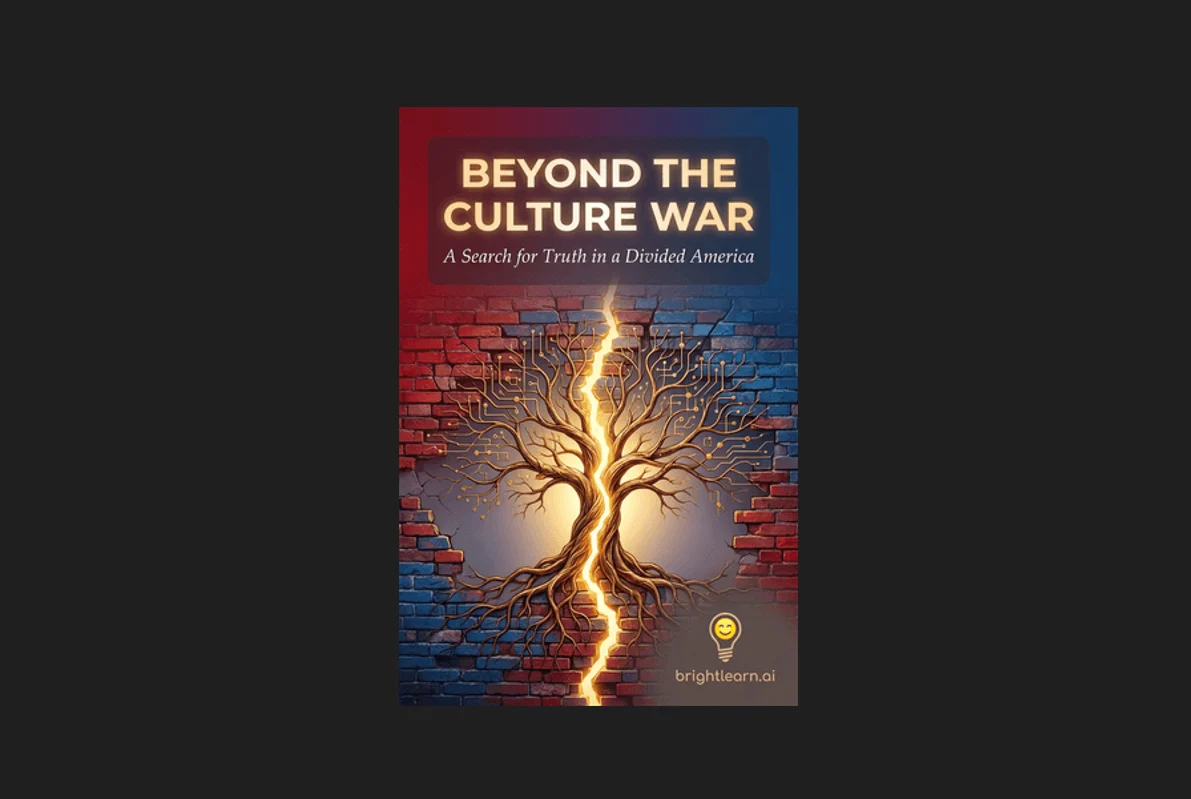
In an era defined by perpetual outrage and a seemingly unbridgeable societal chasm, a provocative new work, Beyond the Culture War: A Search for Truth in a Divided America, argues that the current state of American discord is neither natural nor organic. Instead, the book posits that the constant friction regarding race, gender, and political ideology is the product of a sophisticated, well-funded "hate factory"—a system designed to keep the populace fragmented while elite interests consolidate power.
As public trust in institutions hits historic lows, this thesis offers a radical re-evaluation of the political landscape, suggesting that the "culture war" is less about genuine ideological disagreement and more about strategic distraction. By keeping the citizenry preoccupied with manufactured grievances, the military-industrial complex, the pharmaceutical sector, and the entrenched political class ensure that the public remains too distracted and stressed to scrutinize the systemic issues that truly affect their lives.
The Mechanics of Division: A Chronology of Control
To understand the current state of American polarization, one must look at the evolution of the "divide and conquer" strategy. Historically, this ancient methodology has been deployed by ruling classes to prevent collective resistance.
The Institutionalization of Outrage
Over the last several decades, the infrastructure of the culture war has been meticulously built. It began with the consolidation of media ownership, which transitioned from providing objective reporting to fostering tribal loyalty. In the modern era, this has been supercharged by algorithmic social media platforms that prioritize high-arousal emotions—specifically anger and fear—to maximize engagement.
The Rise of the "Hate Factory"
The book outlines a timeline of escalation:
- The Media Pivot (1990s–2000s): The shift from journalistic standards to "infotainment" models, where narrative spin began to supersede the reporting of primary documents.
- The Digital Silo Era (2010s): The emergence of echo chambers, where individuals are fed content that reinforces their pre-existing biases, effectively insulating them from dissenting perspectives.
- The Institutional Integration (2020s–Present): The alignment of government, corporate, and educational institutions in promoting specific, often divisive, cultural narratives that discourage independent critical inquiry.
This evolution has created a feedback loop where the political class utilizes media-generated outrage to pass policies that serve their donors, while the media utilizes political controversy to generate clicks and ratings, all at the expense of social cohesion.
Supporting Data: The Anatomy of a Distraction
The primary contention of Beyond the Culture War is that the energy spent on cultural skirmishes acts as a smokescreen for foundational policy failures.
The Cost of Distraction
While the public is locked in heated debates over identity politics, the book points to three critical areas where elite interests are operating largely unchecked:
- Monetary Policy: The systematic devaluation of the currency and the inflationary pressures that erode the middle class’s wealth.
- Foreign Intervention: The continuation of "endless wars" and global military entanglements that benefit defense contractors while diverting trillions from domestic infrastructure and social stability.
- Erosion of Civil Liberties: The expansion of surveillance and the centralization of power in bureaucratic agencies, which proceeds largely without broad public debate.
Data regarding the concentration of wealth during periods of intense cultural strife suggests a direct correlation: as the intensity of the culture war increases, so too does the concentration of capital within the elite tier of society. This suggests that the conflict is not merely a side effect of a changing society, but a functional tool for wealth redistribution and control.
Official Responses and the Challenge of Dissent
Predictably, the institutions identified in the book as beneficiaries of this discord rarely acknowledge their role in perpetuating it. When confronted with claims of manufactured conflict, official responses from both legacy media outlets and political bodies often dismiss such critiques as "conspiracy theories" or "divisive rhetoric."
However, this dismissal is, according to the author, part of the process. By labeling any attempt to analyze the structural roots of the culture war as radical or dangerous, institutions successfully keep the conversation within the narrow boundaries of "Left vs. Right."
The "Loneliest Place in America"
The book identifies a specific, uncomfortable location: the space between the two tribes. This is the intellectual ground where critical thinking resides. The author notes that individuals who dare to step out of their assigned ideological camp face immediate pressure from both sides to conform. This social pressure, often manifesting as public shaming or "cancellation," serves as a deterrent to independent thought, effectively policing the boundaries of acceptable opinion.
Implications: A Call for Intellectual Autonomy
The implications of this analysis are profound. If the culture war is indeed a machine, the solution is not to "win" the war, but to stop participating in it entirely. The author proposes a framework for breaking free from this trap, grounded in the pursuit of truth rather than the pursuit of ideological victory.
The Path to Intellectual Humility
The first step toward liberation is the radical practice of questioning everything. This involves:
- Primary Source Analysis: Moving beyond the curated summaries of mainstream outlets to read original documents, raw transcripts, and unedited video footage.
- Active Dissent: Seeking out voices that fundamentally disagree with one’s own views, not to debate, but to test the robustness of one’s own logic.
- Intellectual Humility: The willingness to admit, "I don’t know," and the courage to change one’s mind in the face of new evidence.
Redefining Values
The book encourages readers to strip away the labels imposed by the system—Democrat, Republican, conservative, liberal—and return to foundational values: family, community, and personal liberty. By anchoring one’s identity in these concepts rather than political affiliation, individuals become immune to the fear-based marketing tactics used by the media and political machines.
Conclusion: The Choice Between Puppet and Citizen
Ultimately, Beyond the Culture War presents the reader with a binary choice. One can remain a participant in a manufactured conflict, serving as a pawn for interests that do not have one’s well-being in mind, or one can choose the difficult, often lonely path of the independent thinker.
True freedom, the author argues, is not found in the victory of one tribe over another, but in the realization that the "war" itself is a distraction. By seeing through the smoke and mirrors, citizens can reclaim their agency and focus their energy on the issues that truly matter. It is a path that comes at a high personal cost—often involving social alienation and the loss of comfort—but it is the only way to ensure that the individual remains a sovereign thinker in a world designed to produce subjects.
As we navigate an increasingly volatile future, the message is clear: the side worth being on is not the side of a specific movement or party, but the side of truth. For those interested in exploring these concepts further, the book serves as a manifesto for the modern dissident, offering a blueprint for navigating the complexities of a divided nation with clarity and integrity.
For those seeking to explore the arguments laid out in "Beyond the Culture War: A Search for Truth in a Divided America," the book is available via this link. To discover further readings and engage with a decentralized platform for knowledge sharing, visit Books.BrightLearn.AI. To gain additional perspectives on the intersection of geopolitics, economics, and culture, watch the discussion between the Health Ranger Mike Adams and Lou Valentino on the Health Ranger Report via Brighteon.com.