






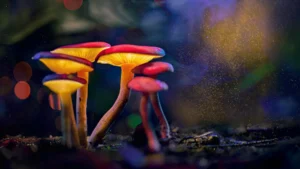




In the evolving landscape of neuropharmacology, the investigation into psychedelic compounds has shifted from the fringes of counter-culture research to the epicenter of modern psychiatric study. While clinical trials often focus on the efficacy of psilocybin—the active compound found in over 200 species of Psilocybe mushrooms—in treating human depression and anxiety, a new, unconventional study has emerged from the laboratories of Canada. Researchers have discovered that this compound possesses an unexpected ability to dampen aggressive, high-energy combativeness in the mangrove rivulus (Kryptolebias marmoratus), a small fish species known for its territorial volatility.
This study, published in the journal Frontiers in Behavioral Neuroscience, represents a significant milestone in behavioral biology. It offers the first evidence that psilocybin can selectively target the neural mechanisms governing escalated aggression without compromising the fundamental social faculties of a vertebrate subject.
The Subject: Why the Mangrove Rivulus?
To understand the scope of these findings, one must first understand the subject. The mangrove rivulus is not a typical aquarium pet. It is an amphibious, highly territorial fish that exhibits a natural inclination toward aggressive posturing and high-speed attacks when faced with conspecifics—members of its own species.
For scientists, this combativeness is a feature, not a bug. "Mangrove rivulus are naturally aggressive, which makes their behavioral responses highly measurable," explains Dr. Suzie Currie, a biologist at the University of British Columbia and senior author of the study. Because these fish have a high "baseline" of aggression, any deviation caused by a pharmaceutical intervention is statistically easy to detect.
Furthermore, the species possesses a biological quirk that makes it the "gold standard" for genetic consistency: the ability to self-fertilize. Because these fish produce offspring that are genetically identical to the parent, researchers can eliminate genetic variability as a confounding factor. This ensures that when a change in behavior is observed, it can be attributed to the chemical intervention rather than inherited personality traits.
Chronology of the Experiment
The research team, led by first author Dayna Forsyth of Acadia University, designed a rigorous, multi-stage protocol to measure the behavioral shifts induced by psilocybin.
Phase I: Baseline Establishment
The experiment began with the creation of a baseline. Each fish was placed into an observation tank alongside a counterpart, separated by an opaque divider and a fiberglass mesh. This setup allowed the fish to perceive each other through visual and olfactory cues while preventing physical combat. After a five-minute acclimation period, the opaque divider was removed, allowing the researchers to observe the natural, pre-treatment social dynamics of the pair.
Phase II: The Intervention
Twenty-four hours after the baseline observations, the experimental group was exposed to a controlled, low dose of psilocybin dissolved in their tank water. The exposure lasted exactly 20 minutes, a timeframe chosen to ensure the compound was absorbed without inducing toxicity or severe physical impairment.
Phase III: Post-Treatment Interaction
Immediately following the 20-minute exposure, the fish were returned to the observation tanks. The opaque dividers were once again removed, and the interaction between the treated fish and its counterpart was recorded. The goal was to determine if the presence of the psychedelic compound had altered the "escalation threshold"—the point at which a fish transitions from a social display to a high-energy attack.
Supporting Data: Parsing Aggression vs. Sociality
The results were statistically significant. Fish treated with psilocybin exhibited a marked reduction in "swimming bursts"—high-velocity, energy-intensive maneuvers that act as the precursor to physical violence.
"Swimming bursts are high-energy attack behaviors that represent an escalation of aggression," Dr. Currie explained. Crucially, the researchers noted that while these violent bursts were suppressed, lower-energy social behaviors—such as head-on displays used for communication and territorial assessment—remained largely untouched.
This distinction is vital. It suggests that psilocybin does not simply "sedate" the animal or render it catatonic. Instead, it seems to selectively prune the more extreme, costly, and dangerous behavioral outputs. The treated fish remained socially active and aware of their environment, but they were no longer compelled to engage in the high-stakes, volatile physical confrontations that typically define their species’ interactions.
General activity levels were also reduced, but the specificity of the decline in aggression points toward a complex modulation of the serotonin system, which is known to influence mood, appetite, and social impulse control in both mammals and fish.
Official Responses and Researcher Insights
The implications of this research are being viewed with cautious optimism by the scientific community. Dayna Forsyth, the lead author, highlighted the specificity of the findings during the dissemination of the results. "We show that an acute, low dose of psilocybin significantly reduces activity and aggressive attack behavior during social interactions in adult mangrove rivulus fish," Forsyth noted.
The research team was particularly careful to emphasize the "selective" nature of the reduction. By leaving lower-energy social behaviors intact, the findings suggest that the compound may influence the neural pathways responsible for impulse control without inhibiting the animal’s ability to navigate its social hierarchy.
However, the team maintains a strictly scientific tone regarding potential human applications. "These findings provide the first evidence that psilocybin can selectively reduce escalated aggression in a vertebrate model," Dr. Currie stated, but she was quick to add a caveat: "It is important to emphasize that this is a vertebrate model, not a clinical trial. We have not established that these effects would translate to human behavioral health."
Implications for Future Psychedelic Research
The study raises profound questions about the evolution of serotonin signaling and its role in social cohesion across species. If psilocybin can reliably dampen aggression in a fish, it provides a powerful platform for researchers to map the specific neural circuits involved.
1. Mapping Neural Signaling
The next frontier for this team involves identifying exactly which serotonin receptors are being activated or modulated during these interactions. Because these circuits are evolutionarily conserved, understanding how they function in the mangrove rivulus could provide a blueprint for how they function in more complex mammalian brains.
2. The Limits of Current Data
The current study was limited to acute exposure—a single dose over a short timeframe. As the authors admit, there are significant gaps in our knowledge. Does the anti-aggressive effect persist if the dose is repeated? Do the fish develop a tolerance, effectively "learning" to be aggressive again despite the presence of the drug? And, most importantly, what are the long-term neurobiological consequences of such an intervention?
3. A Potential Paradigm Shift in Behavioral Therapy
While it is premature to suggest psilocybin as a pharmacological treatment for aggressive behavior in humans, the research opens a new door for neuro-psychiatric inquiry. Current treatments for severe aggression often rely on antipsychotics or sedatives that can have debilitating side effects, including lethargy and a total loss of social responsiveness. If a compound could be developed that mimics the "selective dampening" observed in this study—reducing the urge to escalate conflict while leaving the personality and social capability intact—the therapeutic potential would be immense.
Conclusion: A Measured Step Forward
The study of the mangrove rivulus provides a compelling, if preliminary, insight into the pharmacological potential of psilocybin. By moving the focus away from the subjective "trip" experienced by humans and toward the objective, measurable behaviors of a model organism, Forsyth and Currie have stripped the debate of its cultural baggage, leaving only the raw data of neural chemistry.
As the scientific community continues to peel back the layers of how psychedelics interact with the vertebrate brain, studies like this serve as a vital reminder: the therapeutic future of these compounds may lie not in their ability to alter perception, but in their precision-targeted ability to regulate the most primal and volatile aspects of animal behavior. Whether these findings will eventually lead to breakthroughs in human medicine remains a question for future, long-term, and human-centric research. For now, the mangrove rivulus has provided a fascinating, if unexpected, window into the calming chemistry of the mind.