











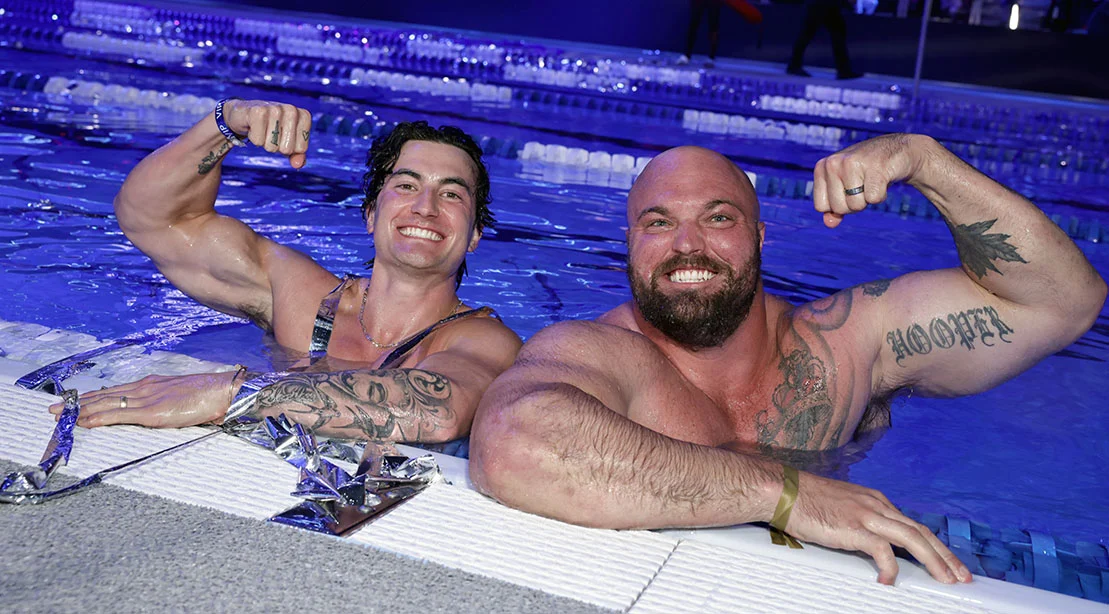
To the millions of fans who watch him dominate the international stage, Mitchell Hooper is an immovable object. Known as “The Moose,” he is the reigning World’s Strongest Man, a titan capable of feats that defy biological plausibility. Yet, to categorize Hooper solely by the weight on his barbell is to overlook the most significant transformation in strength sports today.
Hooper is not merely a record-breaker; he has emerged as one of the most articulate and transparent voices in athletics. By dismantling the "invincible" archetype, he is inviting a global conversation on the intersection of professional excellence, mental health, fatherhood, and the pursuit of longevity.
The Unlikely Genesis: A Childhood of Insecurity
It is a common trope in sports journalism to chart the rise of a champion by highlighting their early, natural gifts. For Hooper, that narrative does not exist. His journey to the pinnacle of strength sports was not paved with early accolades in football, hockey, or track. In fact, his athletic background—which included stints in golf, marathons, and endurance sports—offered no hint that he would eventually become the strongest human on the planet.
When asked which version of his younger self would be most stunned by his current reality, Hooper bypasses his teenage years and looks directly at his childhood. “I think myself at five to 10 years old would be the most shocked,” he admits.
While many young athletes are fueled by a sense of destiny, the young Hooper was marked by an unusual, often painful level of self-awareness. He did not grow up harboring dreams of the NFL or NHL, largely because he felt he lacked the requisite profile. This self-doubt was not fleeting; it was rooted in a struggle with weight and body image that persisted through his adolescence.
Hooper speaks with raw candor about his past, describing how he grappled with severe social anxiety and panic attacks. He recalls wearing hoodies to school in the heat—not as a fashion statement, but as a protective layer to hide the physical signs of anxiety, specifically excessive sweating during social interactions. This admission is striking, coming from a man whose current professional existence requires him to be the focal point of thousands of eyes.
The Philosophy of "Not Being Cured"
As we navigate an era where mental health awareness has become a cultural pillar, many public figures present their stories through the lens of triumph—the idea that they were once broken but are now “cured” and ready to offer life-altering wisdom. Hooper rejects this framework entirely.
"I’m not cured, and I still struggle a lot," he states. For the two-time World’s Strongest Man, the battle is not a linear path toward a finish line; it is a daily commitment to putting one foot in front of the other. He views the act of speaking about his mental health not as a form of personal therapy, but as an “olive branch” to those who feel isolated in their own internal struggles.
He acknowledges that talking publicly provides him no personal relief. Instead, he views it as a moral responsibility. Having been “blessed with gifts”—the platform, the title, the audience—he feels compelled to provide a return on that investment by showing a realistic version of success. He posits that ambition was his coping mechanism, a way to justify his existence and overcome deep-seated feelings of inadequacy. Today, he aims to demonstrate that one can be both high-achieving and profoundly human.
Fatherhood and the Redefinition of Strength
The recent shift in Hooper’s perspective has been accelerated by the most profound role of his life: fatherhood. His recent collaboration with fitness creator Jesse James West provided a candid glimpse into the realities of the modern father, stripping away the romanticized notions of the experience.
Hooper is blunt about the transition. “As a new dad, you have to be ready that the first six months are not very fun for you,” he explains, noting that the baby’s initial attachment to the mother often leaves the father feeling redundant. He describes this as a period where one feels "less useful."
However, this struggle is the catalyst for a broader evolution. Fatherhood has shifted his internal metric for success. He no longer measures his worth solely by prize money or podium finishes. Instead, he speaks of a "new kind of anxiety" rooted in the desire to protect a dependent. This has forced him to adopt a philosophy he calls "Dad Strong." Real strength, in his view, is not the ability to deadlift half a metric ton; it is the ability to carry responsibility, to show up for the mundane tasks—like changing diapers—and to maintain consistency when no one is watching.
The Enhanced Games: A Data-Driven Experiment
Hooper’s participation in the Enhanced Games has been a lightning rod for controversy, but he views the project through the lens of a scientist. For him, the event serves two distinct purposes: creating a controlled environment for the study of performance enhancement and challenging conventional wisdom regarding human aging.
His observations from the event were eye-opening. He noted that the average age of participants hitting personal bests was 30, suggesting that human performance potential extends much further than traditional sports science previously indicated. Furthermore, he points to the absence of the "catastrophic injuries" that critics had predicted as a sign that the conversation should shift from fear-based rhetoric to evidence-based analysis.
The 505kg Attempt: A Victory of Restraint
The 505kg deadlift attempt at the Enhanced Games is often misremembered as a failure. To Hooper, it was a triumph of long-term planning. Following a relentless schedule of victories at the Rogue Invitational and the Arnold Strongman Classic, his body was in a state of severe depletion. During the World’s Strongest Man competition, he was relying on pain management interventions to survive the event.
By the time he arrived at the Enhanced Games, his training had been severely compromised by back pain and systemic fatigue. The fact that he was able to break the floor with such weight was, in his estimation, a victory of nervous system recovery.
The Nuance of Equipment: Airwaav and Longevity
Perhaps the most telling moment of his recent career was his tactical decision regarding the Airwaav performance mouthpiece. While the mouthpiece is known to increase force production and reduce cortisol—benefits that every athlete craves—Hooper chose not to wear it for his heaviest deadlift attempt.
This decision serves as the ultimate case study in his evolving philosophy. He knew that the mouthpiece would make him more explosive, but he feared that this increased rate of force development would be the catalyst for a catastrophic injury. He opted for a slower, more controlled pull to protect his body for the future.
"I didn’t want to absolutely yank on the bar and cause myself an injury," he says. This is the hallmark of a mature athlete: the ability to prioritize the next decade of health over a single, fleeting record.
Implications: The Hierarchy of Risk
Ultimately, Hooper’s most radical stance is his call for honesty regarding health risks. He argues that the obsession with Performance Enhancing Drugs (PEDs) in public discourse is often a distraction from more tangible health threats.
When asked about his own risks, he presents a hierarchy:
- Genetics: A family history of cardiac events.
- Bodyweight: The inherent risks of maintaining a 330-pound frame.
- Training Volume: The sheer load placed on the body.
- Cardiovascular Health: The daily maintenance of a massive physique.
- PEDs: Which he places at the bottom of his specific risk assessment.
By highlighting this, he is not dismissing the debate around performance enhancers, but rather demanding that the public engage in a more nuanced, evidence-based conversation.
Mitchell Hooper is no longer just a strongman. He is a man navigating the complexities of the human condition with a barbell in his hand and a clear eye on the horizon. Whether he is lifting weights or discussing the realities of parenting, his mission remains consistent: to prove that excellence is not the absence of struggle, but the ability to manage it with grace, intelligence, and a commitment to the long game.