








For audiences who came of age during the 1990s, the name David Charvet conjures a very specific aesthetic: the sun-drenched, slow-motion runs of Baywatch as Matt Brody or the brooding, heartthrob intensity of Craig Feld on Melrose Place. For years, Charvet was the face of primetime glamour, defined by his signature smile and the iconic red swim trunks that became a pop-culture artifact.
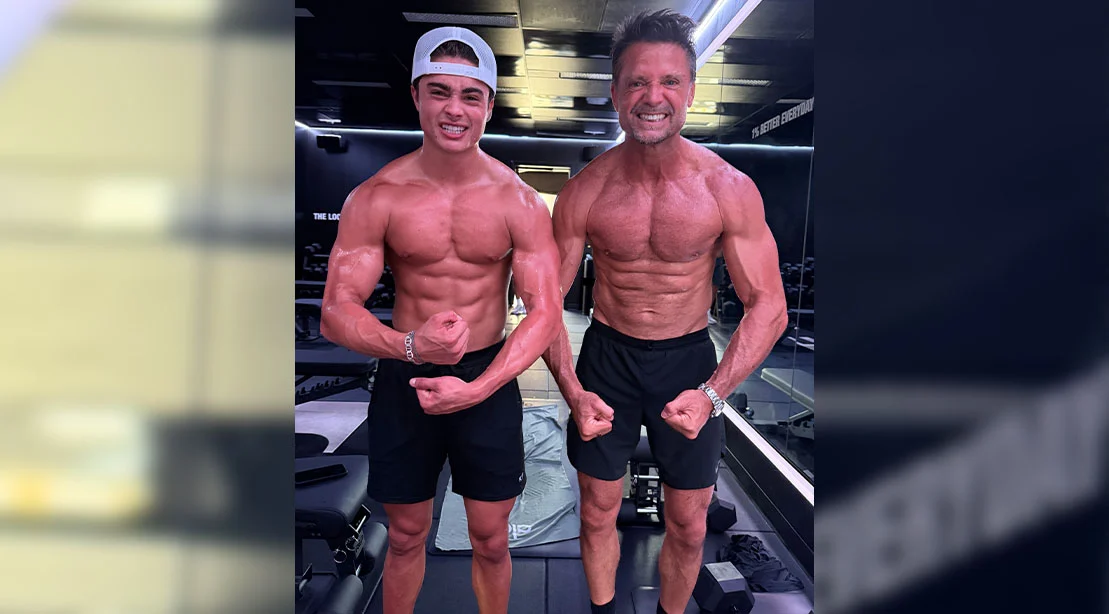
Yet, as the decades have passed, Charvet has traded the soundstages of Hollywood for the sweat-drenched atmosphere of the gym. His most significant role, he maintains, is not one that was scripted by a writer’s room, but one forged in the weight room alongside his 18-year-old son, Shaya Charvet. Their latest collaborative venture, a fitness concept titled BUILD, represents a pivot from television stardom to a serious, science-backed approach to human performance and father-son bonding.
The Genesis of BUILD: A Father’s Reflection
The transition from actor to fitness entrepreneur was not a sudden pivot, but a realization sparked by a moment of quiet reflection. During his son’s high school graduation, Charvet found himself scanning the bleachers where he had spent countless hours over the previous four years.
"When I was at his graduation, I was looking at those bleachers because I was there every single day after 3:30 after work," Charvet shared in an exclusive interview with Muscle & Fitness. "I used to always watch him and just support him throughout his whole high school career. I didn’t miss a day. And so, I was leaving the graduation and I said, ‘Wow, I’m never going to see these bleachers again.’"
This poignant realization became the catalyst for a deeper question: Was his foray into the fitness industry an unconscious attempt to extend that chapter of his life?
"Did I really create BUILD because I still wanted to be on a bench and I wanted my son to perform in front of others still? Did I subconsciously do this so that I could still be close to him?" Charvet reflects. "The answer is definitely yes. I couldn’t see myself not being able to be close to my son. I deliberately created something that he was interested in and passionate about, and I think that we both created it together without knowing that we were going to stay together."
Chronology: From Gym Buddies to Business Partners
The foundation of the BUILD partnership was laid long before the first studio opened. Shaya Charvet recalls being brought into the gym by his father as early as age eight. What began as a mandatory routine to instill discipline soon evolved into the primary language of their relationship.
- Age 8-14: The "Formative Years." David introduced Shaya to basic weight training and household chores, emphasizing that hard work was a non-negotiable trait. These years established the discipline that would later define Shaya’s career.
- High School Years: A constant presence. David attended every practice and training session, providing the consistent support that would eventually define their shared identity.
- The Post-Graduation Pivot: Following Shaya’s graduation, the transition from father-son gym partners to business collaborators occurred. Shaya dove into the science of exercise physiology, far exceeding his father’s initial expectations.
- The Launch of BUILD: Partnering with Maria Chase, the duo launched the BUILD concept in Southern California, with David’s construction expertise bringing the physical studios to life.
The Science of the Build: Anatomy of a Workout
BUILD is not just another gym; it is a proprietary fitness ecosystem designed for precision and recovery. The 45-minute classes, which are capped at 10 participants to ensure high-touch coaching, integrate three distinct pillars:
- Progressive Heavy Lifting: Utilizing weights ranging from 10 to 95 pounds, the program focuses on low-rep, high-intensity movements that target the upper and lower body in isolation.
- Low-Intensity Infrared Heat: By utilizing infrared technology, the studio creates an environment that elevates the core temperature, allowing for an efficient, safe sweat that reduces strain on the cardiovascular system compared to traditional high-impact cardio.
- Medical-Grade NIR/LED Therapy: The inclusion of red light therapy post-workout serves as a recovery catalyst, reducing inflammation and promoting tissue repair—a nod to the modern, science-first approach to wellness.
The physical architecture of the studio is also a product of the family dynamic. David’s construction firm handled the design and development of the facilities, ensuring that the environment reflected the minimalist, focused, and high-performance philosophy of the brand.
Official Perspectives: The Evolution of a Dynamic
The dynamic between father and son has shifted significantly as the business has matured. While David was initially the instructor and mentor, the roles have effectively leveled out.
"He kind of took it upon himself in the last three years to learn more about the science behind it," David says. "He blows me away now because he talks about things that I had no idea about. I sit back sometimes and I go, ‘Holy moly: This is my son.’"
Shaya, for his part, acknowledges the initial friction that comes with having a famous, perfectionist father as a business partner. "He was super nitpicky in the beginning, and he’s my dad, so obviously he’s going to be harder on me than anyone else," Shaya admits. "But now? Not anymore. I like feedback, but when it comes to the classes, that’s what my expertise is in. He doesn’t give a lot of input, but everything else, he’s very present."
This transition from "dad" to "business partner" is one David embraces with intention. "I don’t talk to him as my son," David explains. "I talk to him as my business partner, as an equal. I’ll always be his dad and I’ll always be standing on the sidelines watching him, but I want him to also be able to be his own man."
Implications: A Model for Generational Business
The success of the BUILD concept in Southern California highlights a growing trend in the fitness industry: the move toward hyper-personalized, boutique experiences that emphasize community and longevity over mass-market scalability.
For the Charvets, the implications are both personal and professional. By embedding their family values—specifically the "110% effort" rule—into their business model, they have created a brand that feels authentic rather than corporate. Shaya notes that his father’s greatest lesson was simple: "If you’re going to do something, you do it with everything… that applied to sports, that applied to working out, that applied to relationships, business, everything."
As they look toward expanding the BUILD brand across the country, the father-son duo faces the challenge of scaling a business that relies so heavily on their personal, present-day involvement. However, they are banking on the fact that the culture of discipline and "the bug" for helping others—which Shaya has clearly caught—will be the foundation upon which their future empire stands.
Conclusion: Beyond the Screen
For David Charvet, the red trunks of Baywatch are a distant memory, replaced by the reality of a son who has not only surpassed his physical conditioning but has also stepped into his own as a professional leader. BUILD is more than a gym; it is the physical manifestation of a transition from the life of a television star to the life of a mentor.
As they move forward, the lines between father and son, and business partner and colleague, will continue to blur. Yet, in the quiet of the studio, watching his son command a class of 10 with the confidence of a seasoned pro, David Charvet finds a satisfaction that no ratings spike or fan-favorite episode could ever provide. The "Bleacher Moments" may have ended, but the work—and the connection—is only just beginning.