











For those navigating a cancer diagnosis, the medical landscape can feel overwhelming, characterized by a whirlwind of terminology, treatment plans, and life-altering decisions. Among the most significant—and often misunderstood—terms is the “clinical trial.” Far from being a last-ditch effort, clinical trials represent the engine of medical progress and, for many patients, a gateway to life-extending options that would otherwise be unavailable.
Understanding clinical trials is not merely an academic exercise; it is an act of patient empowerment. Every current “standard of care” treatment—from foundational chemotherapy to cutting-edge immunotherapies—exists today only because individuals chose to participate in clinical research in the past. By exploring these trials, patients and their families can play an active role in their own care while contributing to a global legacy of scientific advancement.
The Landscape of Modern Cancer Research
Defining the Clinical Trial
At its core, a cancer clinical trial is a rigorously designed research study aimed at evaluating the safety and efficacy of new medical approaches. These studies are the essential bridge between the laboratory bench and the patient’s bedside. Without the data gathered through these trials, the medical community would be unable to advance beyond existing limitations.
The scope of these trials is vast. While the public often associates research primarily with experimental drugs, modern clinical trials are multifaceted. Some focus on:
- Preventative Measures: Strategies to stop cancer before it begins in high-risk populations.
- Early Detection: Refinement of screening technologies to identify malignancies at more treatable stages.
- Symptom Management: Research aimed at enhancing quality of life by mitigating the side effects of traditional treatments.
- Innovative Therapies: Investigations into immunotherapy, personalized medicine, and genomic-targeted therapies that tailor treatment to the individual’s unique molecular profile.
The Evolution of Care
The historical trajectory of cancer treatment is a direct map of clinical trial success. Decades ago, diagnoses that were once considered universally terminal are now managed as chronic conditions or are entirely curable. This progress is not accidental; it is the result of thousands of patients participating in trials. As Dr. Joshua Brody of the Icahn School of Medicine at Mount Sinai aptly puts it, “Every miraculous breakthrough has come from clinical trials.”

Chronology and The Phases of Clinical Research
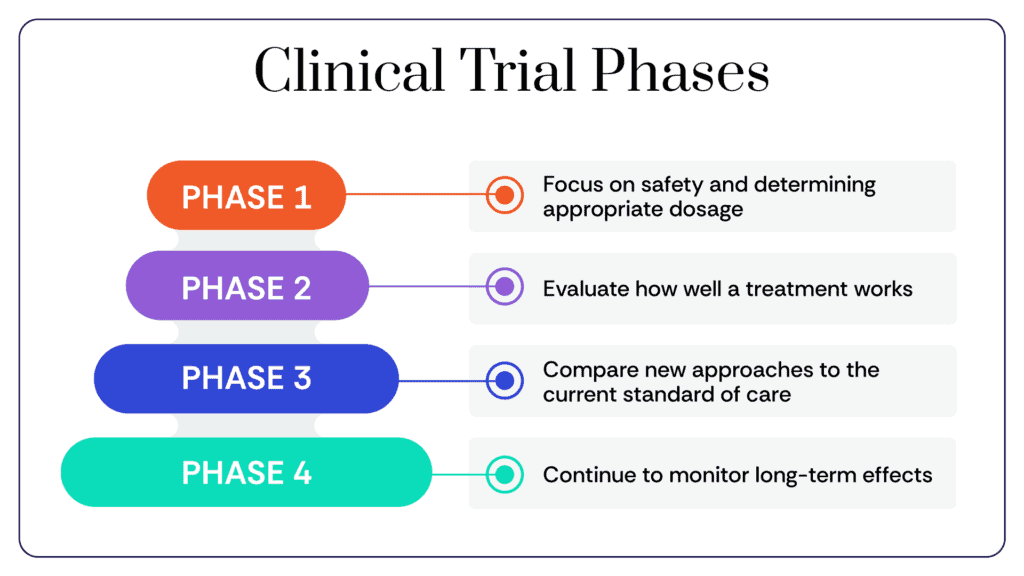
To ensure that new treatments are safe and effective before they reach the general public, clinical trials are structured in a phased progression. Each phase builds upon the findings of the previous one, creating a systematic, evidence-based approach to medicine.
Phase I: Safety and Dosage
The primary objective of Phase I trials is to determine the highest dose of a new treatment that can be safely administered without causing severe side effects. Researchers monitor a small group of participants closely to identify how the drug is metabolized and to spot early signs of efficacy.
Phase II: Expanding Efficacy
Once a safe dosage is established, the study expands to a larger group of patients with a specific type of cancer. The goal here is to see if the treatment effectively targets the cancer and to continue gathering data on safety.
Phase III: Comparison to Standard Care
Phase III trials are the “gold standard” of research. They compare the new treatment against the existing standard of care. These trials involve larger, more diverse groups of participants and are often randomized, meaning patients are assigned to either the new treatment or the standard treatment to provide the most accurate, unbiased comparison.
Phase IV: Post-Approval Monitoring
After a treatment is approved by regulatory bodies, Phase IV trials continue to monitor its performance in the broader population. This ensures that long-term effects and rare side effects are captured, providing a comprehensive safety profile for the medication.

The Patient Experience: Why Participate?
Participating in a clinical trial is a deeply personal decision, influenced by one’s medical status, personal values, and desire for potential outcomes.
Direct Benefits to the Participant
One of the most immediate benefits is access to state-of-the-art therapies. Patients in trials often receive care from leading experts in the field. Furthermore, because these trials are highly regulated, participants receive intensive monitoring and, frequently, a higher level of personalized attention than might be found in a standard clinical setting.
The Altruistic Motivation
Many patients, such as Stage 4 Leukemia survivor Kristin Kleinhofer, find that the decision to join a trial is driven by a desire to "pay it forward." Even if a treatment does not provide the desired result for the individual, the data gathered helps researchers refine future protocols, potentially saving the lives of those who will receive a diagnosis years down the line.
Dispelling the "Last Resort" Myth
A pervasive misconception in oncology is that clinical trials should only be considered when all other options have been exhausted. This view is outdated. In many modern treatment plans, trials are considered early in the diagnostic process. Discussing trial options with an oncologist immediately following a diagnosis can ensure that patients have access to the full spectrum of available research, rather than waiting until a disease has progressed significantly.
Practical Considerations and Financial Realities
Deciding to enroll in a trial requires careful planning. It is not just a medical decision; it is a logistical one.

Assessing the Fit
Not every patient is eligible for every trial. Eligibility criteria are strict, dictated by factors such as:
- Tumor Type and Stage: The specific biology of the cancer.
- Prior Treatment History: What medications or surgeries the patient has already undergone.
- Biomarkers: Specific genetic mutations that may make a patient more likely to respond to a particular therapy.
- Overall Health: The patient’s general physical ability to tolerate the study’s requirements.
These criteria are not meant to exclude patients arbitrarily; they are designed to ensure safety and to allow researchers to isolate the effects of the treatment.
The Financial Landscape
Cost is a common barrier to participation. While the trial sponsor generally covers the cost of the experimental drug and specialized study procedures, routine care—such as standard doctor visits, scans, and blood work—is often billed to the patient’s insurance. Patients are encouraged to have a candid conversation with their oncology team and insurance provider to understand their specific financial obligations before committing to a trial.
Supporting the Patient Journey: Resources and Advocacy
No one should have to navigate the complex world of clinical trials alone. Support services are increasingly available to bridge the gap between complex medical documentation and patient understanding.
Tools for Empowerment
Resources like the CRI Clinical Trial Finder serve as vital tools for patients, allowing them to search for trials based on their specific diagnosis. These platforms are designed to demystify the search process, turning a complex database into an accessible, user-friendly experience.
Preparing for the Conversation
The most effective way to start the process is to sit down with a primary oncologist. Preparation is key. Patients should come to appointments with a list of questions to ensure they leave with clarity. Essential questions include:
- "Are there any trials currently available that align with my specific diagnosis, genetic markers, and treatment history?"
- "What is the ultimate goal of this trial? Is it to cure, manage, or improve quality of life?"
- "How does this treatment differ from the standard care I would receive otherwise?"
- "What are the known risks, and what unknowns should I be prepared for?"
- "What is the day-to-day commitment? How many visits, scans, or travel days will be required?"
- "What happens if the treatment proves ineffective for me?"
- "How will this impact my current quality of life, including potential side effects?"
- "Are there financial burdens or out-of-pocket costs I should anticipate?"
Implications for the Future
The implications of clinical trial participation extend far beyond the individual patient. As medicine moves toward a future defined by precision oncology and immunotherapy, the need for patient participation is greater than ever.
As survivor Sharon Belvin notes, "Clinical trials are the lifeline for long-term survival rates with cancer." Every person who asks a question, every person who investigates a trial, and every person who decides to enroll is a participant in a grand, collaborative effort to rewrite the future of oncology.
By moving from a position of passive recipient to active participant, patients gain more than just a potential treatment; they gain a sense of agency. Whether or not a trial ends up being the right path, the simple act of inquiring opens a door to possibility. In a field defined by uncertainty, the clinical trial remains our most reliable beacon of hope, moving the entire medical community closer to a world where cancer is not just treated, but conquered.
If you or a loved one are facing a cancer diagnosis, remember that the conversation about clinical trials is one of the most important you can have. It is an opportunity to explore all avenues, leverage the latest in scientific discovery, and perhaps, change the future of medicine forever.