











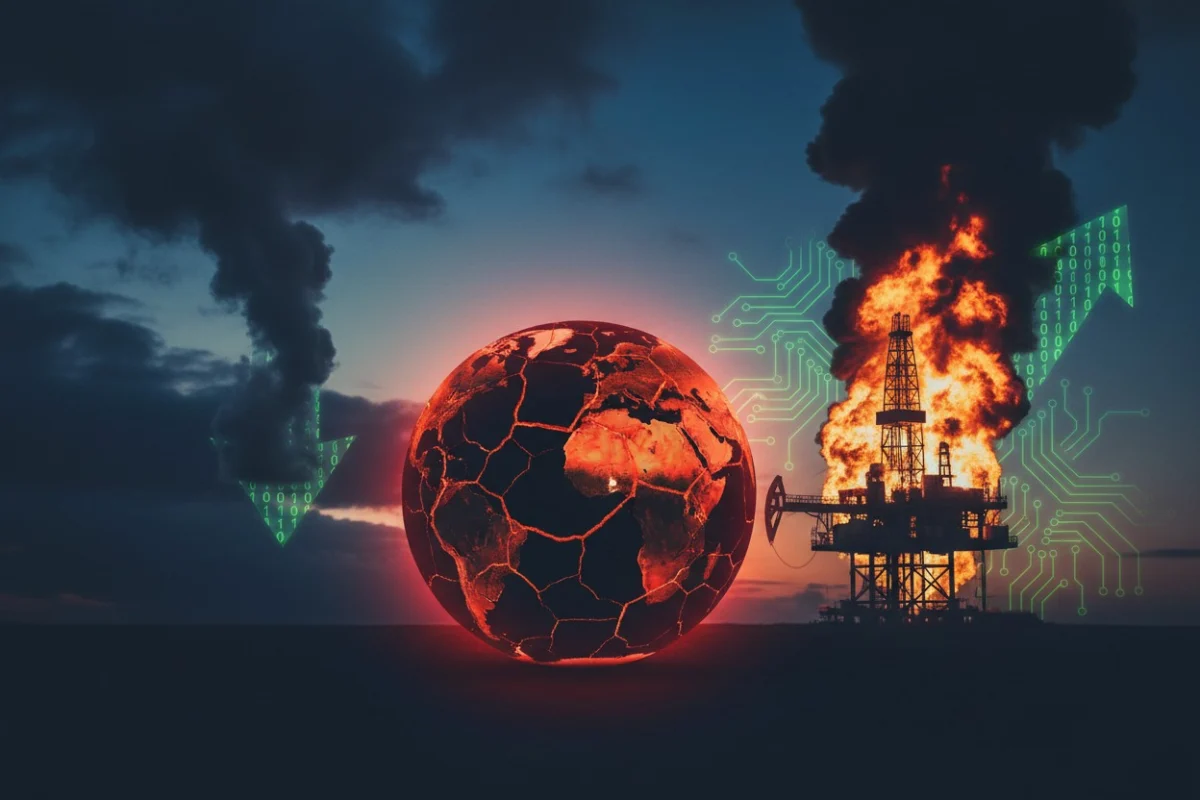
The global economic landscape has shifted dramatically, moving from a period of cautious optimism toward a precarious future defined by energy volatility and geopolitical instability. According to the International Monetary Fund’s (IMF) World Economic Outlook update released on July 8, 2026, the global growth forecast for 2026 has been revised downward to 3%, a notable retreat from the 3.5% growth observed in 2025.
At the heart of this contraction is the intensifying conflict involving Iran, which has acted as a catalyst for a global energy price shock. This escalation has effectively halted two years of steady disinflation, forcing central banks and policymakers to recalibrate their expectations for a "soft landing." While the burgeoning investment in Artificial Intelligence (AI) was once touted as a potential panacea for stagnant productivity, the IMF now warns that the sheer weight of energy-driven inflation has largely neutralized these technological gains.
The Chronology of a Slowdown
The downward revision is not a sudden surprise, but rather the culmination of a deteriorating geopolitical environment that began early in 2026.
- Q1 2026: Markets initially remained resilient, bolstered by strong corporate earnings in the U.S. and an aggressive AI infrastructure build-out.
- April 2026: Early IMF projections estimated a relatively stable growth trajectory of 2.5% for the United States, contingent on stable energy prices and controlled inflation.
- May–June 2026: The rapid escalation of the conflict in the Middle East disrupted critical maritime trade routes and sent oil prices into a sustained rally. This period saw the "cooling" of inflation stall, as energy inputs surged across the manufacturing and logistics sectors.
- July 8, 2026: The IMF officially downgraded its global outlook, citing a "triad of threats": energy volatility, supply chain fragmentation, and the erosion of consumer purchasing power.
Supporting Data: Regional Divergence
The economic impact of this crisis is far from uniform. The IMF’s data reveals a world bifurcated by energy dependence and structural flexibility.
The United States: A Shielded Outlier
The U.S. economy remains the global benchmark for resilience, with a projected growth rate of 2.3% for 2026. As a net energy exporter, the U.S. has been insulated from the worst of the supply shocks that have crippled other advanced economies. Fiscal stimulus, combined with a relentless influx of capital into AI and domestic semiconductor manufacturing, has sustained equity markets. However, the IMF cautions that while the nation is better positioned than its peers, it is not immune; American consumers are increasingly feeling the squeeze of higher energy-related costs at the pump and in their utility bills, which may dampen retail consumption in the latter half of the year.
The Eurozone: Stagnation and Structural Fragility
In stark contrast, the Eurozone is facing a period of near-stagnation. With a growth forecast of just 0.9%—down from 1.4% in 2025—the region is struggling under the weight of its energy import dependency. The United Kingdom, suffering from a similar lack of domestic energy security, faces an even bleaker outlook at 0.8% growth. The IMF report highlights that high energy costs are not merely a headline inflation issue but a structural one, forcing European governments to reallocate budget surpluses toward debt servicing and social safety nets, leaving little room for the capital investment required to match U.S. productivity growth.
China and India: The Emerging Giants
China’s growth is expected to moderate to 4.6%. Beijing is currently relying on a two-pronged strategy: aggressive public works spending to mitigate a domestic property sector crash and a pivot toward advanced, high-tech manufacturing. While effective, this strategy is vulnerable to the same global trade disruptions affecting the rest of the world.
India continues to lead as the fastest-growing major economy, with a projection of 6.4%. While this is a deceleration from last year’s 7.7%, India’s domestic consumption remains robust. However, as IMF Africa Director Zeine Zeidane pointed out, the ripple effects of the Middle East conflict—specifically regarding fertilizer prices and agricultural input costs—threaten to undermine the food security of emerging economies across Asia and Africa, potentially creating a secondary wave of humanitarian and economic instability.
Official Responses and Strategic Assessments
The IMF’s leadership has been unequivocal in its assessment of the current climate. Managing Director Kristalina Georgieva noted that the global economy is entering an era of "persistent shocks," where the traditional cyclical nature of the business cycle is being superseded by geopolitical volatility.
"The world is facing a series of overlapping crises," Georgieva stated during the July 8 briefing. "We are no longer looking at a simple adjustment period. We are looking at a fundamental shift in how global trade and energy markets function."
The Fund has announced it is prepared to deploy up to $50 billion in emergency liquidity for nations most severely impacted by the energy shock. This is intended to prevent a broader sovereign debt crisis in emerging markets, where rising costs for fuel and food imports have pushed several nations to the brink of fiscal insolvency.
Meanwhile, industry analysts remain divided on the long-term prognosis. While some suggest that the "AI productivity dividend" will eventually catch up to offset energy costs, others argue that the geopolitical reality—"when all else fails, they take you to war"—will continue to dictate economic outcomes, rendering technological innovation secondary to the necessity of secure supply chains.
Implications: The Looming Threat of Recession
The most alarming takeaway from the July 2026 update is the IMF’s "worst-case scenario" modeling. Should the conflict in the Middle East escalate further or should trade routes remain permanently compromised, the IMF estimates that global growth could dip below 2%. In economic terms, this is effectively a "near-recession," a state where population growth outpaces economic output, leading to a decline in per-capita prosperity.
The Death of Disinflation
For the past two years, the global narrative was centered on the "Great Disinflation"—the process of bringing interest rates and consumer prices back to pre-pandemic levels. The current conflict has effectively killed this trend. As energy prices stay elevated, "cost-push" inflation is becoming entrenched. Unlike wage-driven inflation, which can be managed through interest rate hikes, energy-driven inflation is a supply-side constraint that central banks are poorly equipped to handle.
Labor Market Shifts
The labor market, which remained tight throughout 2024 and 2025, is showing signs of cooling. The IMF projects employment growth to settle at approximately 0.3% in the advanced economies. As companies face higher energy bills and uncertain demand, hiring freezes are becoming the standard, signaling the end of the post-pandemic labor shortage.
Food Security and Global Stability
Perhaps the most overlooked implication is the impact on the agricultural sector. As Africa Director Zeine Zeidane emphasized, the region is highly dependent on fertilizer exports that are currently trapped or prohibitively expensive due to the energy crisis. The disruption to the agricultural cycle in the Global South could lead to a systemic food security crisis, which historically acts as a precursor to social unrest and political migration, further complicating the global economic outlook.
Conclusion: A New Economic Reality
The IMF’s 2026 forecast serves as a sober reminder that the global economy is not a closed loop of trade and technological advancement, but a system sensitive to the fluctuations of geopolitical stability. While the U.S. demonstrates a surprising degree of resilience, the broader world is clearly feeling the weight of the current conflict.
The path forward, according to the IMF, requires a two-fold approach: a renewed focus on energy diversification and a commitment to international cooperation to keep trade routes open. Without these, the world faces a prolonged period of economic stagnation. Investors and policymakers alike must now prepare for a reality where "business as usual" is no longer an option, and where volatility is the only remaining constant. As the year progresses, all eyes remain on the energy markets, which continue to act as the primary barometer for the global economy’s health.