










For years, the gold standard for fitness enthusiasts, bodybuilders, and nutrition-conscious individuals has been simple: track the numbers. Whether through MyFitnessPal, Cronometer, or a meticulously kept spreadsheet, the practice of "counting macros"—monitoring the exact grams of protein, fats, and carbohydrates consumed—has been the bedrock of physique maintenance and performance.
But for Dr. Gabrielle Fundaro, a PhD in Human Nutrition with over a decade of coaching experience and six powerlifting competitions under her belt, the practice eventually hit a wall. Despite her professional expertise, she found herself trapped in a cycle of dependency, terrified that if she stopped inputting her meals, her physique would vanish and her health would crumble.
Her realization was not that macro-tracking is inherently "bad," but that for many, it eventually stops being a tool and becomes a psychological shackle. This led her to develop a revolutionary framework: RPE-Eating.
The Anatomy of the Problem: Why Tracking Fails
The core issue for many long-term dieters is the reliance on external metrics. When you define your success through a digital dashboard, you slowly lose the ability to interpret internal signals—the subtle, biological feedback loops of hunger, fullness, and satisfaction.
Dr. Fundaro’s struggle was representative of a broader phenomenon. She wasn’t worried about the nutrition itself; she was worried about her loss of control. "What if I don’t eat enough protein and lose muscle?" she would ask herself. "What if I overeat and gain fat?" These questions, rooted in the fear of physiological decline, kept her tethered to the app.
The irony was palpable: an expert in human nutrition felt incapable of nourishing herself without an algorithm telling her how to do it. This created a paradox of competence, where the more she knew about nutrition, the less she felt she could trust her own body.
The Epiphany: From the Powerlifting Platform to the Plate
The solution arrived in an unlikely place: the gym. In strength sports, athletes often use the Rate of Perceived Exertion (RPE) scale. Rather than relying solely on a percentage of their one-rep max—which can fluctuate based on sleep, stress, or recovery—lifters use RPE to gauge how "heavy" a weight feels on a given day. If they feel sluggish, they adjust. If they feel strong, they push.
As Dr. Fundaro utilized this framework to enhance her recovery and strength, the parallel became clear. If the RPE scale could successfully manage high-intensity physical output, why couldn’t a similar framework manage caloric intake?
Thus, "RPE-Eating" was born. It is not a diet in the traditional sense; it is a biofeedback system designed to help individuals regain agency over their nutritional choices by replacing data-entry with self-awareness.
The RPE-Eating Framework: How It Works
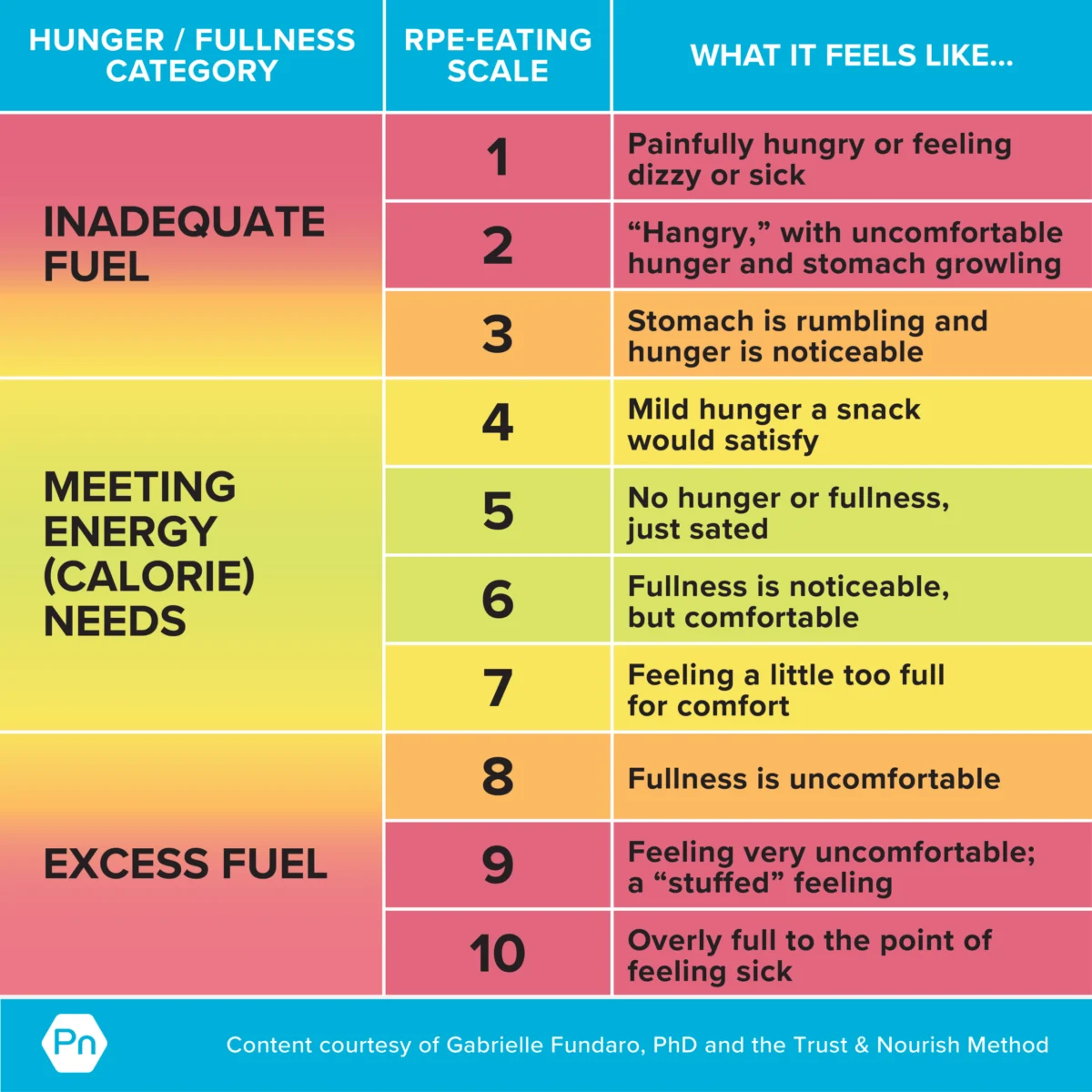
The RPE-Eating scale is a 1-to-10 metric designed to quantify physical sensations. It moves away from "good vs. bad" food labeling and toward "sufficient vs. insufficient" fueling.
The Scale Defined:
- 1-3 (Inadequate): From painful hunger and dizziness to "hangry" irritability.
- 4-7 (Adequate/Neutral): The "sweet spot" where hunger is managed, energy is stable, and the body feels satisfied without being over-taxed.
- 8-10 (Excess): Ranging from "a little too full" to physical sickness and over-consumption.
The goal of this system is to train the brain to recognize where one sits on this scale before, during, and after a meal. By doing so, the individual builds "interoceptive awareness"—the ability to perceive the internal state of the body.
Practical Implementation: A Four-Step Process
Transitioning away from a tracker is a skill, not a switch. Dr. Fundaro outlines a clear, four-step process for those looking to adopt the RPE-Eating method.

1. Define Your Intentions
RPE-Eating is not designed for the extreme demands of professional bodybuilding or weight-class sports. It is designed for longevity and mental freedom. If your goal is to maintain a healthy, sustainable physique, you must accept that the "perfect" macro balance is less important than the "consistent" ability to listen to your body.
2. Differentiate Hunger vs. Appetite
One of the most common pitfalls in modern nutrition is the confusion between physical hunger (a biological need for energy) and appetite (the psychological desire for food). By checking in with the RPE scale at the start and halfway point of every meal, individuals learn to identify when the biological need for food has been met, even if the psychological desire for more remains.
3. The "Notice and Name" Strategy
Emotional eating is a human reality. When stress or boredom triggers a desire to eat, Dr. Fundaro suggests the "Notice and Name" technique. By identifying the underlying emotion—anxiety, sadness, or fatigue—before reaching for food, one can create a pause. This pause allows for the consideration of non-food coping mechanisms, such as a walk, breathing exercises, or a conversation.
4. Satiety vs. Satisfaction
A meal that provides physical fullness (satiety) but lacks pleasure (satisfaction) is a recipe for a binge later in the day. RPE-Eating encourages including foods that are genuinely enjoyable. By removing the "forbidden" label from specific foods, the pendulum-swing effect—where one restricts all day and binges at night—is significantly mitigated.
Implications for the Coaching Industry
The shift toward RPE-Eating has significant implications for how nutritionists and personal trainers work with clients. Traditionally, coaches provide meal plans or macro targets. This creates a dependency where the client is only successful as long as the coach is present to enforce the numbers.
By teaching RPE-Eating, coaches empower their clients to become their own experts. This is particularly crucial for clients with a history of disordered eating or chronic "yo-yo" dieting. In these cases, tracking can be a trigger for body dissatisfaction. RPE-Eating provides a safety net: it allows for structure without the rigidity that often leads to psychological burnout.
Addressing the Skeptics: Is This Just "Feelings Over Facts"?
Critics of intuitive-based methods often argue that "feelings" are not a reliable metric for health. They point to the precision of calorie counting as the only objective way to manage weight.
Dr. Fundaro counters this by drawing a comparison to early resistance to RPE in the weight room. "RPE was once laughed at by lifters," she notes. "Now, it is widely accepted as a valid, science-backed method for managing training load."
She argues that RPE-Eating is not about ignoring biology; it is about using it. It uses the body’s internal signals—which are inherently linked to blood glucose and energy levels—as a real-time monitor. Being aware of stomach rumbling is a more practical, sustainable, and accurate daily tool for most people than constant blood glucose monitoring or obsessive macro-calculation.
Conclusion: A Shift in the Nutritional Paradigm
The ultimate goal of RPE-Eating is not to replace science with intuition, but to integrate the two. It acknowledges that while macronutrients matter, the human experience of eating is complex, social, and psychological.
For those who have spent years feeling like a slave to a fitness app, the transition to RPE-Eating is a profound act of liberation. It replaces the fear of "doing it wrong" with the confidence of knowing how to nourish oneself. As Dr. Fundaro concludes, "The goal is to know that you’re nourishing yourself—and you don’t need a food tracker to do that."
While this method requires patience and a willingness to sit with the discomfort of letting go of rigid metrics, the result is a sustainable, healthy, and—above all—human relationship with food. For the athlete, the parent, and the busy professional alike, this represents a significant step forward in the evolution of nutrition.