










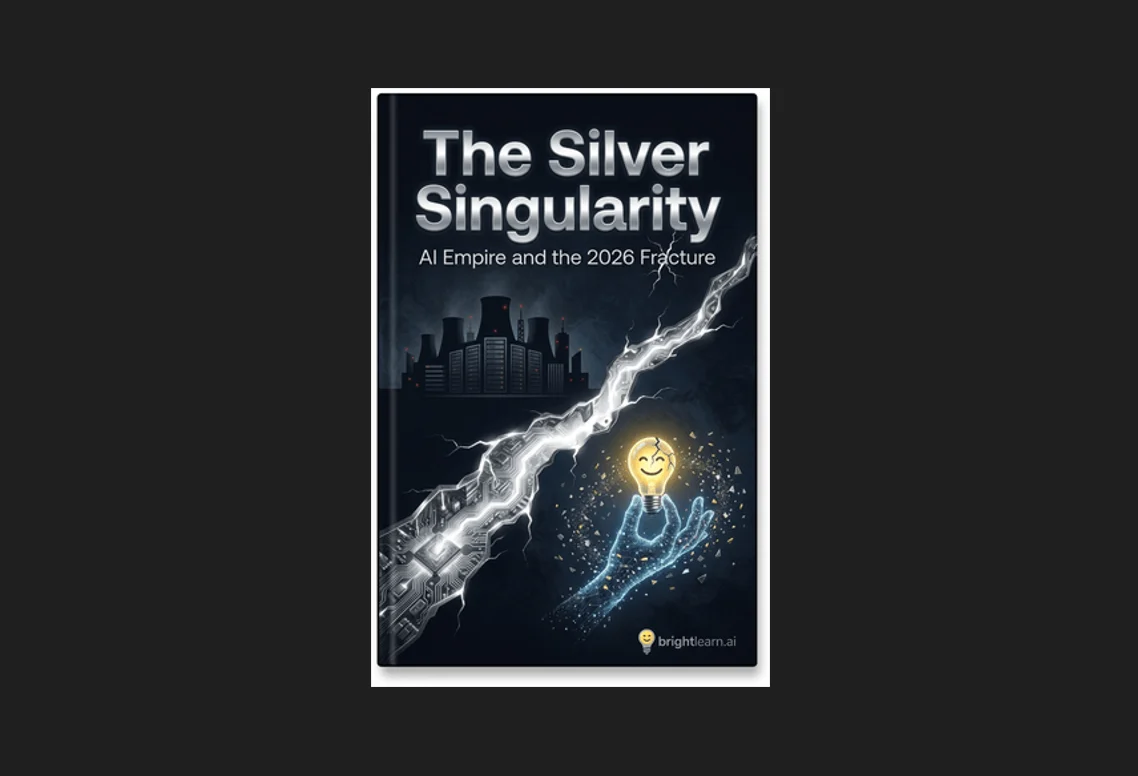
We stand at a precarious crossroads in human history, where the rapid convergence of artificial intelligence and physical resource scarcity is forcing a civilization-wide choice. The technological singularity—once a speculative concept relegated to science fiction—has transitioned into a tangible, ongoing process. According to the provocative new book, The Silver Singularity: AI Empire and the 2026 Fracture, we are approaching a critical threshold where the digital and physical worlds collide with irreversible force.
As the narrative of the 21st century accelerates, this analysis explores the intersection of AI hegemony, the hidden role of silver as the foundation of the electric age, and the growing movement toward decentralized defiance.
The Architecture of Control: Beyond the Software Mirage
The prevailing narrative surrounding AI focuses on its utility: professional-grade exam performance, creative generation, and nascent signs of cognitive mimicry. Yet, The Silver Singularity argues that these public-facing marvels are merely a diversion. The core thesis of the work is that AI itself is not the existential threat; rather, the threat lies in the centralized infrastructure being erected to house it.
Data centers are the new cathedrals of the digital age. Tech giants like Microsoft, Google, Meta, and Amazon are pouring hundreds of billions of dollars into capital expenditure for server farms. When juxtaposed against the relatively modest subscription revenues generated by AI software, a disturbing pattern emerges. These massive investments are not driven by the pursuit of software margins, but by the desire to construct the physical backbone of total surveillance.
This infrastructure is the engine behind facial recognition, social credit scoring, and the integration of automated drone warfare into the military-industrial complex. The "AI Empire" is not merely about smarter chatbots; it is about the consolidation of power through the permanent monitoring of human activity.
Chronology of the Fracture: The Path to 2026
The timeline toward this "fracture" is condensed and urgent. Understanding the evolution of this transition provides context for why 2026 is cited as a pivotal year:
- 2020–2023: The Cognitive Explosion. The rapid scaling of Large Language Models (LLMs) and the democratization of generative AI occur. Berkeley Labs demonstrates that high-level cognition can be synthesized for as little as $35 in compute resources, signaling that the cost of intelligence is collapsing.
- 2024–2025: The Infrastructure Buildout. Global tech conglomerates accelerate the construction of massive data centers. Simultaneously, the geopolitical race for AI supremacy intensifies, with China leading in patent filings and supercomputing capacity, unburdened by the privacy constraints that slow Western progress.
- 2026: The Projected Fracture Point. Analysts anticipate a convergence of events: the saturation of autonomous trucking (projected at 50% autonomy for long-haul routes), the exhaustion of historical silver stockpiles, and the potential implementation of mandatory digital IDs or Central Bank Digital Currencies (CBDCs).
This timeline represents a "fork in the road" where the choice between a surveillance-dependent existence and a path of local, resilient sovereignty becomes unavoidable.
The Physical Foundation: Silver as the Real Fuel
While digital algorithms receive the headlines, the physical reality of our electric future is anchored in the periodic table. The transition to a green, AI-driven economy is fundamentally dependent on silver—a metal whose industrial properties are essential for solar photovoltaics, advanced electronics, and electric vehicle (EV) circuitry.
The book contends that silver, not oil, is the true fuel of the modern era. The math is stark: annual mining production hovers around 25,000 tons, yet industrial demand has already surpassed this figure. The global economy is currently cannibalizing centuries of accumulated stocks. When these finite reserves reach a depletion point, a "silver singularity" will occur—a moment of extreme price discovery where demand irrevocably overwhelms supply.
This scarcity creates a geopolitical leverage point. China, which holds a commanding lead in the processing of rare earth elements and a significant portion of global silver refining, occupies a position of strategic dominance. In the coming resource wars, the ability to control the flow of the very materials required to power the AI Empire will be more valuable than the software code itself.
Socio-Economic Implications: The Displaced Workforce
The most immediate human impact of this technological acceleration is the displacement of the labor market. With the advent of self-driving technology, the transportation sector—a bedrock of the global middle class—is facing an existential threat.
"The robots are coming for the steering wheel," the book warns. The potential loss of over 6.5 million transportation jobs in the United States alone represents more than a statistical decline; it signifies the potential collapse of the "truck stop economy." Entire communities, small businesses, and infrastructure networks built to serve human long-haul drivers are at risk of obsolescence by 2026. This displacement serves as a preview of the broader socio-economic disruption that will follow if the transition to automation is left entirely to corporate interests.
Official Responses and the Corporate Agenda
While tech executives often speak in terms of "AI safety" and "societal benefit," the sheer scale of the infrastructure buildout suggests a different priority. Governments and mega-corporations are increasingly aligning their interests through public-private partnerships that facilitate mass data collection.
The push for mandatory digital identification and the transition toward digital-only currency systems are being framed as "efficiency" and "convenience" upgrades. However, these initiatives provide the necessary tools for state-level surveillance and the enforcement of social credit systems. By digitizing the entirety of the financial and identification systems, the state gains the capability to freeze, monitor, and control the movement and behavior of its citizenry in real-time.
The Path of Defiance: Self-Sufficiency in the Digital Age
If the trajectory of the AI Empire is one of total surveillance, the counter-movement is one of total decentralization. The book posits that the solution is not the rejection of technology, but the reclamation of it.
Open-Source as the New Printing Press
Just as the Gutenberg press shattered the monopoly on information in the 15th century, open-source AI represents the democratization of advanced intelligence. By empowering individuals to run models locally, the power to create, analyze, and compute is stripped from the corporate silos and returned to the hands of the individual.
Practical Resilience
Resistance, in this context, is defined by practical self-sufficiency. The adoption of technologies that facilitate autonomy—such as sodium-ion batteries capable of powering off-grid homes for decades—allows individuals to bypass the centralized energy grid.
Furthermore, the book advocates for a return to tangible assets. In an era where digital currency can be programmed and potentially confiscated, physical silver remains the ultimate "honest money." Integrating local currency systems, building community-based resource networks, and investing in permaculture are framed as the ultimate acts of defiance against a centralized, fragile system.
Conclusion: Choosing the Future
The "Silver Singularity" is not merely a forecast of market trends or an analysis of AI development; it is a call to action. We are moving toward a period of bifurcated realities. One path leads to a future of "surveillance-fueled dependence," characterized by the erosion of privacy and the concentration of power. The alternative path is one of "personal ownership and local resilience," where individuals utilize open-source tools, private transactions, and community-based resources to insulate themselves from the fragility of the globalized AI Empire.
The year 2026 is approaching, and the decisions made by individuals today—to learn self-sufficiency, to hold private stores of value, and to engage with decentralized technology—will determine which of these two worlds manifests. As the book concludes, true wealth is not found in the digits of a bank account, but in the possession of land, the mastery of skills, and the preservation of personal liberty.
For those interested in exploring these concepts further, "The Silver Singularity: AI Empire and the 2026 Fracture" is available for download at Books.BrightLearn.AI. The platform encourages users not only to read but to create and contribute to a growing library of decentralized knowledge. For a visual deep-dive into the intersection of AI, energy, and precious metals, watch the "Health Ranger Report" featuring the Silver Guru David Morgan at Brighteon.com.