






In the realm of modern medicine, few drug classes are as ubiquitous as Selective Serotonin Reuptake Inhibitors (SSRIs). Since the late 1980s, antidepressants have been marketed as a cornerstone of mental health treatment, framed by the psychiatric establishment as highly effective tools for managing depression. However, a growing cadre of researchers and medical whistleblowers, led by Dr. Peter C. Gøtzsche, co-founder of the Cochrane Collaboration, is challenging this narrative. Their central claim is startling: antidepressants may not work for depression at all, and the industry surrounding them is built on a foundation of "statistical alchemy," unblinding bias, and, in some cases, outright fraud.
Main Facts: The Discrepancy Between Clinical Data and Patient Experience
The core of the controversy lies in how "success" is measured in clinical trials. While psychiatric leaders often point to meta-analyses suggesting that antidepressants are effective, critics argue these results are artifacts of biased study designs rather than genuine therapeutic benefits.
The Effect Size Gap
A primary metric in these studies is the "effect size." In meta-analyses of placebo-controlled trials, psychiatrists frequently report an effect size of approximately 0.30 for antidepressants. On the Hamilton Depression Rating Scale (HAM-D), which ranges from 0 to 52, this translates to a difference of roughly two points between the drug and the placebo. Crucially, clinical guidelines generally agree that a difference of at least 5 to 6 points is required for a treatment effect to be "clinically relevant"—meaning, for the patient to actually feel a noticeable improvement.
Furthermore, there is a stark divide between who is doing the rating. Research indicates that while doctors may report an effect size of 0.25 to 0.30, patients themselves—when asked for their own self-assessments—report an effect size as low as 0.05 to 0.06. This suggests that the perceived benefit of the drug exists primarily in the eye of the observer, not the experience of the sufferer.
The "Unblinding" Problem
The gold standard of medical research is the double-blind, placebo-controlled trial. However, antidepressants have conspicuous side effects, such as nausea, dry mouth, and sexual dysfunction. Critics argue that these side effects effectively "unblind" the trials. Both patients and doctors can often guess who is receiving the active drug and who is receiving the sugar pill. This introduces a profound bias: if a doctor knows a patient is on the drug, they are more likely to interpret ambiguous symptoms as signs of "improvement."
Chronology: From the Rise of Prozac to the STAR*D Scandal
To understand the current state of the debate, one must look at the timeline of antidepressant regulation and the subsequent "unraveling" of key studies.
1987: The FDA Approval of Fluoxetine (Prozac)
The approval of Prozac marked the beginning of the SSRI era. While the FDA moved forward with approval, other global regulators were more cautious. The German drug regulator, for instance, initially found fluoxetine "totally unsuitable for the treatment of depression," noting that patient self-ratings showed little to no response compared to placebo.

2004–2008: Early Red Flags
In the mid-2000s, researchers like Irving Kirsch began publishing meta-analyses of data submitted to the FDA (including unpublished trials). Their findings suggested that for the majority of patients, the difference between antidepressants and placebos was negligible. During this same period, the U.S. National Institute of Mental Health (NIMH) conducted the STAR*D study, the largest trial of its kind, which would later become a focal point of fraud allegations.
2015–2018: The "Final Answer" and the Cipriani Meta-Analysis
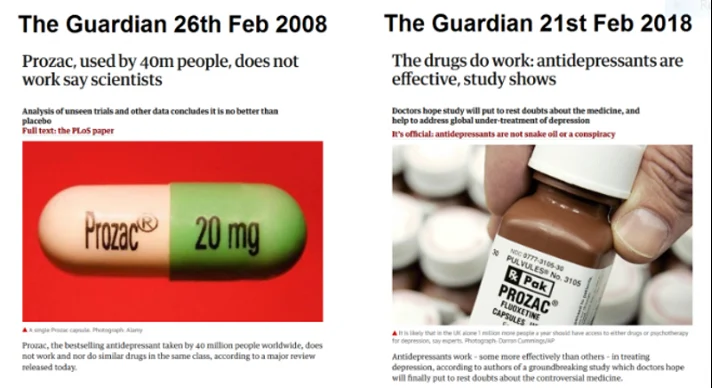
In 2018, a massive meta-analysis led by Andrea Cipriani was published in The Lancet. It concluded that all 21 antidepressants studied were more effective than placebo. The BBC and other major outlets hailed this as the "final answer" to the controversy. However, critics quickly pointed out that the effect sizes remained below the threshold of clinical significance and that the study relied on industry-funded trials prone to the aforementioned biases.
*2023–2024: The Re-Analysis of STARD*
Recent re-evaluations of the STARD study’s raw data have ignited a scandal. While the original 2006 reports claimed a 67% to 70% remission rate, a 2023 re-analysis published in BMJ Open found that the actual remission rate was significantly lower, and that the study had deviated from its original protocol to inflate success rates.
Supporting Data: Risks, Harms, and Statistical Manipulation
The argument against antidepressants is not merely that they are ineffective, but that they are actively harmful. Dr. Gøtzsche and his colleagues argue that the "Number Needed to Harm" (NNH) often outweighs the "Number Needed to Treat" (NNT).
The Risk of Suicide and Homicide
Meta-analyses of clinical study reports have shown that antidepressants double the risk of suicide in both children and adults. Despite this, many suicide prevention articles and psychiatric guidelines continue to ignore this data, focusing instead on the "risk of untreated depression." Furthermore, case studies and some clinical data suggest a link between SSRI use and increased aggression or homicidal ideation in a small but significant subset of users.
Physical and Sexual Dysfunction
One of the most persistent side effects of antidepressants is sexual dysfunction, affecting approximately 50% of users. In some cases, this dysfunction (PSSD—Post-SSRI Sexual Dysfunction) can become permanent even after the medication is discontinued. In the elderly, antidepressants are linked to an increased risk of falls and hip fractures. Given that one-fifth of elderly patients die within a year of a hip fracture, critics categorize antidepressants as a leading cause of indirect mortality.
The Withdrawal Crisis
The psychiatric establishment has long used "maintenance studies" to prove that patients need to stay on drugs to prevent relapse. In these studies, long-term users are suddenly switched to a placebo. When they crash, doctors call it a "relapse of depression." However, critics argue these are actually withdrawal symptoms. Data shows that roughly half of patients experience withdrawal when stopping antidepressants, and for half of those, the symptoms are severe.

Official Responses: The Defense of the Psychiatric Establishment
The psychiatric community and pharmaceutical manufacturers have not remained silent in the face of these critiques. Their defense generally rests on three pillars:
- The Severity Argument: Many psychiatrists concede that antidepressants may not be necessary for mild depression but insist they are "lifesavers" for severe depression. However, researchers like Gøtzsche counter this with data showing that even in severe cases, the Hamilton scale difference remains below the level of clinical significance (approx. 2.7 points).
- Individual Variation: A common response to low average effect sizes is that "some patients respond better than others." Psychiatrists argue that while the average benefit is small, for certain individuals, the drug is transformative. Critics dismiss this as "statistical variation," noting that if you give any ineffective treatment to enough people, some will naturally improve due to time or the placebo effect.
- The Meta-Analysis Consensus: Organizations like the Royal College of Psychiatrists point to the Cipriani study and others as proof of efficacy. They argue that the cumulative weight of hundreds of trials cannot be dismissed by a few "dissenting voices."
Implications: A Specialty in Crisis?
The allegations of "statistical alchemy" and "organized denial" suggest a profound ethical crisis within the field of psychiatry. If the critics are correct, the implications are far-reaching.
Public Health Impact
If antidepressants are the "third leading cause of death" after heart disease and cancer (as Gøtzsche argues, factoring in suicides and falls), then the current prescribing guidelines represent a massive public health failure. The widespread use of these drugs in children and the elderly would need to be immediately re-evaluated.
The Erosion of Trust
The STARD scandal and the perceived "industry capture" of journals like The Lancet* and organizations like the Cochrane Collaboration threaten to erode public trust in medical science. When "landmark" studies are found to have manipulated protocols to achieve desired results, it casts a shadow over the entire regulatory process.
The Need for Non-Drug Alternatives
The debate over antidepressants highlights a desperate need for a paradigm shift in mental health. If the chemical imbalance theory is increasingly viewed as an oversimplification and the drugs themselves are seen as ineffective, the focus must shift toward social, environmental, and psychological interventions.
In conclusion, the debate over antidepressants is no longer just about whether a pill works. It is a debate about the integrity of medical research, the influence of pharmaceutical money on clinical guidelines, and the fundamental way society addresses human suffering. As more researchers call for the retraction of fraudulent studies and the removal of certain drugs from the market, the psychiatric establishment faces a reckoning that may redefine the specialty for decades to come.