








The deadlift is often heralded as the "king of exercises." A foundational movement that recruits the glutes, hamstrings, quadriceps, traps, lats, and core, it is the ultimate barometer of posterior chain strength. Yet, despite its reputation for simplicity—the act of pulling a weighted barbell from the floor to a standing position—the deadlift is a movement of immense complexity. For many, the transition from lifting heavy to lifting correctly is a gap that leads to stagnant progress or, worse, debilitating injury.
To bridge this gap, one must look toward the masters of the craft. Sebastian Oreb, widely recognized as "The Australian Strength Coach," has spent years refining a technical system that has turned human potential into world-record-shattering performance. Most notably, Oreb is the architect behind the monumental success of Hafþór "Thor" Björnsson, the Icelandic giant who has redefined the limits of human strength, including his awe-inspiring 1,124-pound deadlift record.
Oreb’s philosophy is as egalitarian as it is elite. While many believe such techniques are reserved for the 200kg, 6-foot-9-inch giants of the Strongman world, Oreb insists that the biomechanics are universal. "The techniques that Thor uses," Oreb notes, "are the same techniques that I teach my daughter."
The Anatomy of a World-Class Deadlift: Key Technical Pillars
Mastering the deadlift is not about brute force; it is about efficiency, leverage, and anatomical alignment. Oreb’s methodology eliminates the guesswork, replacing "trying hard" with "moving smart." Below is a comprehensive breakdown of the technical system that has propelled some of the strongest humans in history.
I. Establishing the Base of Support: The Stance
The most frequent error observed in commercial gyms is a fundamental misalignment at the start of the lift. Many trainees position the barbell too far from their feet. When the bar is distant, the hips are forced to compensate, shifting forward to reach the metal. This creates a "rolling" effect, where the barbell travels in an arc rather than a straight vertical line.
"Then, you’ve got the ugly, seesaw kind of deadlift," Oreb explains. To mitigate this, Oreb advocates for a strict, hip-width stance. The barbell must be positioned directly over the midfoot. This midfoot placement serves as the "base of support." At maximal loads, the physics of the lift demand that the barbell remains in line with this base; if it drifts forward, the leverage becomes unfavorable, making the weight feel significantly heavier than it is.
II. Maximizing Leverage: The Lengthening of the Arms
Efficiency is the enemy of wasted energy. Oreb emphasizes the importance of keeping the arms long and straight. With legs extended, the arms should hang naturally, running parallel to the outside of the legs. This is not just a matter of aesthetics; it is a matter of travel distance.
If a lifter adopts a stance that is too wide, the arms are forced to angle outward, effectively shortening their reach. This creates a "long-range" lift, where the bar must travel a greater vertical distance to reach the lockout. Furthermore, Oreb warns against the common instinct to bend the elbows. "If they’re bent, your biceps are on, and your biceps are not strong enough to deadlift what your back can deadlift," Oreb cautions. This is the primary catalyst for bicep tears—an injury that can sideline an athlete for months. By keeping the arms straight, the lifter utilizes the skeletal structure to transfer force, sparing the vulnerable tendons of the elbow.
III. The Shin-Bar Contact: The Trigger for the Lift
One of the most persistent debates in strength training concerns hip height. How deep should the squat be before the pull? Oreb removes the subjectivity of this question by focusing on the shins.
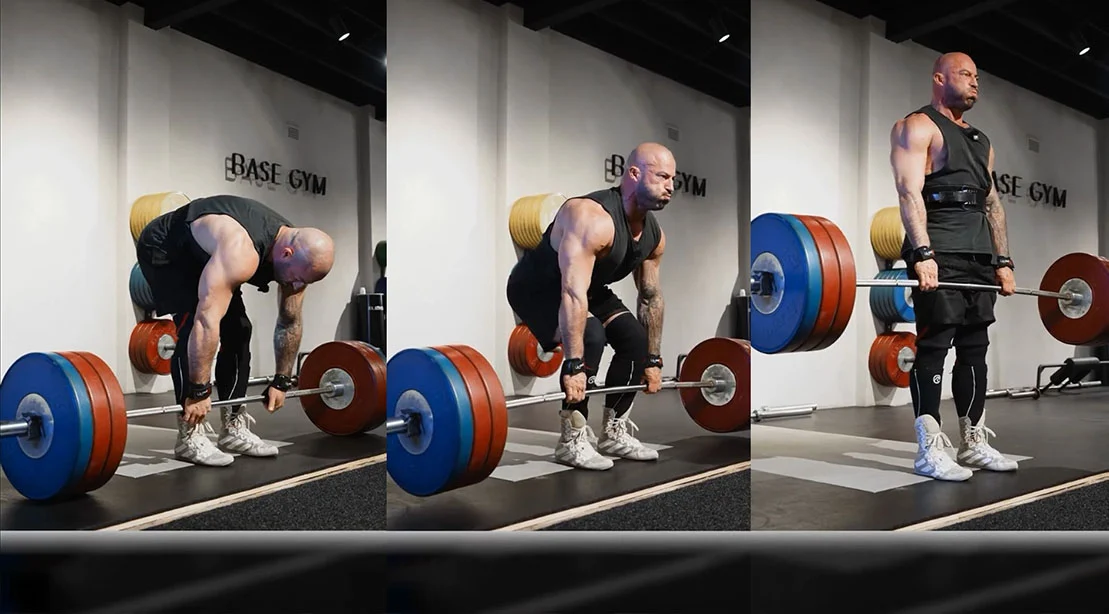
The process is simple: lower the hips and bend the knees until the shins gently make contact with the barbell. That point of contact is the bottom of the movement. It is crucial, however, that the shins do not shove the bar forward. If the bar moves, the "base of support" is lost. Once the shins are touching, the lifter should pull their armpits toward their pelvis to engage the lats. Crucially, the lats should hang forward rather than being aggressively retracted or "squeezed" back, which can ruin positioning.
With the crown of the head reaching toward the ceiling and a deep breath taken to brace the core, the lifter is ready. The final cue is the most important: "Push the world away, don’t pull the bar up."
Chronology of Excellence: From Iceland to the World Stage
The partnership between Sebastian Oreb and Hafþór Björnsson represents a paradigm shift in how strongman training is viewed by the public. When Björnsson first began working with Oreb, he was already a force of nature, but his technique was inconsistent under extreme load.
2018-2019: The Foundation Period
During this time, Oreb focused on refining Björnsson’s bracing techniques and his "pulling path." By emphasizing the "pushing the earth away" mantra, Oreb helped Thor stabilize his spinal alignment, allowing him to handle 400kg+ loads with significantly less risk of lower back strain.
2020: The Historic Record
The culmination of this technical refinement was the 501kg (1,104 lbs) deadlift in 2020. The lift was a masterclass in Oreb’s methodology: a perfect midfoot setup, straight arms, and a controlled, rhythmic pull.
2025 and Beyond
In the years since, Björnsson has continued to break his own records, including his latest 1,124-pound feat. This ongoing success highlights the durability of Oreb’s system. It is not a "quick fix" for a single competition; it is a sustainable, biomechanically sound system that grows with the athlete.
Supporting Data: Why Technique Outperforms Brute Force
Biomechanics dictate that for every inch the barbell drifts from the center of gravity (the midfoot), the torque required at the lower back increases exponentially.
- Load Distribution: When the bar is correctly positioned, the load is distributed across the hamstrings and glutes. If the bar drifts forward, the lumbar spine must carry the burden, increasing the risk of disc herniation.
- The Bicep Factor: The bicep is a flexor muscle, not a stabilizer. By maintaining a locked elbow position, the load is transferred through the humerus and the lats, which are capable of supporting massive amounts of weight compared to the small bicep tendons.
- Energy Efficiency: A deadlift is a vertical path. Any deviation—a forward shift or a seesaw motion—wastes energy. By optimizing the starting position, Oreb’s athletes save their anaerobic capacity for the hardest part of the lift: the lockout.
Official Responses and Public Reception
The viral nature of Oreb’s technical tutorials speaks to the hunger for quality information in the fitness community. Following his Instagram breakdown of the deadlift, the response was overwhelmingly positive. Industry professionals and amateur gym-goers alike lauded the clarity of his instruction.
"One of the best deadlift technique videos I have ever seen," commented a high-performance coach, echoing the sentiment of thousands. The detail-oriented approach—specifically the nuance regarding lat engagement and shin-to-bar contact—has become a gold standard in online coaching circles.
Implications for the Future of Strength Training
The implications of Oreb’s work extend far beyond the podium. For the average fitness enthusiast, these lessons represent a path toward longevity. By shifting the focus from "how much can I lift?" to "how well can I move?", Oreb is democratizing elite strength.
The "Australian Strength Coach" model proves that the same principles apply whether you are deadlifting 100kg or 500kg. As the fitness industry continues to evolve, the shift toward technical proficiency over ego-lifting is becoming more pronounced. With experts like Oreb leading the charge, the future of the deadlift is one where safety and record-breaking performance are no longer mutually exclusive.
Whether you are a beginner looking to set your first personal record or a seasoned lifter looking to refine your form, the message is clear: strip the weight back, respect the geometry of the lift, and, most importantly, learn to push the world away.
For those looking to continue their education, The Australian Strength Coach provides regular updates and in-depth coaching insights via his official Instagram account.