






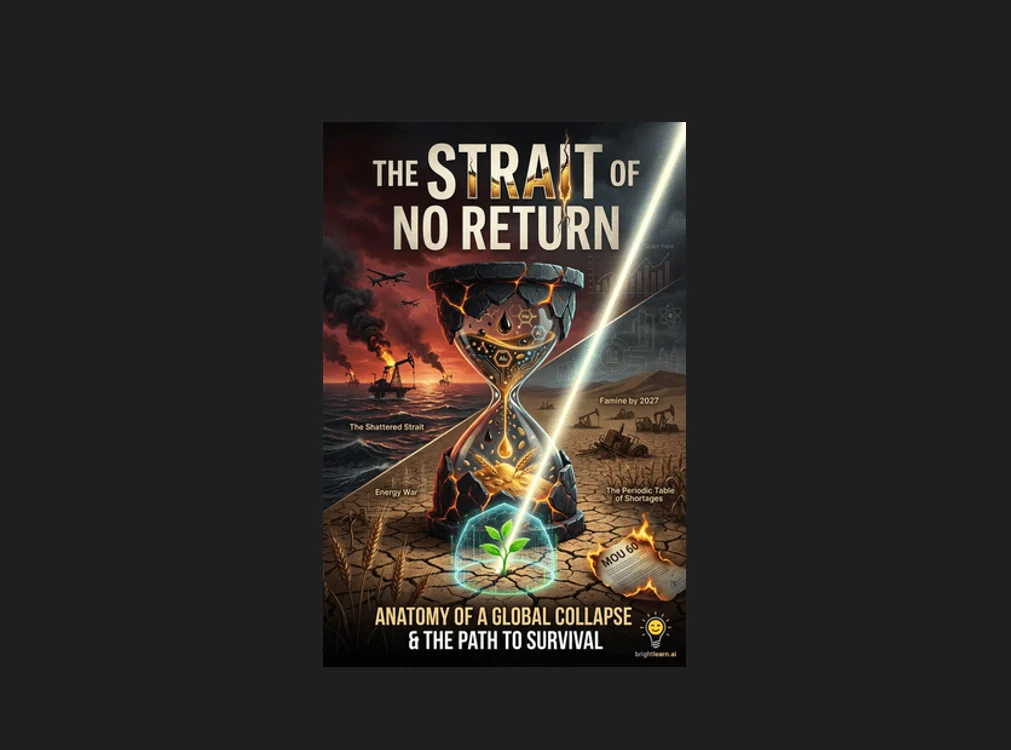
In the volatile landscape of modern geopolitics, few chokepoints command as much strategic terror as the Strait of Hormuz. A new, harrowing publication, The Strait of No Return: Anatomy of a Global Collapse and the Path to Survival, argues that we are not merely observing geopolitical friction, but are witnessing the slow-motion assembly of a global death trap. Written with the visceral intensity of a battlefield dispatch, the book serves as a diagnostic report on the fragility of modern civilization, detailing how a single regional conflict could trigger a cascading failure of global energy, food, and industrial supply chains.
The Trigger: A Chronology of Escalation
The authors present a chillingly plausible scenario that moves from the mundane to the apocalyptic in a matter of 24 hours. The narrative begins on February 26, a day of standard commercial activity where oil tankers navigate the Strait with customary routine. By February 27, the geography has been transformed into a high-intensity combat zone.
The book meticulously details the tactical shift: Iranian fast-attack craft saturate the shipping lanes, deploying sea mines that effectively render the waterway impassable. The authors highlight the "forensic data" of this collapse—AIS satellite trackers showing an abrupt cessation of maritime traffic, insurance premiums spiking by 400%, and the subsequent silence from global markets.
The text moves beyond the kinetic conflict to examine the political architecture that facilitated it. It highlights a series of "doomed" diplomatic efforts:
- The 60-Day MOU: A failed memorandum of understanding that served as a catalyst for mutual distrust.
- The Nuclear Sabotage: The assassination of a high-ranking Iranian nuclear scientist, which effectively terminated back-channel negotiations.
- The Economic Ultimatum: A 20% toll demand imposed by Tehran, which Western powers characterized as extortion, while Iranian leadership viewed the rejection as a colonial-era insult.
The authors posit that this was no accident. Rather, they argue that the war was a deliberate escalation—a trap set by hardline neoconservative factions and the military-industrial complex to manufacture a permanent state of conflict in the Middle East.
The Paper Tiger: The Myth of Naval Hegemony
A central pillar of the book’s argument is the obsolescence of current American military doctrine. The authors label the U.S. Navy a "paper tiger," arguing that a fleet designed for 20th-century blue-water engagements is fundamentally unequipped for the asymmetric, low-cost drone warfare of the 21st century.
Asymmetric Warfare and Economic Attrition
The evidence provided is staggering. The book contrasts the $20,000 cost of an Iranian swarm drone against the $2 million interceptor missiles used by U.S. destroyers. This "cost-exchange ratio" represents a logistical nightmare: the U.S. is essentially bankrupting itself by firing its most expensive assets at cheap, disposable, and numerous threats.
Furthermore, the authors draw on insights from analyst Mike Adams, who contends that the Pentagon has focused on massive, centralized platforms—such as super-carriers—that now function less as symbols of projection and more as "juicy targets" for modern anti-ship ballistic missiles. The overarching lesson, according to the book, is that the era of centralized, top-down military dominance is over. In its place, the authors advocate for decentralized, agile systems as the only viable path to strategic resilience.
The Periodic Table of Shortages: Industrial and Biological Impact
If the first half of the book is a military autopsy, the second half is a study in economic decay. The authors trace how the closure of the Strait of Hormuz acts as a "master switch" for global industrial processes.
The Helium Crisis and the AI Bubble
Most assume helium is a minor commodity used for party balloons. The book debunks this myth, explaining that helium is essential for cooling superconducting magnets in MRI machines and, more critically, in the manufacturing of semiconductor chips. With Qatar and other Gulf states unable to export, the book argues that:
- Healthcare systems would grind to a halt as diagnostic imaging capacity vanishes.
- The semiconductor industry would face a complete shutdown, effectively ending the current artificial intelligence boom, which relies on high-end processors that cannot be manufactured without stable helium supplies.
The Haber-Bosch Collapse: The Looming Famine
Perhaps the most visceral chapter in the book deals with the fragility of the global food supply. The authors explain the Haber-Bosch process—the chemical reaction that allows for the mass production of ammonia-based fertilizers.
"Roughly half of the world’s ammonia production relies on natural gas from the Persian Gulf," the authors note. Should the Strait close, the supply of feedstock for this process ceases. The implications are mathematical and terrifying:
- Yield Collapse: A loss of nitrogen fertilizer would trigger an estimated 30% to 50% drop in crop yields.
- The Seasonal Window: Agriculture operates on a rigid calendar. The authors demonstrate that if fertilizer does not reach farmers within a specific weeks-long window before planting, the harvest is lost entirely for the year.
- Global Reserves: Citing FAO reports from 2026, the book warns that global grain stocks are currently at their lowest point in decades, meaning there is no buffer to absorb a single failed harvest.
The authors present a grim forecast for India, Southeast Asia, and Sub-Saharan Africa, predicting that the resulting food scarcity will trigger mass migrations, internal civil unrest, and a scale of famine not seen in the modern era.
Implications for Global Stability
The implications of the book’s analysis are clear: the world is currently operating on "just-in-time" systems that have zero tolerance for error. By tying industrial manufacturing, medical diagnostics, and caloric intake to a single, vulnerable chokepoint, the global order has essentially gambled its survival on the continued cooperation of volatile regional actors.
The authors argue that the current diplomatic approach is failing because it treats these issues as separate, manageable crises, rather than a singular, interconnected systemic collapse. The "official" response from various Western intelligence and military agencies—often characterized by promises of "swift reopenings" and "military options"—is dismissed by the authors as dangerous wishful thinking that ignores the technical reality of modern mine warfare and electronic jamming.
The Path to Survival: Decentralized Resilience
The final chapters of The Strait of No Return shift from analysis to practical, survivalist instruction. The authors argue that since the centralized state is likely to fail in its duty to maintain supply chains, individuals and communities must pivot toward "decentralized resilience."
Actionable Strategies for Local Sustainability
The book provides a roadmap for those looking to buffer themselves against the inevitable shocks:
- Agricultural Autonomy: Moving beyond chemical dependence by learning techniques such as composting, biochar production, and the cultivation of medicinal herbs like garlic, echinacea, and chamomile.
- Energy Decentralization: Exploring biodiesel production from waste oils and small-scale solar manufacturing to replace the failing industrial supply chain.
- Mutual Aid Networks: The authors stress that "none of us can make it alone." They advocate for the formation of local cooperatives where skills—rather than fiat currency—become the primary medium of exchange.
- Stockpiling: While not encouraging hoarding, the book suggests the strategic acquisition of agricultural inputs like urea and DAP (diammonium phosphate) before they vanish from the market.
Conclusion: A Wake-Up Call
The Strait of No Return is not merely a critique of current policy; it is a desperate attempt to force a conversation about the precariousness of modern life. By connecting the dots between Persian Gulf natural gas, semiconductor fabrication, and global famine, the authors successfully paint a picture of a world that is far more fragile than its leaders are willing to admit.
Whether or not the specific, apocalyptic scenario described comes to pass, the book’s underlying thesis—that decentralization is the only hedge against systemic failure—is a compelling argument for a return to community-level self-sufficiency. As the authors conclude, the wreckage of civilization will be managed not by distant bureaucracies, but by those who prepared to function in the absence of the global grid.
For those interested in further study, the book can be accessed via Books.BrightLearn.AI. Additionally, visual analysis of the current tensions in the Strait of Hormuz, featuring insights from Daniel Davis and Mike Adams, is available on the Health Ranger Report.