











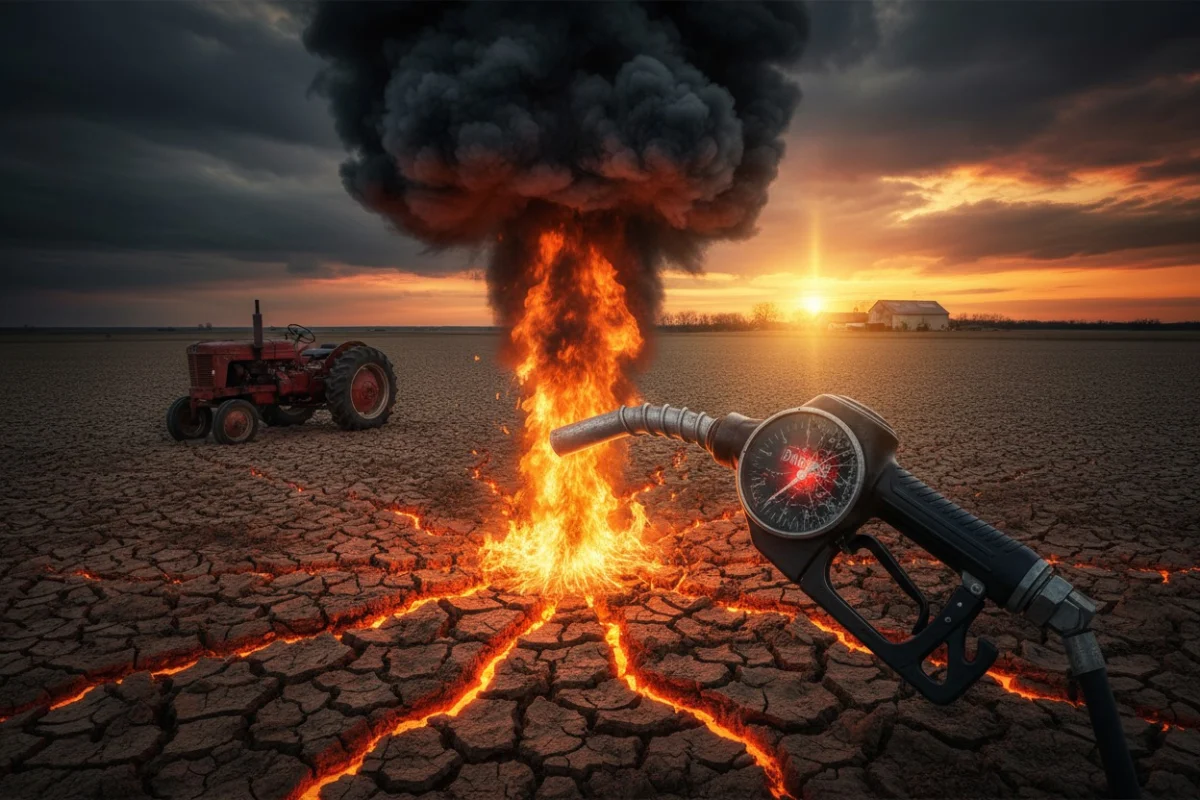
The American economy is currently navigating what many energy analysts are calling a "structural fuel collapse." While the public often focuses on the price of gasoline as the primary indicator of economic health, the true engine of the American supply chain—diesel—has reached a point of critical failure. With prices surging past $8 per gallon in regions like California and regional inventory levels hitting 70-year lows, the warning signs are no longer theoretical. The "diesel time bomb," long predicted by industry experts, has moved from a looming threat to a present, debilitating reality.
The Anatomy of the Crisis: It’s Not About Crude
To understand the current economic hardship, one must first dismantle the misconception that the crisis is tethered to crude oil availability. Crude oil is an inert raw material; it is useless until it undergoes the intensive process of refining into distillates such as diesel, heating oil, and jet fuel.
The economic barometer for this sector is the "diesel crack spread"—the delta between the cost of a barrel of crude and the market price of the refined product. When this spread widens to historic levels—reaching over $108 in recent weeks—it is a diagnostic signal that the bottleneck is not in the oil fields, but in the refineries. We are witnessing a fundamental lack of processing capacity. The market is screaming that we have successfully produced enough crude, but we have systematically dismantled the ability to turn that crude into the fuel that powers our civilization.
Chronology of a Managed Decline
The current fuel crisis is the culmination of years of policy shifts, geopolitical volatility, and corporate consolidation.
- 2019–2021: The Great Consolidation: As global demand shifted during the pandemic, several major U.S. refineries, including significant facilities in California owned by Phillips 66 and Valero, ceased operations. These closures removed approximately 429,000 barrels per day of refining capacity from the domestic market.
- Early 2022: The onset of geopolitical tensions in Eastern Europe and the Middle East began to strain global supply chains. The market entered a period of extreme volatility as Western nations moved to decouple from Russian energy.
- Late 2023: Refining inventory levels plummeted to a 25-day supply—the lowest level recorded for that time of year since 1951.
- 2024–Present: The "perfect storm" matured. Ongoing instability in the Strait of Hormuz, coupled with systematic drone strikes on Russian refining infrastructure, reduced global output. Domestic prices in California breached the $8 threshold, signaling a permanent shift in regional energy costs.
Supporting Data: The Logistics of Scarcity
The statistical reality behind the crisis is sobering. According to recent industry reports, the United States is operating on an razor-thin margin of distillate inventories. Because diesel is the primary fuel for heavy-duty transport, the "just-in-time" delivery model that defines modern retail is now under existential threat.
Data indicates that the cost of shipping goods has risen in direct correlation with the diesel crack spread. Every movement of an 18-wheeler, every cycle of an agricultural tractor, and every hour of construction equipment operation is now subjected to an inflationary tax that is passed directly to the consumer. Agricultural experts note that in the Corn Belt, the cost of a single pass over a field with a tractor has escalated to a point where it threatens the profitability of entire seasons, forcing farmers to consider leaving acreage fallow.
Official Responses and Political Rhetoric
The response from the political class has been characterized by a distinct disconnect from the logistical realities on the ground. For years, official narratives downplayed the significance of refinery closures, labeling them as temporary market adjustments. Statements regarding the stability of the Strait of Hormuz and the supposed "defeat" of energy supply threats in the Middle East have repeatedly failed to manifest in lower consumer prices.
While the administration has focused on geopolitical maneuvering and the promotion of a transition to renewable energy, there has been a notable lack of policy addressing the immediate "middle-mile" infrastructure deficit. Critics argue that by prioritizing decarbonization goals without first ensuring a bridge of fuel security, the government has essentially accelerated the "demand destruction" phase of the energy crisis. Families are being priced out of their livelihoods, and small-scale logistics firms are folding under the pressure of overhead costs that have doubled in less than 24 months.

Implications for the American Economy
The consequences of this diesel shortage extend far beyond the gas pump. Because diesel is the fuel of "physical reality," its scarcity is the primary driver of the current inflationary cycle.
1. The Agricultural Threat
The agricultural sector is the most vulnerable. Diesel powers the irrigation pumps, the combines, and the long-haul trucks that move produce from the farm to the urban center. When these inputs become prohibitively expensive, food prices do not merely rise; they experience a structural reset. If farmers cannot afford to plant, the resulting supply shocks will be felt in grocery stores for years to come.
2. The Construction and Housing Squeeze
Construction is an energy-intensive industry. From the transport of raw materials like cement and steel to the operation of heavy machinery at excavation sites, diesel is the primary fuel for development. As the cost of logistics rises, developers are canceling projects, leading to a stagnation in housing starts and a further tightening of the supply-side of the economy.
3. The Move Toward Decentralization
In response to these macro-level failures, a grassroots shift toward energy independence is taking shape. The current consensus among those preparing for long-term hardship is that reliance on a centralized, state-managed energy grid is a strategic vulnerability.
Many individuals and small-scale farmers are pivoting toward "decentralized energy." This includes the adoption of residential solar systems and battery storage, which allow for the generation of electricity that is immune to fuel-market volatility. While these solutions are not a replacement for heavy industrial diesel use, they represent a psychological and logistical shift: citizens are choosing to insulate themselves from the fragility of the national grid.
The Road Ahead: A New Era of Energy Reality
The era of cheap, abundant fossil fuels is undergoing a painful, forced transition. The current crisis is not a temporary hiccup in the supply chain; it is a permanent loss of capacity that will require years to rectify—if it can be rectified at all.
As refineries remain offline and geopolitical tensions continue to constrict global energy flows, the United States faces a prolonged period of economic contraction. The path forward requires a fundamental reassessment of how we manage our critical infrastructure. Until policymakers prioritize the domestic production and processing of energy over ideological goals and foreign entanglements, the American consumer will remain trapped in a cycle of volatility.
For the individual, the lesson is clear: the safety net of a centralized, government-managed economy is fraying. True security in the coming years will likely be found in self-reliance, local food production, and the adoption of decentralized energy technologies. The "diesel time bomb" has already detonated; the question now is how citizens will rebuild in the wake of the blast.