







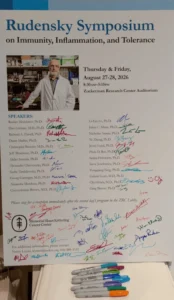

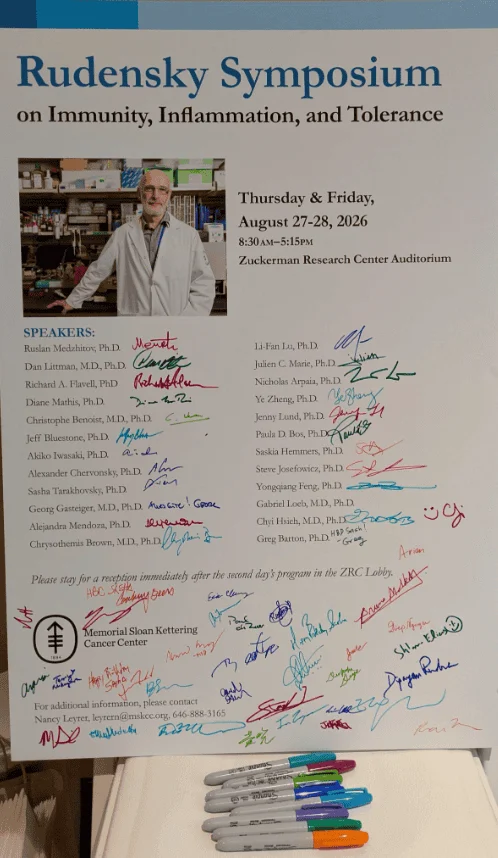
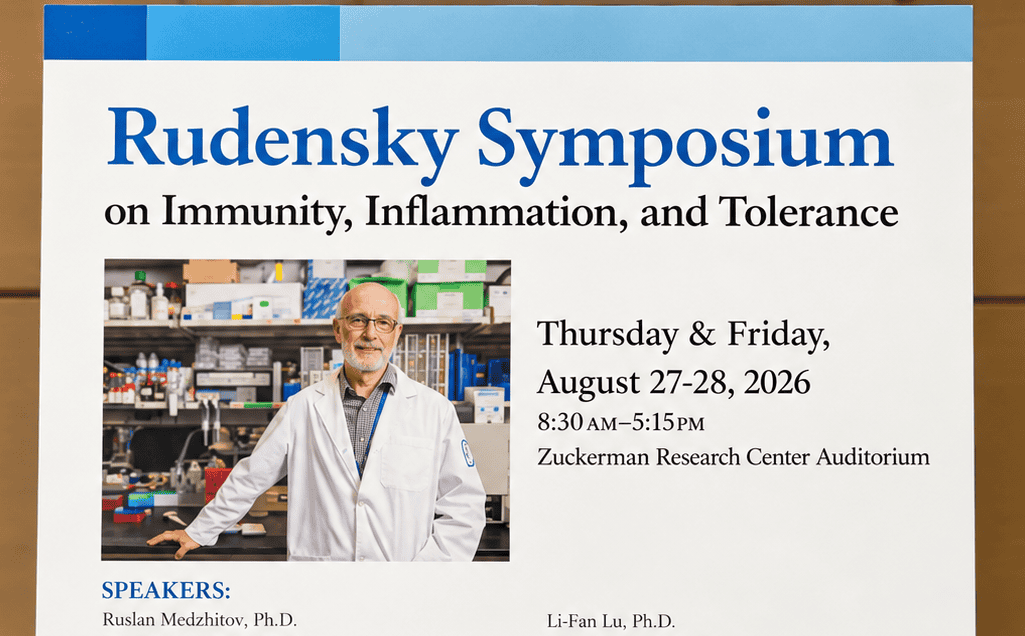
On August 27–28, 2026, the scientific community converged for a landmark event that transcended the standard academic conference. The "Rudensky Symposium on Immunity, Inflammation, and Tolerance" was held not merely to discuss the frontiers of immunology, but to celebrate the 70th birthday of a giant in the field: Alexander “Sasha” Rudensky, PhD, of the Memorial Sloan Kettering Cancer Center.
More than a professional milestone, the symposium served as a living map of a scientific lineage. Former trainees, lifelong collaborators, and esteemed colleagues gathered to weave together decades of shared research, mentorship, and friendship. For the Cancer Research Institute (CRI)—which has supported Dr. Rudensky’s pioneering work for over two decades—the event was a poignant reminder that the most profound breakthroughs in cancer treatment are rooted in a deep, fundamental understanding of how the immune system maintains the body’s internal balance.
The Genesis of a Scientific Legacy
The history of Dr. Rudensky’s career is intrinsically linked to the evolution of modern immunology. His work, particularly in the domain of regulatory T cells (Tregs), has fundamentally altered our understanding of how the body prevents autoimmunity while maintaining the vigilance necessary to combat malignancy.
In 2015, the Cancer Research Institute bestowed upon Dr. Rudensky the prestigious William B. Coley Award for Distinguished Research in Basic and Tumor Immunology. This recognition underscored his role in defining the molecular mechanisms that allow Tregs to restrain excessive immune responses—a protective mechanism that, when hijacked by cancer, becomes a primary barrier to successful immunotherapy.
The symposium served as a platform to honor this legacy, highlighting a network of over a dozen CRI-funded fellows who have trained in the Rudensky lab. These scientists, now leaders in their own right, represent the "ripple effect" of long-term research investment. By supporting basic science—research that seeks to understand the fundamental laws of biology without an immediate mandate for clinical application—CRI has helped build the intellectual infrastructure that makes today’s immunotherapy possible.
Chronology of Insights: From Tissue Homeostasis to Cancer
The symposium’s agenda was meticulously curated to reflect the interconnectedness of biological systems. Rather than compartmentalizing "cancer research" as a silo, the speakers illustrated that the processes governing tissue repair, gut health, and immune tolerance are the very same processes that dictate how tumors develop, evolve, and resist therapy.
The Maintenance Crew: Immunity and Tissue Balance
The event opened with a focus on "housekeeping." Dr. Ruslan Medzhitov, a 2003 CRI Coley Awardee, set the tone by reframing the immune system’s role. He presented research on how stressed cells recruit macrophages to clear out damaged protein "garbage." This shift in perspective portrays immune cells not just as soldiers defending against infection, but as essential maintenance crews that preserve tissue integrity.
Building on this, 2024 CRI Coley Awardees Dr. Diane Mathis and Dr. Christophe Benoist provided deeper nuance into Treg function. Dr. Mathis detailed how specific Treg populations facilitate muscle repair and manage scarring post-injury, while Dr. Benoist’s work highlighted how the molecular targets recognized by a Treg determine its unique functional identity. These presentations were critical: they established that immune restraint must be surgically precise. If the restraint is too weak, the body succumbs to autoimmunity; if it is too strong, it provides the "cover" that allows cancer to escape detection.
Early Intervention: Catching Cancer in the Cradle
One of the most compelling segments of the symposium explored the "pre-cancerous" state. Dr. Richard A. Flavell, a 2012 CRI Coley Awardee, shared findings from his research into intestinal stem cells. By utilizing mouse models, his team observed the competitive survival of cells carrying a BRAF mutation—a common cancer driver.
Crucially, the research suggested that the immune system is actively involved in "editing" these abnormal cells before a tumor ever becomes visible. When these mutant cells lost the ability to communicate with T cells, they gained a significant advantage in occupying the intestinal niches. This suggests a future paradigm where we might intervene during the earliest stages of oncogenesis, long before clinical symptoms appear.
Parallel to this, Dr. Julien C. Marie investigated the plasticity of inflammatory cells. By disrupting the TGF-β signaling pathway in intestinal Th17 cells, his team observed these cells entering a state of persistent inflammation that led to DNA damage and cancer. The fact that restoring these signals could reverse the inflammatory program offers a glimmer of hope for therapeutic interventions that "reset" the cellular environment before cancer takes hold.
The Ecosystem of the Tumor
As the symposium progressed, the discussion shifted from the cellular level to the systemic "ecosystem" of the tumor. The consensus was clear: a tumor is not an island; it is an active participant in its surrounding microenvironment.
The Microbiome and Systemic Immunity
Dr. Dan Littman, a CRI SAC member and 2016 CRI Coley Awardee, presented foundational work on the gut-tumor axis. His research has shown that gut bacteria serve as "trainers" for T cells, directly influencing the efficacy of checkpoint immunotherapy. This confirms that a patient’s systemic immune health—often dictated by the microbiome—is a primary variable in the success of cancer treatment.
Structural Barriers to Treatment
The role of the tumor’s physical environment was brought to the fore by Dr. Paula D. Bos. She demonstrated that Tregs don’t just suppress immune cells; they alter the physical scaffolding of the tumor. By removing Tregs in preclinical models, her team was able to shift macrophages toward a tumor-fighting state and dissolve the aligned collagen fibers that act as "escape routes" for metastatic cells. This research is vital because it moves us away from the blunt instrument of systemic Treg depletion and toward specific, targeted interventions that neutralize the tumor’s protective barriers.
Engineered Neighborhoods
Finally, Dr. Nicholas Arpaia discussed the "neighborhood" effect. His team identified specific fibroblasts that act as architects of immune-suppressive zones around lung tumors. In a brilliant synthesis of fields, he showcased collaborative work with CRI Lloyd J. Old STAR awardee Dr. Tal Danino. They are currently utilizing engineered bacteria to deliver therapeutics directly into the tumor core. This approach aims to maximize the concentration of immune-modulating drugs exactly where they are needed, minimizing toxic side effects.
Implications for Future Oncology
The Rudensky Symposium provided a masterclass in why basic science matters. The progress showcased—ranging from understanding macrophages as janitors to engineering bacteria as drug-delivery systems—was not the result of a single "eureka" moment. It was the result of a scientific culture that values rigorous questioning, mentorship, and the freedom to follow data into uncharted territory.
The implications for patients are profound. We are moving toward a future where cancer prevention may involve modulating the inflammatory state of tissues, where immunotherapy efficacy is optimized by managing the gut microbiome, and where tumors are dismantled by targeting the very structural and cellular neighborhoods they build for protection.
A Commitment to the Future: The CRI Perspective
The symposium served as a bridge between the past 70 years of immunology and the next generation of breakthroughs. For the Cancer Research Institute, supporting Dr. Rudensky and his "research family" has been an investment in the people who form the backbone of the scientific community.
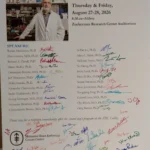
As the conference concluded, the sight of a poster board covered in signatures from former students and colleagues served as a tangible manifestation of the "ripple effect." The symposium reinforced the reality that scientific progress is a relay race. Trainees become mentors, foundational discoveries in basic biology evolve into clinical trials, and collaboration transforms the seemingly impossible into the routine.
The Rudensky Symposium was more than a birthday celebration; it was a testament to a career defined by service to science. By fostering an environment where ideas are challenged, tested, and refined, Dr. Rudensky has not only expanded our knowledge of the immune system—he has helped train the very minds that will continue the fight against cancer for decades to come. The goal remains unified: to understand the complex language of the immune system so completely that we can finally speak it to cure cancer.