







In a significant leap for wearable health technology, researchers at The Hong Kong University of Science and Technology (HKUST) have unveiled a breakthrough in bio-integrated electronics. The team has developed the “HELP” (heteromodal epidermal liquid-metal patch), a soft, skin-like device capable of simultaneously tracking heart activity and respiratory patterns with clinical-grade precision. By leveraging liquid-metal technology and a bioinspired anchoring system, the HELP patch promises to shift the paradigm of chronic disease management from reactive hospital visits to proactive, continuous home-based monitoring.
The Core Innovation: Bridging Sensitivity and Stability
For years, the field of flexible electronics has been stalled by a persistent technical paradox: the “sensitivity-stability trade-off.” Wearable sensors are typically composed of elastic substrates embedded with conductive materials. While liquid metals—such as gallium-based alloys—offer excellent conductivity and the ability to deform alongside human skin, they are notorious for their poor adhesion to elastic surfaces. Under the strain of daily movement, these materials often slide, migrate, or detach, leading to significant signal distortion and “noise” that renders the data unreliable for medical diagnosis.
The HKUST team, led by Assistant Professor Hnin Yin Yin Nyein of the Department of Chemical and Biological Engineering, has successfully bypassed this limitation. Their solution centers on a bioinspired anchoring strategy that mimics the hierarchical, interlocking structures found in the feet of geckos.
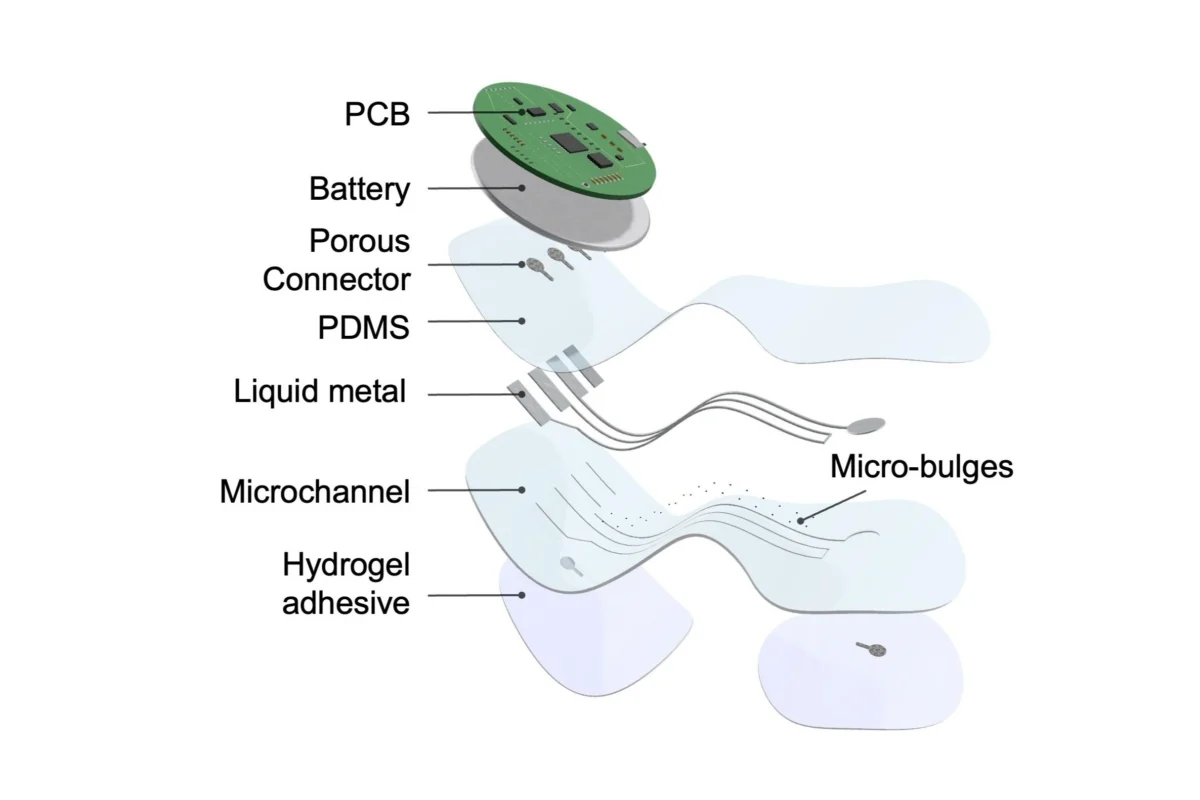
By pre-depositing a sophisticated network of microscopic silver nanowires onto a flexible silicone base, the researchers created a physical and chemical “anchor” for the liquid metal. This interlocking structure prevents the liquid metal from shifting during bodily movement, ensuring that the sensor maintains its integrity even after 500,000 stretching cycles. This durability is crucial for a device intended to be worn for extended periods, providing a consistent, drift-free stream of data that can be trusted by healthcare providers.
Engineering the “Analog Constriction Gate”
Beyond its mechanical stability, the HELP patch features a proprietary “analog constriction gate” architecture. This design includes a series of graded, dome-like microbulges positioned along the device’s breathing channel.
As a patient breathes, their chest wall expands and contracts. As the user’s chest expands, these micro-gates sequentially constrict the flow path of the liquid metal. This mechanism amplifies the signal, allowing the device to detect even the most minute physiological changes—such as a shallow resting breath that exerts less than 0.01% chest strain—without any signal interference. This level of sensitivity is rare in thin-film wearables and puts the HELP patch on par with the bulky, wired sensors typically found in sleep laboratories.
Chronology of Development and Pilot Validation
The path to the HELP patch’s current iteration involved rigorous testing and iterative engineering.
- Initial Conceptualization: The HKUST team began by identifying the failure points of existing liquid-metal sensors, specifically the signal drift caused by substrate incompatibility.
- Bio-mimicry Research: Inspired by the hierarchical adhesion of biological organisms, the team spent months perfecting the silver nanowire network, determining the optimal density and structure to maximize grip without compromising the device’s flexibility.
- Stencil-Brushing Process: To ensure the technology could move from the lab to the real world, the team developed a scalable, cost-effective manufacturing process known as "stencil-brushing." This allows for rapid production of the patches at a fraction of the cost of traditional clean-room electronics.
- Clinical Pilot Phase: In recent clinical trials, the HELP patch was tested against gold-standard hospital polysomnography (PSG) equipment. The results showed strong correlation, confirming that the patch could reliably detect sleep apnea events and track the efficacy of bronchodilator treatments in asthma patients in real time.
Supporting Data and Technical Specifications
The HELP patch is characterized by its dual-channel architecture. The first channel is specifically optimized for electrocardiogram (ECG) heart signal acquisition, while the second, U-shaped channel is dedicated to capturing thoracic and abdominal wall movement.
The integration of these two data streams provides a comprehensive picture of a patient’s cardiorespiratory health. By analyzing the interplay between heart rate variability and respiratory rhythm, the device can provide insights into autonomic nervous system function—a vital metric for managing conditions like Chronic Obstructive Pulmonary Disease (COPD) or heart failure.
The mechanical resilience of the patch is perhaps its most impressive feature. In laboratory stress tests, the device retained its electrical conductivity and signal fidelity after half a million deformation cycles. This suggests a potential service life that far exceeds current commercial fitness trackers, which often lose calibration or structural integrity after a few months of heavy use.

Official Perspectives: Shifting the Clinical Paradigm
The development of the HELP patch represents more than just an engineering feat; it represents a fundamental change in how clinicians view “hidden” symptoms.
Dr. Hnin Yin Yin Nyein emphasizes that the greatest value of the HELP patch lies in its ability to observe the patient in their natural environment—specifically during sleep. “What is particularly rewarding about our clinical pilot results is seeing how continuous home monitoring can capture hidden symptoms,” Dr. Nyein noted in a release.
She points to the example of COPD patients, whose daytime clinical assessments often suggest normal oxygen levels. This is frequently a false positive caused by the body’s active, conscious compensation while the patient is awake. “Our patch unmasks these physiological changes as the body relaxes during sleep,” Nyein explains, “enabling proactive rather than reactive care.”
By moving the point of care from the doctor’s office to the patient’s home, the HELP patch could reduce the burden on healthcare systems, minimize hospital readmission rates, and improve the quality of life for millions of people living with chronic, long-term health challenges.
Implications for the Future of Telemedicine
The implications of the HKUST research are far-reaching. As the global population ages and the prevalence of chronic respiratory and cardiovascular conditions rises, the demand for affordable, remote diagnostic tools has never been greater.
1. Enhanced Diagnostic Accessibility
The stencil-brushing manufacturing process ensures that the HELP patch can be mass-produced, making it an economically viable option for patients in both developed and resource-limited settings. This accessibility could bridge the gap in healthcare equity, providing high-quality diagnostic data to those who live far from urban medical centers.
2. Personalized Medicine
Because the patch is designed for continuous wear, it can establish a patient-specific baseline. Rather than comparing a patient to a population average, physicians can track changes relative to the patient’s own healthy state, allowing for the detection of subtle health declines weeks or months before a major medical event occurs.
3. Integration with AI and Digital Health
The continuous, high-fidelity data stream provided by the HELP patch is an ideal candidate for integration with artificial intelligence (AI) algorithms. Future applications could see these patches connected to smartphone apps that provide real-time alerts to caregivers or automatically adjust medication dosages or oxygen flow in connected medical devices.
Conclusion
The HKUST HELP patch represents a triumph of materials science and bioengineering. By solving the age-old problem of liquid-metal instability through a clever, nature-inspired anchoring system, the team has created a tool that is not only robust and sensitive but also practical for mass adoption.
As we look toward the future of medicine, devices like the HELP patch will likely become the cornerstone of a new, decentralized healthcare ecosystem. By empowering patients to monitor their own physiological metrics with the accuracy of a hospital lab, we are entering an era where healthcare is no longer confined to the sterile rooms of a clinic, but is seamlessly woven into the fabric of our daily lives.