









For years, Dr. Gabrielle Fundaro lived by a rigid set of numerical mandates. As a professional with a PhD in Human Nutrition, over a decade of coaching experience, and a competitive powerlifting career, she was the archetype of the data-driven athlete. Her life was measured in grams of protein, carbohydrates, and fats.
Yet, beneath the veneer of expert-level control, a crisis was brewing. The very tool she used to ensure her physique—macro tracking—had become a source of profound anxiety. "I worried that if I stopped tracking macros, I would lose my physique," she admits.
This tension—between the perceived safety of external data and the desire for intuitive freedom—is a struggle shared by millions of fitness enthusiasts. However, Dr. Fundaro’s solution, an innovative framework known as "RPE-Eating," is now offering a viable "off-ramp" for those desperate to escape the cycle of compulsive tracking.
The Chronology of a Shift: From Data to Instinct
Dr. Fundaro’s journey toward this new methodology was not an overnight epiphany; it was the result of a long, wearisome cycle of diminishing returns. For years, she relied on macro counting to stay "on track." It was effective for her powerlifting goals until the psychological cost outweighed the physiological benefits.
The breaking point was not a sudden loss of muscle or a metabolic crash, but a loss of autonomy. She grew tired of the mental arithmetic required to dine out and the pervasive fear that a single unmeasured meal would lead to an immediate loss of progress. Every attempt to quit tracking was met with a cascade of "what-ifs": What if I don’t eat enough protein? What if I gain fat? What does it say about my expertise if I can’t maintain my body without an app?
The breakthrough arrived at the gym. While training, Dr. Fundaro began utilizing the Rate of Perceived Exertion (RPE) scale—a tool used in strength sports to quantify effort based on internal feedback rather than just the weight on the bar. She noticed that when she listened to her body’s feedback, she was not only training safely but recovering more efficiently.
The realization was sudden: If RPE could regulate the extreme physical output of powerlifting, could a similar framework govern the daily act of eating? Thus, the RPE-Eating scale was born.
Supporting Data: Understanding the RPE Framework
To understand why this shift is gaining traction, one must look at the origin of RPE. Invented by Gunnar Borg in the 1960s, RPE was designed to bridge the gap between subjective experience and objective performance. While originally a 6–20 scale for clinical physiotherapy, it has been modernized into a 0–10 scale that is now a staple in high-level athletic training.
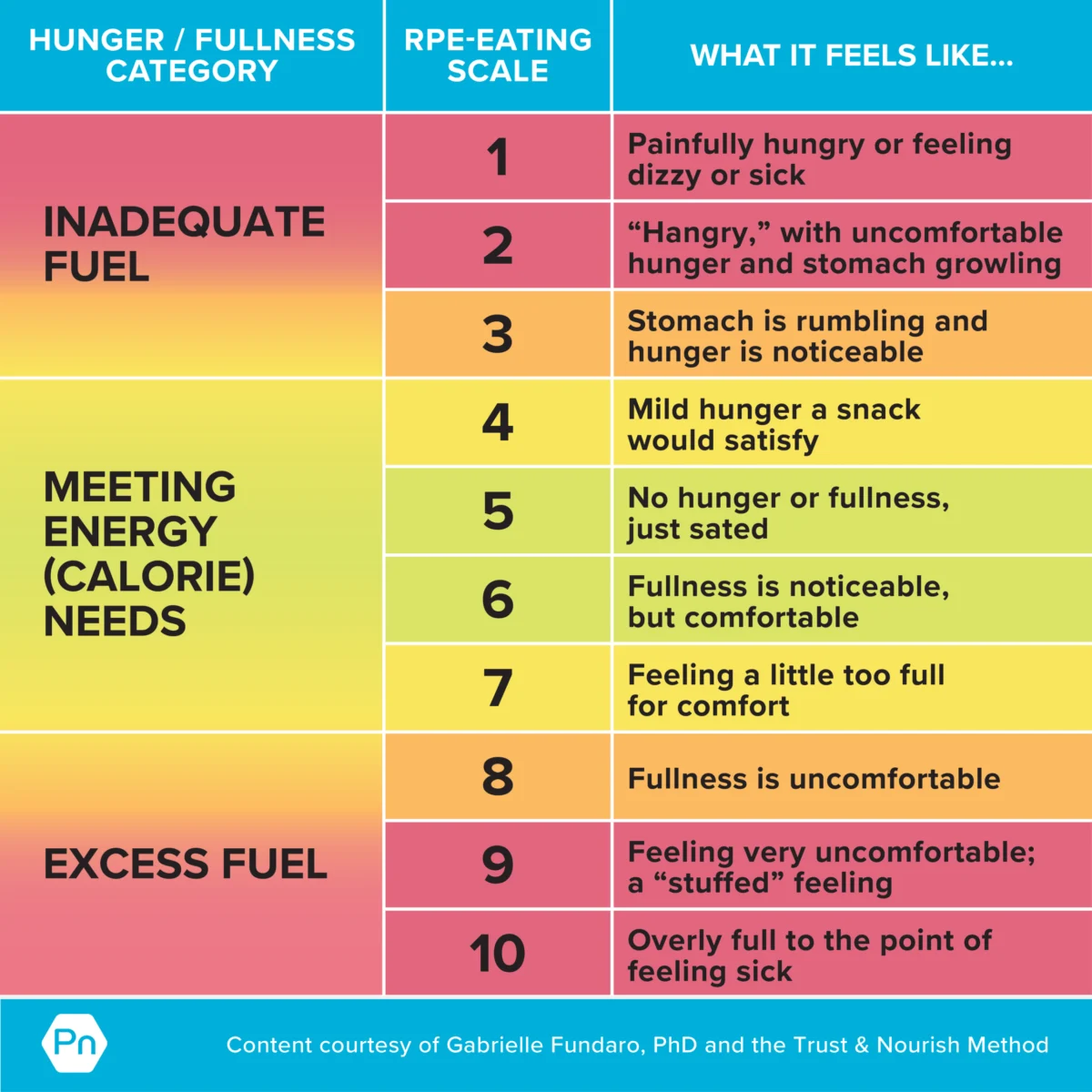
Dr. Fundaro adapted this into a hunger-fullness spectrum. The logic is rooted in interoceptive awareness—the physiological ability to perceive the internal state of the body.

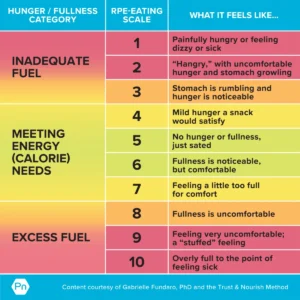
The RPE-Eating Spectrum
- 1–2 (Empty/Hangry): Painful hunger, dizziness, or physical discomfort.
- 3–4 (Noticeable Hunger): Mild hunger; the body is signaling for fuel.
- 5 (Sated): The neutral zone; no hunger, no fullness.
- 6–7 (Comfortably Full): The ideal stopping point for most meals.
- 8–10 (Stuffed/Sick): Physical distress resulting from overconsumption.
The data supports the notion that human bodies are highly efficient at regulating energy intake when they are not conditioned to ignore internal cues. By shifting the focus from an external "macro target" to an internal "satiety signal," individuals can theoretically maintain a healthy body composition without the mental tax of a food log.
Official Perspectives: The Philosophy of Autonomy
Dr. Fundaro emphasizes that RPE-Eating is not a "diet" in the traditional sense. It is a pedagogical tool designed to retrain the brain. "It’s not about aiming to change your body," she notes. "It’s about sensing into what your body needs and building inner trust."
A Four-Step Approach to Implementation
- Clarifying Goals: Recognize that this method is about self-trust rather than "optimal" physique manipulation. It is a tool for long-term health, not necessarily short-term competitive prep.
- Identifying Hunger vs. Appetite: The methodology forces a distinction between hunger (a physiological need for energy) and appetite (the desire to eat based on pleasure or external triggers).
- Recognizing Non-Hunger Triggers: Using the "Notice and Name" technique, practitioners learn to identify when they are eating due to stress, boredom, or environmental cues rather than biological necessity.
- Balancing Satiety and Satisfaction: A critical distinction in the framework. Satiety is physical fullness; satisfaction is emotional fulfillment. By intentionally including foods that are pleasurable, the practitioner reduces the "pendulum effect"—the tendency to restrict and then binge.
Implications for the Fitness Industry
The adoption of RPE-Eating carries significant implications for the fitness industry, which has long been dominated by "if it fits your macros" (IIFYM) culture.
The Safety Net
For individuals with a history of disordered eating, yo-yo dieting, or extreme body dissatisfaction, the pressure of tracking can be a significant psychological trigger. Dr. Fundaro argues that RPE-Eating provides a "safety net" that traditional tracking cannot. By encouraging the practitioner to pay attention to their feelings—both physical and emotional—it creates a buffer against the rigid, binary thinking that often leads to eating disorders.
The "Feelings vs. Facts" Argument
Critics often label RPE-Eating as "feelings over facts." However, this criticism overlooks the scientific validity of autoregulation. Just as the bar speed in a squat indicates proximity to failure, the absence of hunger at the end of a meal is a biological indicator of metabolic satisfaction. Using internal cues is not "guessing"; it is the application of biological feedback loops that have guided human survival for millennia.
Challenges and Limitations
The framework is not a panacea. It requires a level of mindfulness and labor that many modern, busy individuals may find challenging. It is difficult to practice a "leisurely, mindful meal" while managing a career or raising children. Furthermore, for athletes in weight-class sports (like powerlifting or bodybuilding), RPE-Eating is insufficient for the precise requirements of a contest prep. As Dr. Fundaro aptly puts it, using RPE-Eating for an elite bodybuilding show is "like using physio exercises to prepare for a powerlifting competition."
Conclusion: A Shift Toward Sustainable Health
The transition away from macro tracking is often marked by fear—a fear of losing control, a fear of the unknown, and a fear of the body itself. However, the success of RPE-Eating suggests that the most sustainable "nutrition plan" is one that an individual can maintain without an app.
By providing a structured yet flexible language for internal sensations, Dr. Fundaro is not just teaching people how to eat; she is teaching them how to trust their own biological signals. In a world where nutrition advice is often overwhelming and contradictory, the most reliable expert might just be the one living inside your own skin.
For those trapped in the cycle of constant tracking, RPE-Eating offers a path forward: a way to nourish the body while reclaiming the peace of mind that comes with knowing you are truly in control, no calculator required.