




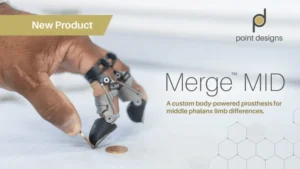


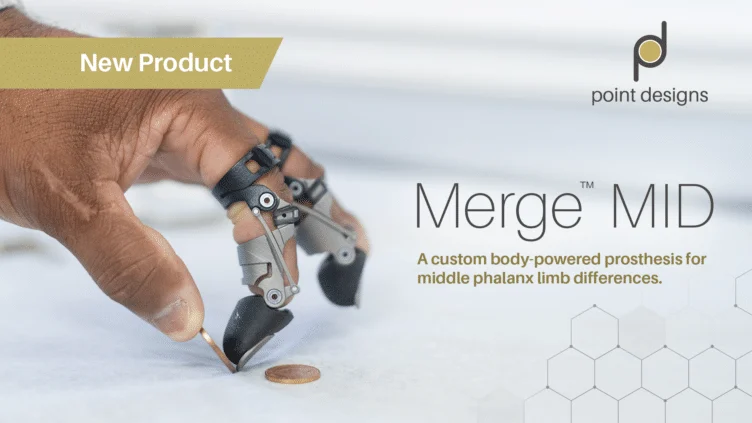
Boulder, Colorado – [Insert Date of Publication, e.g., October 26, 2023] – Point Designs, a pioneering force in advanced prosthetic solutions, has announced the official launch of the Merge MID, a custom body-powered finger prosthesis meticulously engineered to revolutionize functional restoration for individuals experiencing middle-phalanx amputations of digits 2 through 5. This groundbreaking device is set to address a long-standing clinical gap, offering renewed independence and enhanced quality of life to a patient population historically underserved by conventional prosthetic technologies.
The introduction of the Merge MID marks a significant milestone in the field of partial-hand prosthetics, combining Point Designs’ renowned expertise in precision engineering with a deep understanding of patient-centered design. While approximately 13,000 patients annually suffer middle-segment amputations, a startlingly low figure of less than 4% currently receive any form of prosthetic solution. The Merge MID directly confronts this disparity, bringing a proven engineering approach to body-powered devices that integrate seamlessly with a patient’s residual anatomy, offering intuitive and reliable function.
"We’ve always been driven by a single mission: to restore function and independence for people with partial-hand amputation," stated Levin Sliker, Vice President and General Manager of Point Designs. "Merge MID expands that mission into a category we hadn’t yet addressed: body-powered solutions. It reflects our commitment to rigorous engineering, clinical collaboration, and genuine patient-centered design, delivering something that works—really works—for everyone involved." Sliker’s remarks underscore the company’s dedication to innovation driven by tangible patient needs, pushing the boundaries of what is possible in prosthetic care.
A New Era for Partial-Hand Amputation Care
The launch of the Merge MID is not merely the release of a new product; it signifies a pivotal moment in the evolution of prosthetic care for partial-hand amputations. Historically, the focus of prosthetic development has often centered on full limb loss or major joint replacements, leaving the nuanced and complex challenges of partial-hand and partial-finger amputations relatively overlooked. This new offering from Point Designs brings much-needed attention and a sophisticated solution to a specific, yet prevalent, type of limb difference.
The Unmet Need: A Clinical Imperative
The statistics are stark and reveal a critical unmet need within the healthcare landscape. With an estimated 13,000 individuals experiencing middle-segment amputations each year, the vast majority—over 96%—are left without a prosthetic intervention. This deficit can be attributed to several factors, including the perceived complexity of fabricating functional prostheses for smaller, more intricate hand segments, the limitations of existing technologies, and perhaps, a lack of awareness regarding the significant impact these seemingly minor amputations can have on a person’s life.
Middle-phalanx amputations, affecting the central segment of a finger, can severely compromise a person’s ability to perform everyday tasks. Simple actions like grasping, pinching, typing, holding utensils, or even dressing oneself become challenging, leading to frustration, reduced independence, and often, a significant decline in quality of life. The psychological burden can be equally profound, impacting self-esteem, body image, and social interactions. The Merge MID emerges as a beacon of hope for this population, promising to bridge the gap between their current limitations and a future of restored function.
Introducing the Merge MID: A Fusion of Innovation and Function
The Merge MID is specifically designed for patients who have undergone amputations through the middle phalanx of their second through fifth digits. Crucially, successful candidacy relies on the patient retaining sufficient residual finger length and active proximal interphalangeal (PIP) joint motion. This specific requirement ensures that the individual possesses the necessary anatomical leverage to effectively operate the body-powered prosthesis. Point Designs’ clinical team undertakes a thorough review of patient measurements and photographs, guaranteeing optimal candidacy and maximizing the potential for successful outcomes.
The prosthesis itself represents a sophisticated blend of materials science and biomechanical engineering. It is custom-fabricated, meaning each device is uniquely tailored to the individual’s anatomy, ensuring a precise fit, maximum comfort, and seamless integration. This personalized approach is vital for smaller, more delicate prostheses where even minor discrepancies in fit can lead to discomfort, skin irritation, or compromised function.
How the Merge MID Works: Engineering for Natural Movement
At its core, the Merge MID operates as a body-powered prosthesis. Unlike myoelectric devices that rely on muscle signals and external power sources, body-powered prostheses harness the user’s existing body movements to control the device. In the case of the Merge MID, the active motion of the patient’s residual PIP joint is ingeniously leveraged to articulate the prosthetic finger segment.
Here’s a conceptual breakdown of its operational principle, drawing upon common body-powered mechanics:
- Residual Limb Movement: The patient bends their residual finger, specifically at the PIP joint.
- Cable or Mechanical Linkage: This movement is translated through an internal mechanical linkage system, possibly involving small cables, levers, or gears integrated within the custom-fitted socket of the prosthesis.
- Prosthetic Finger Articulation: The linkage system then drives the movement of the prosthetic finger segment, allowing it to flex and extend in a natural, intuitive manner. This direct mechanical feedback provides the user with immediate tactile information, enhancing control and dexterity.
- Custom Socket Design: The custom-fabricated socket, designed from a precise mold of the patient’s residual limb, plays a critical role. It provides the secure anchor point for the prosthesis, ensuring efficient transfer of power from the residual finger’s movement to the prosthetic digit. The socket also distributes pressure evenly, preventing discomfort and allowing for prolonged wear.
This body-powered mechanism offers several distinct advantages. It provides direct, proprioceptive feedback, meaning the user can "feel" the position and movement of the prosthetic finger, leading to more precise control and a more natural interaction with objects. Furthermore, body-powered devices are typically lighter, more durable, and do not require batteries or charging, making them highly reliable and suitable for various environments and activities without the concern of power depletion. Their simplicity of operation often translates to quicker learning curves for patients.
Chronology of Innovation and Development
Point Designs’ journey to the Merge MID is rooted in a history of dedicated innovation in the prosthetic space. While specific founding dates and early product lines were not detailed in the summary, the company has established a reputation for focusing on specialized prosthetic challenges. Their previous work has likely involved developing robust and functional prosthetic fingers and partial-hand solutions, building a foundation of engineering expertise that has culminated in the Merge MID.
The development of the Merge MID itself would have followed a rigorous process typical of medical device innovation:
- Identification of Need: Recognizing the significant population of middle-phalanx amputees lacking adequate solutions.
- Research and Development: Extensive design, prototyping, and material selection phases, focusing on miniaturization, durability, and seamless integration with human anatomy.
- Clinical Collaboration: Working closely with occupational therapists, hand surgeons, and prosthetists to gather critical insights, refine designs, and ensure the device meets clinical efficacy and patient usability standards.
- Testing and Validation: Though not explicitly mentioned, it is highly probable that the Merge MID underwent various stages of internal and external testing to ensure its functionality, durability, and safety before its official launch. This could involve bench testing, user trials, and iterative design improvements based on feedback.
- Launch and Availability: The formal announcement marks the culmination of these efforts, making the Merge MID now available for order through Point Designs’ streamlined custom fabrication process. Interested parties can find comprehensive information regarding candidacy, ordering procedures, and clinical resources on the dedicated Merge MID page of the Point Designs website.
Supporting Data and Broader Impact
The data underscoring the necessity of the Merge MID cannot be overstated. The figure of 13,000 annual middle-segment amputations, coupled with a less than 4% prosthetic adoption rate, paints a vivid picture of a deeply underserved patient group. This segment of the population faces unique challenges that often go unaddressed by general prosthetic solutions.
Impact of Partial-Hand Amputations:
- Functional Limitations: The loss of even a single finger segment can drastically impair fine motor skills, grip strength, and the ability to perform bimanual tasks. Activities taken for granted, such as writing, typing, buttoning clothes, opening jars, or engaging in hobbies like playing musical instruments or crafting, become arduous or impossible.
- Psychological and Social Effects: Living with a visible limb difference, especially one that impacts daily function, can lead to feelings of self-consciousness, social anxiety, and depression. The ability to restore a more complete hand appearance and function can significantly boost confidence and improve mental well-being.
- Economic Consequences: Difficulty performing job-related tasks can lead to unemployment or underemployment, impacting financial stability and overall societal contribution. A functional prosthesis can facilitate a return to work, benefiting both the individual and the economy.
Advantages of Body-Powered and Custom Solutions:
The Merge MID’s success hinges on its dual nature: being both body-powered and custom-fabricated.
- Body-Powered Benefits: As discussed, these devices offer intuitive control, mechanical reliability, lighter weight, and independence from external power sources. For finger prostheses, this can mean a more direct and natural connection to the user’s intent.
- Custom Design Superiority: A custom fit is paramount for finger prostheses. It ensures:
- Optimal Comfort: Eliminating pressure points and chafing.
- Maximized Function: Precise alignment for efficient transfer of motion.
- Enhanced Cosmesis: A natural appearance that integrates seamlessly with the individual’s hand, fostering greater confidence and reducing self-consciousness.
- Durability: A snug fit reduces movement within the socket, minimizing wear and tear on both the residual limb and the prosthesis.
Official Responses and Company Philosophy
Levin Sliker’s statement, "We’ve always been driven by a single mission: to restore function and independence for people with partial-hand amputation," encapsulates the core ethos of Point Designs. It highlights a commitment that extends beyond mere product development, focusing on the holistic well-being of the patient. The expansion into body-powered solutions for middle-phalanx amputations is a testament to this mission-driven approach, demonstrating a willingness to tackle challenging, underserved areas of prosthetic care.
The emphasis on "rigorous engineering, clinical collaboration, and genuine patient-centered design" reveals Point Designs’ robust development philosophy. This multi-faceted approach ensures that their products are not only technologically advanced but also clinically effective and truly beneficial from the user’s perspective. It suggests an ongoing dialogue with medical professionals and patients, iterating designs based on real-world feedback and scientific principles.
While the article provides only one direct quote, one can infer the broader sentiment from the prosthetic community. Hand surgeons and occupational therapists likely welcome such a specialized solution, as it provides a valuable tool in their rehabilitative arsenal. Patients, who have long awaited effective options, would view this as a significant step towards regaining normalcy and functionality. The "really works" emphasis in Sliker’s quote suggests confidence derived from extensive testing and positive clinical feedback.
Implications and Future Outlook
The launch of the Merge MID carries profound implications across multiple domains:
For Patients:
The most immediate and significant impact will be on the lives of middle-phalanx amputees. The Merge MID offers:
- Restored Independence: Enabling them to perform daily tasks with greater ease and less reliance on others.
- Improved Quality of Life: Reducing frustration, increasing participation in hobbies, and enhancing overall satisfaction.
- Psychological Uplift: A custom, functional prosthesis can significantly improve body image, self-confidence, and social integration. It can transform feelings of incompleteness into a sense of renewed capability.
- Accessibility: Providing a viable option where few existed before, making advanced prosthetic care more accessible to this specific group.
For the Prosthetic Industry:
The Merge MID sets a new benchmark for innovation in partial-hand prosthetics.
- Catalyst for Further Innovation: It may inspire other manufacturers to invest more heavily in specialized, custom, and body-powered solutions for various levels of partial limb loss.
- Validation of Body-Powered Technology: In an era often dominated by advanced electronics, the Merge MID reaffirms the enduring value and effectiveness of well-engineered body-powered systems.
- Market Expansion: By addressing a previously underserved niche, Point Designs is effectively expanding the market for prosthetic solutions, demonstrating that focused innovation can create new opportunities.
For Healthcare Providers:
- Enhanced Treatment Options: Clinicians now have a sophisticated, custom-fit tool to offer patients with middle-phalanx amputations, allowing for more comprehensive and effective rehabilitation plans.
- Specialized Training: The introduction of such a device may lead to increased demand for specialized training in fitting, adjusting, and educating patients on the use of partial-hand body-powered prostheses.
- Improved Patient Outcomes: Ultimately, healthcare providers can expect to see better functional recovery and higher patient satisfaction rates.
Economic Implications:
While not explicitly detailed, the ability of patients to return to work or maintain their employment due to improved hand function can have substantial economic benefits. Reduced long-term care needs and increased productivity contribute positively to both individual financial stability and broader economic activity.
Future Outlook:
The success of the Merge MID could pave the way for Point Designs to further expand its portfolio of body-powered and custom solutions. This might include:
- Addressing other specific partial-hand amputation levels: Applying the Merge MID’s engineering principles to other digits or amputation scenarios.
- Material Science Advancements: Continued research into lighter, stronger, and more biocompatible materials for prosthetic fabrication.
- Integration with Advanced Technologies: While body-powered, future iterations could explore hybrid designs that combine the reliability of mechanical systems with subtle electronic enhancements for specific functions.
The Merge MID stands as a powerful testament to Point Designs’ unwavering commitment to functional restoration and patient independence. By meticulously addressing a critical unmet need, this custom body-powered finger prosthesis is poised to transform the lives of thousands, ushering in a new era of specialized and highly effective care for partial-hand amputees. Its launch is not just a product announcement; it is a declaration of progress and a promise of a more capable future for those it serves.