









Published November 29, 2026. This feature draws from the Yoga Journal archives, originally appearing in the September-October 1995 issue.
In the vast landscape of yoga, there exists a perennial tension between two approaches to existence: samsara and lila. Samsara—the "wandering through"—is often viewed as the mundane, repetitive cycle of everyday life. Conversely, lila represents the "play" of the divine, the creative self-expression of the Absolute. For the dedicated practitioner, the mat is not merely a site for physical conditioning, but a sacred space where the distinction between exercise and existence dissolves.
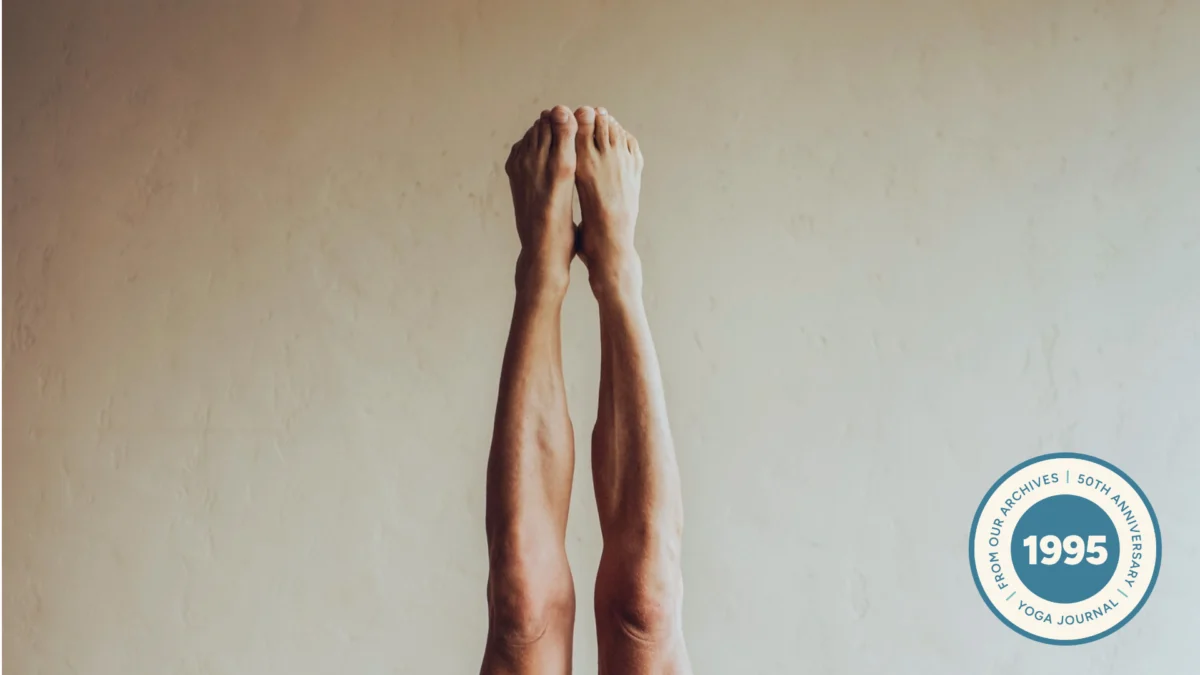
This philosophy finds its physical embodiment in Parsva Sarvangasana, or Side Shoulderstand. A sophisticated variation of the classic Salamba Sarvangasana, this pose serves as a masterclass in balance, internal orientation, and the "infinite game" of yoga.
Main Facts: The Anatomy of Side Shoulderstand
Parsva Sarvangasana derives its name from the Sanskrit parsva, meaning "side" or "flank." In practice, it mimics the curve of a scimitar or the arc of a wheel. While the classic Shoulderstand is a foundational "neutralizing" pose—capable of soothing an agitated mind or invigorating a fatigued body—the Side Shoulderstand introduces a lateral, asymmetrical challenge that demands significant core stability and shoulder girdle strength.
Key Benefits and Challenges
- Physiological Impact: Like its progenitor, Side Shoulderstand stimulates the endocrine system and calms the nervous system. Beyond this, it provides an intense stretch for the neck and chest musculature while acting as a rigorous strengthening exercise for the wrists and triceps.
- The "Compass" Problem: The primary hurdle for practitioners is the disorientation inherent in an inverted, twisted posture. It muddles the internal sense of left and right, front and back, often causing the novice to lose their equilibrium.
- Structural Integrity: The pose requires the practitioner to maintain a rigid, elevated shoulder base while the pelvis performs complex, lateral movements.
Chronology: The Evolution of the Practice
The integration of Parsva Sarvangasana into a modern sequence is a process that requires patience and a systematic approach. The following chronology outlines the necessary stages for safe development:
1. The Preparatory Phase (Bridge Variations)
Before attempting the full inversion, students must understand the "curved" torso required for the pose. Using a block and a folded blanket, the practitioner performs Setu Bandha Sarvangasana (Bridge variation). By placing a block under the sacrum, the student can isolate the sensation of the pelvis shifting laterally, preparing the body for the asymmetrical loading of the final pose.
2. The Wall-Supported Transition
Moving to the wall provides the necessary feedback for the spine. By positioning the blankets near a wall, the practitioner can press their feet into the vertical surface, allowing them to focus on the alignment of the shoulders and the delicate placement of the hands against the sacrum.
3. The Independent Inversion
Once the practitioner has developed the strength to maintain the shoulder-to-floor connection without external support, they transition to the "infinite game" of the full Side Shoulderstand. This stage is reached only when the core is stable enough to allow the legs to move in a 90-degree arc without compromising the thoracic lift.
Supporting Data: The Science of Support
A common error in contemporary yoga classrooms is the neglect of proper prop usage. Practitioners often attempt Shoulderstand variations on hard, flat surfaces. Based on technical standards established by masters such as B.K.S. Iyengar, the use of blankets is not optional—it is a safety imperative.
The Blanket Protocol
To prevent cervical strain, the shoulder support must be elevated by at least three to five inches.
- Foundation: Use rectangles measuring approximately 24 by 18 inches.
- Stacking: Stagger the folded edges of the blankets slightly inward. This creates a "staircase" effect that supports the shoulders while allowing the neck to remain in its natural, neutral curve.
- Cervical Health: If the back of the neck feels tight or "short," support it with the blankets. If the neck is naturally flat, it should remain unsupported to maintain the healthy lordotic curve.
Official Perspectives: The Philosophy of "Play"
To understand the mechanics of this pose, one must look at the psychological framework suggested by theorists like James Carse. Carse distinguishes between "finite games"—played for the sake of winning—and "infinite games"—played for the sake of continuing the play.
The Infinite Game of Asana
When we perform Parsva Sarvangasana, we are not merely attempting to "perfect" a shape. We are engaging in an infinite game. There is no "win" in yoga; there is only the ongoing discovery of the body’s connection to the world. As we assume the masks of the sage or the moon, we contribute to the divine radiance of the world.
When a student struggles with the "thud" of the legs falling or the "bulging eyes" of exertion, they are, in effect, playing a finite game. The remedy, according to advanced practitioners, is to engage the triceps and scapulae with greater intentionality. By "playing" with the boundaries of the posture rather than simply obeying them, the student transforms the practice from a task into a ritual.
Implications: Integrating the Practice into Daily Life
The mastery of Parsva Sarvangasana has implications that extend far beyond the yoga studio.
Developing Internal Awareness
The "muddling" of the internal compass mentioned earlier is a metaphor for the confusion of modern life. By practicing the ability to maintain a steady center while the world (or the legs) tilts sideways, the yogi develops a mental resilience that persists off the mat.
Avoiding "Yoga Overload"
If a student finds themselves quivering, clenching the throat, or struggling to breathe, the practice has become "finite"—it has become a struggle against a rule rather than a dance with reality. The instruction is clear: if the body signals overload, return to a supported state (such as the wall or a second block). This is not a failure; it is a tactical adjustment in the infinite game.
The Final Synthesis
Ultimately, the goal of this posture is to dissolve the distinction between the practice and life. When we finally reach the completed form—legs parallel to the floor, torso balanced on the palm, breath steady and deep—we are no longer "doing" an asana. We are embodying a "seat" for the divine.
In this state, the posture becomes a sacred ritual. The muscles of the neck are lengthened, the wrists are fortified, and the mind is unified. Whether you hold the pose for fifteen seconds or a minute, the lesson remains the same: in the infinite game of yoga, you have already arrived. You are not trying to get anywhere; you are simply, and joyfully, playing along.
For those seeking further instruction, consult "Light on Yoga" by B.K.S. Iyengar or "The Runner’s Yoga Book" by Jean Couch. Always ensure your setup is reviewed by a qualified teacher before attempting advanced inversions.