








Published: November 29, 2026 | Source: Yoga Journal Archives (Originally July-August 2002)
In the vast lexicon of yoga, the names of asanas (postures) serve as more than mere labels; they are invitations to embody the spirit of the natural world. From the slithering grace of the cobra (Bhujangasana) to the towering stability of the tree (Vrksasana), practitioners are encouraged to mimic the diverse forms of life. Among these, Garudasana, or Eagle Pose, stands as a profound testament to the synthesis of physical strength, mental focus, and spiritual inquiry. As we revisit this archival exploration, we examine how an ancient posture continues to offer modern practitioners a path toward grace, resilience, and the realization of the "Universal Spirit."
The Philosophy of Form: Divine Essence in Asana
The ancient yogis held a foundational belief that divine essence permeates every atom of existence. This perspective negates any notion of a spiritual hierarchy within yoga practice. Whether one is holding the foundational Tadasana (Mountain Pose) or navigating the complex, knotted structure of Garudasana, the objective remains constant: the cultivation of union between body, mind, and spirit.
B.K.S. Iyengar, in his seminal work Light on Yoga, articulated this ethos with clarity. He suggested that the disciplined mind of a yogi is one that learns to honor all creatures, recognizing that from the most minute insect to the enlightened sage, the same Universal Spirit breathes. By adopting the shape of an animal—in this case, the eagle—a practitioner does not simply engage in physical exercise; they participate in a symbolic act of reverence, acknowledging that the divine assumes "innumerable forms."
Chronology of the Eagle: From Myth to Mat
The lineage of Garudasana traces back centuries, rooted in the rich tapestry of Indian mythology. Garuda, the king of birds, is a revered deity—a divine eagle who serves as the vehicle for Lord Vishnu. In the mythological tradition, Garuda represents speed, power, and the martial prowess required to protect the dharma (cosmic order).
When the pose transitioned into the physical practice of Hatha Yoga, it retained these symbolic qualities. By the time it was cataloged in the late 20th century as a standard component of modern postural yoga, Garudasana had become synonymous with balance and intense concentration. The 2002 archival entry of Yoga Journal serves as a bridge, reminding us that while the aesthetics of yoga have evolved over the last two decades, the core intent of the eagle—to see clearly and stand firmly—remains an immutable pillar of the practice.
Supporting Data: The Mechanics of the Eagle
To understand the efficacy of Garudasana, one must look at the specific physiological impact of the pose. It is a compound movement that targets both the lower and upper body simultaneously, requiring a sophisticated level of proprioception.
Anatomical Benefits
- The Lower Body (Talons): By entwining the legs, the practitioner creates a deep, compressive lock. This serves to stimulate blood flow through the lower extremities. The pose is widely cited for its ability to strengthen the ankles, mitigate calf cramps, and improve the tone of the quadriceps and gluteal muscles.
- The Upper Body (Beak and Wings): The intricate wrapping of the arms—specifically the crossing of elbows—provides a deep, static stretch to the rhomboids and trapezius muscles. In an era where "tech neck" and sedentary desk work are ubiquitous, this movement is vital for releasing the chronic tension held between the shoulder blades.
- The Core and Balance: Balancing on a single, bent leg requires the engagement of the deep stabilizers of the pelvis and the transversus abdominis. This constant adjustment creates a "dynamic stillness" that is essential for developing neural pathways related to balance and poise.
The "Eagle-Eye" Cognitive Effect
Beyond the physical, the pose derives its name from the bird’s legendary visual acuity. An eagle’s vision is roughly seven times sharper than that of a human, allowing it to spot prey from hundreds of feet above. In the context of yoga, this "eagle-eye" focus refers to Drishti—the unwavering gaze. By maintaining a steady, singular point of focus while in a state of physical complexity, the practitioner trains the mind to remain calm and analytical, even when the body is challenged.
Official Guidance: Mastering the Posture
The execution of Garudasana requires a step-by-step approach to ensure safety and alignment.
Step 1: Establishing the Beak
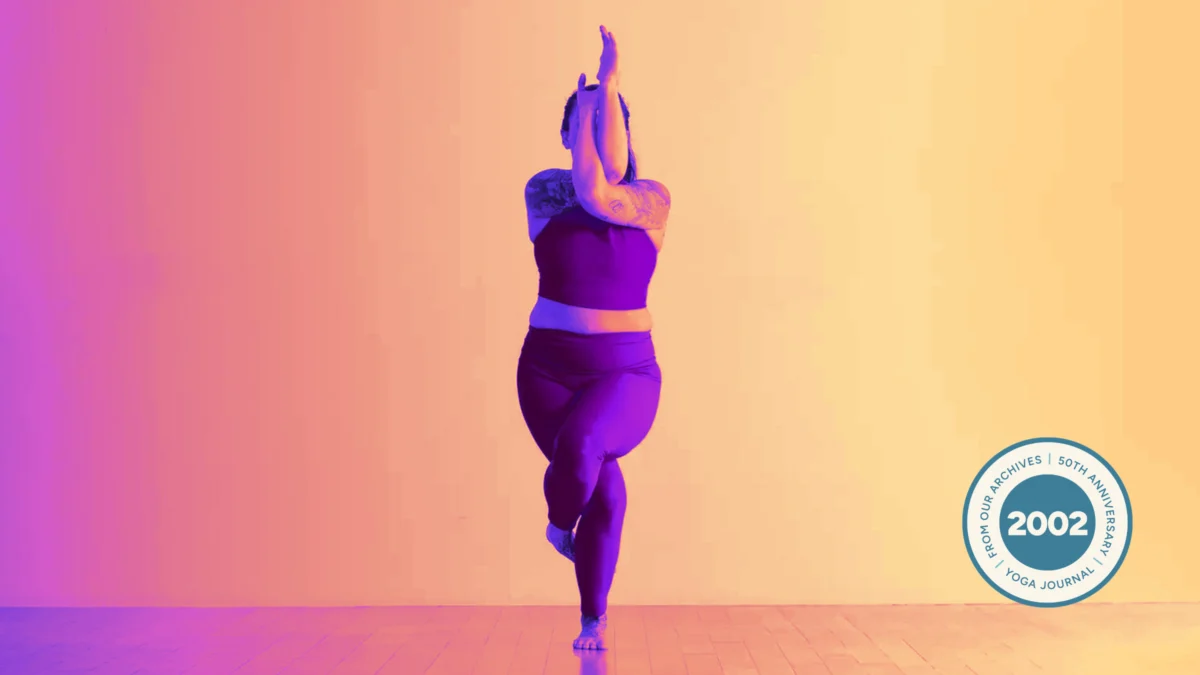
Stand in Tadasana (Mountain Pose) to ground your energy. Bend both elbows to 90 degrees. Cross the right arm under the left, wrapping the forearms until the palms meet. If full contact is not possible, the backs of the hands should face one another. This "beak" position immediately opens the upper back.
Step 2: The Perch
Shift your weight into your right foot. Bend your knees deeply, as if sitting into an invisible chair. Lift the left leg and cross the thigh high over the right. If flexibility allows, tuck the left foot behind the right calf. The goal is to create a singular, sturdy pillar of energy.
Step 3: Sustaining the Shape
Press the forearms into one another, lengthening the spine from the tailbone to the crown of the head. Squeeze the inner thighs together to create a sense of compression. Hold for five to ten deep, rhythmic breaths. Upon exiting, move with the same deliberate grace used to enter the pose, allowing the circulation to return to the limbs naturally.
Implications for the Modern Practitioner
In 2026, the relevance of Garudasana is perhaps more pronounced than it was in 2002. As the world becomes increasingly fragmented and digitally driven, the capacity to return to the mat and embody the eagle—to focus, to balance, and to stand with grace—serves as a necessary counterbalance to the chaos of modern life.
The implications for the practitioner are twofold:
- Resilience through Limitation: Many students find Garudasana frustrating due to the physical "knotting" required. However, the psychological implication of this struggle is profound. By accepting the limitation of the body, the practitioner learns to find "poise" within discomfort.
- Universal Connectivity: As noted in the original archival text, the pose serves as a reminder of the "universal spirit." By assuming the shape of the eagle, we dissolve the barrier between "self" and "other." We are no longer just a person in a room; we are a manifestation of the same spirit that animates the eagle, the mountain, and the sage.
As you step onto your mat today, consider the eagle. Approach the pose not merely as a stretching exercise, but as an opportunity to sharpen your focus and awaken the divine essence within. Whether you are a seasoned yogi or a novice just beginning your journey, the eagle remains a timeless symbol of the height one can reach when balance, focus, and spirit are aligned in perfect union.