









Published June 22, 2026
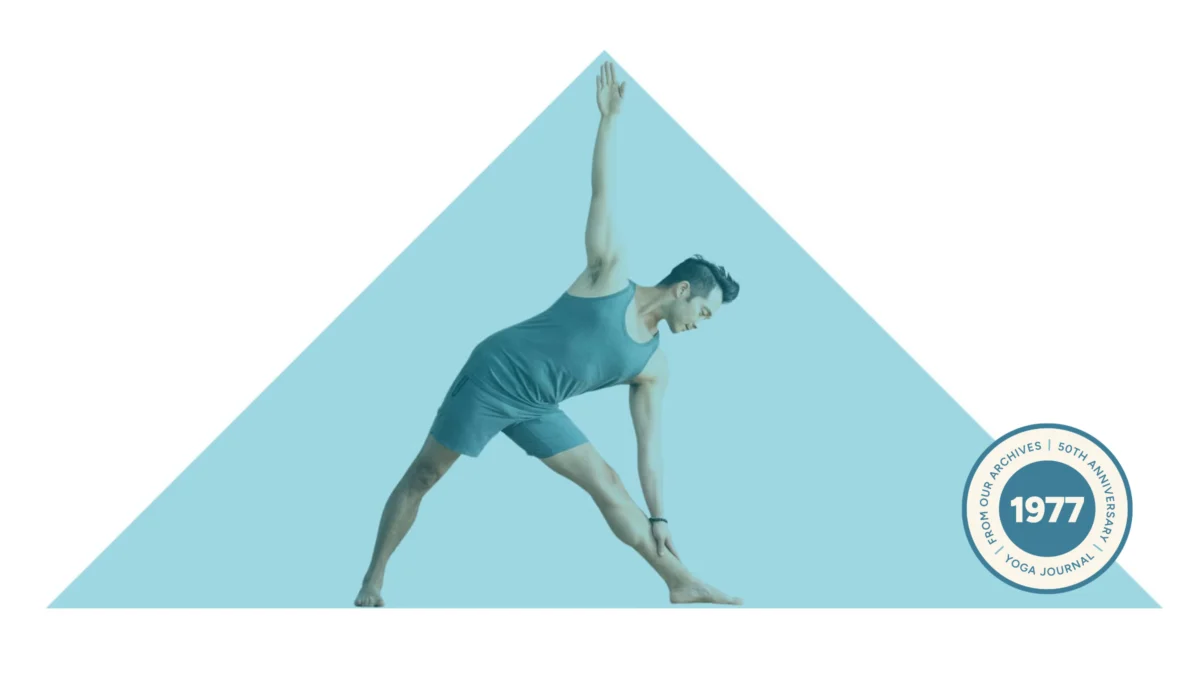
In the vast lexicon of yoga asanas, few postures possess the deceptive simplicity of Utthita Trikonasana, or Extended Triangle Pose. While often introduced to beginners as a foundational standing posture, its reach extends far beyond the physical mechanics of stretching the hamstrings or opening the chest. As part of Yoga Journal’s ongoing archives series—revisiting wisdom originally published in the March-April 1977 issue—we explore why this ancient shape remains a cornerstone of the Ashtanga standing series and a profound metaphor for the human experience.
Main Facts: The Geometry of the Body
The triangle is arguably the most ubiquitous symbol in human history, appearing across nearly every culture and epoch as a representation of strength, stability, and transcendence. When the practitioner steps into Utthita Trikonasana, they are not merely performing a stretch; they are engaging in a structural alignment that mirrors the physical properties of the triangle itself.
Physically, the pose serves as a masterclass in stability. By rooting the feet firmly into the earth, the practitioner creates a base that allows for the elongation of the spine and the expansion of the chest. It targets the muscles of the lower legs and the front of the thighs, while providing a mild, therapeutic traction to the neck. However, the true "main fact" of the posture is its psychological demand: it requires the practitioner to hold a physically demanding, non-traditional body shape without allowing the mind to flicker or wander. As the ancient yogic dictum posits, there can be no peace of mind without first establishing peace—or stillness—within the physical form.
Chronology: A Half-Century of Evolution
To understand the significance of Trikonasana today, one must look back to its place in the 1977 landscape of Western yoga.
- 1975: Yoga Journal begins its tenure as a chronicler of the burgeoning American yoga movement, documenting the influx of Eastern philosophies into the Western consciousness.
- March-April 1977: The original analysis of Trikonasana is published. At this time, yoga was transitioning from a niche, counter-culture practice into a structured discipline. The article emphasized the pose as a "beginner’s" posture, yet one that held the seeds of advanced meditation.
- 1980s–2000s: The rise of "power yoga" and the mainstreaming of Ashtanga and Vinyasa styles cemented the Triangle Pose as the definitive standing posture in studio sequences worldwide.
- 2026: In the current era, modern biomechanics and neuroscience have begun to corroborate what the 1977 authors intuited: that the "dynamic dualism" of the pose—the tension between rooting and reaching—functions as a form of sensory integration that regulates the nervous system.
Supporting Data: The Triad of Stability
The efficacy of Trikonasana is rooted in three distinct pillars of practice, as identified by scholars and long-time practitioners:
1. The Earth Connection
In an age of intellectualization, where many practitioners view yoga through the lens of theory, Trikonasana demands a sensory return to the ground. By emphasizing the descent of weight into the feet, the practitioner reestablishes a tactile connection with earthly energies. This grounding is the essential precursor to balancing the more volatile, "subtle" energies of the mind. Without this structural integrity, the higher, more meditative aspects of yoga remain elusive.
2. The Symbology of the Trinity
The pose acts as a physical reenactment of universal trinities. Whether one views it through the lens of the Christian Holy Trinity or the Hindu Trimurti—Brahma (the Creator), Vishnu (the Sustainer), and Shiva (the Destroyer)—the posture embodies the cycle of growth. In the body, this manifests as the destruction of past physical habits, the sustaining of the current hold, and the creation of new space in the joints and the mind. It is a microcosm of the reality of flux: a state of timeless stillness within a shape that represents movement.
3. The Balance of Polarities
Trikonasana is a study in "dynamic dualism." The arms reach in opposite directions, the eyes gaze toward the heavens, and the heart opens, while the legs remain anchored to the floor. This simultaneous movement—upward and downward, vertical and horizontal—forces the practitioner to reconcile opposites. It teaches the student to express strength in the world while simultaneously withdrawing from the attachments that cause mental agitation.
Official Perspectives: The Breath as a Bridge
Teachers of the Ashtanga tradition have long noted that the transition into Trikonasana is inseparable from the breath. The gentle exhalation that accompanies the entry into the pose is described as the "breath of surrender."
From an instructional standpoint, this exhalation serves as a vital transition from the "excitement of movement" to the "stillness of holding." When the breath is steady, the mind is no longer distracted by the discomfort of the stretch or the desire to move. It is within this stillness that the practitioner finds the "middle path"—the ability to occupy the physical world fully while remaining detached from the ego-driven need for specific results.
As noted in the 1977 archival text, the horizontal alignment of the spine acts as a reminder of our connection to all life forms, including those that move closer to the earth. This realization is designed to cultivate humility, stripping away the practitioner’s sense of superiority and replacing it with an experience of universal oneness.
Implications: The Eternal Relevance of the Triangle
Why does a pose that has been practiced for decades still hold weight in 2026? The implications for modern practitioners are twofold:
Cultivating Internal Resilience
In a world characterized by rapid technological change and mental fragmentation, the requirement to hold a "triangle" of physical stability offers a necessary remedy. The pose teaches that internal peace is not a gift bestowed from outside, but a state that must be built through the intentional placement of the body and the focused regulation of the breath.
Moving Beyond the Asana
The ultimate goal of Trikonasana, as highlighted in our historical archives, is not the perfect shape of the body, but the perfect state of the mind. When the physical body is held in the stillness of the triangle, the distinction between the "doer" and the "done" begins to dissolve. This is the threshold of meditation.
The lessons learned on the mat—that we must be both grounded and expansive, both strong and surrendered—are meant to be carried into the complexities of daily life. Every time a student begins the standing series, they are given a fresh opportunity to re-learn these fundamental truths.
Trikonasana is, therefore, not just an exercise; it is a laboratory for living. It is a reminder that even when our lives feel as though they are in constant flux, there exists a "timeless stillness" within us. By returning to the triangle, we return to the architecture of our own existence—a structure that is strong enough to support our reaching, yet humble enough to stay rooted in the earth. As we look back through the lens of the 1977 archives, the enduring lesson remains clear: the simplest poses are often those that hold the deepest secrets of our humanity.