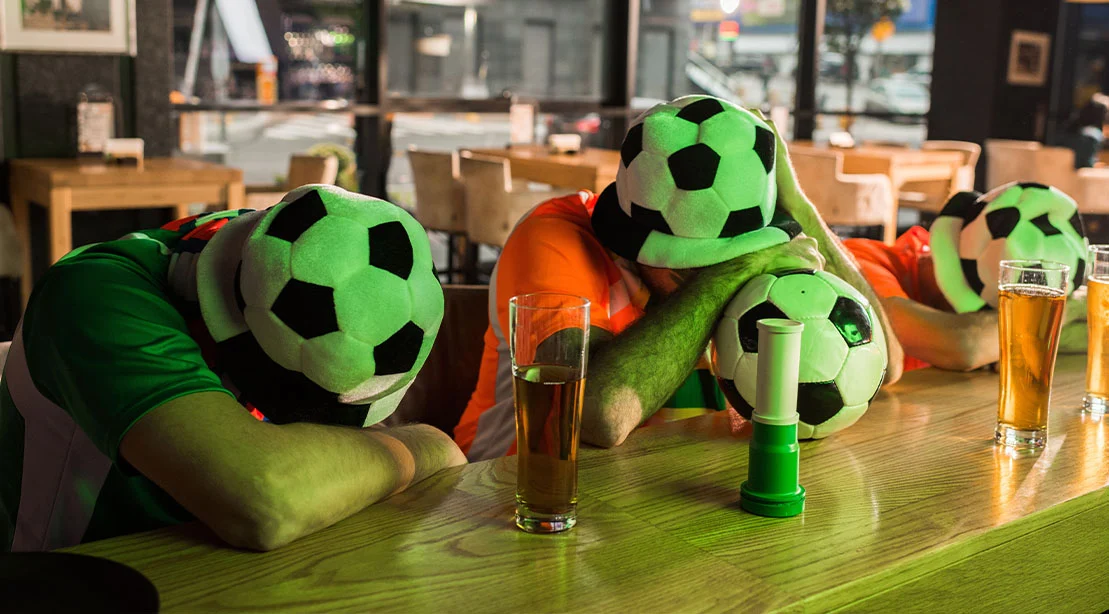
As North America stands at the epicenter of the global sporting universe, the 2026 FIFA World Cup has transformed into a marathon of both physical and psychological endurance. While players battle on the pitch across stadiums from Vancouver to Mexico City, a different, quieter struggle is taking place in living rooms and sports bars across the globe. Millions of supporters, separated by thousands of miles and massive time zone disparities, are sacrificing their circadian rhythms to witness history in real-time.
The phenomenon of “World Cup fever” has historically been associated with euphoric celebrations, but in 2026, it is increasingly synonymous with eye drops, copious amounts of caffeine, and the chronic fatigue of sleep deprivation. For fans in North Africa, the Middle East, and parts of Europe, the tournament has become an unintentional test of stamina, raising the question: How much sleep is a national hero worth?
The Quantifiable Cost of Fandom: Analyzing the Sleep Deficit
To understand the severity of this global fatigue, statisticians at LiveScore.com conducted a comprehensive analysis of the 48 teams competing in the group stages. The study aimed to quantify the “sleep opportunity lost” for supporters based on the official fixture list.
The methodology utilized a standardized 11:00 p.m. to 7:00 a.m. sleep window. Researchers then subtracted 2 hours and 45 minutes for every match that overlapped with this window. This specific duration was chosen to account for the pre-match buildup (15 minutes), the regulation two-hour match slot, and a 30-minute post-match window for interviews and tactical analysis. For nations spanning multiple time zones, the study calculated an average based on the primary civil time zone.
The results paint a stark picture of the “night owl” reality facing international fans. Leading the list of the sleep-deprived is Algeria, whose supporters faced a total of 8.25 hours of potential sleep loss during the group stage. Tunisia followed closely with 7.75 hours, while Iraq rounded out the top three with 7 hours of interrupted rest.
Chronology of the Disruption: A Global Pattern
The distribution of these sleep disruptions was not uniform. The scheduling favored those in extreme time zones—such as Australia, New Zealand, and South Korea—where match times often fell during daylight hours. Conversely, the "middle-ground" nations, particularly those in North Africa and the Middle East, found themselves in the “danger zone” of early morning kick-offs.
The Group Stage Toll
- Algeria (8.25 hours lost): With all three group matches occurring during the deep night, Algerian fans were forced to choose between loyalty and health. For many, this meant setting alarms for the early hours of the morning to witness the Fennecs, resulting in three distinct nights of shattered sleep.
- The "Double-Trouble" Tier: Seven nations, including Scotland, Norway, Sweden, DR Congo, and Saudi Arabia, suffered two major sleep disruptions. These fans had to negotiate their work and school schedules around two high-stakes matches that occurred deep into their local nights.
- The Wider Impact: An additional 14 nations faced at least one night of significant sleep disruption, turning the group stage into a global exercise in recovery.
Supporting Data: The League Table of Exhaustion
The following table summarizes the nations most impacted by the scheduling of the 2026 group stage, highlighting the intensity of the struggle for fans of these specific squads.
| Rank | Team | Group | Disrupted Sleeps | Total Sleep Opportunity Lost |
|---|---|---|---|---|
| 1 | Algeria | J | 3 | 8.25 hours |
| 2 | Tunisia | F | 2 | 7.75 hours |
| 3 | Iraq | I | 2 | 7.00 hours |
| 4 | Norway | I | 2 | 6.00 hours |
| 5 | Czechia | A | 2 | 5.50 hours |
| 6 | Sweden | F | 2 | 5.50 hours |
| 7 | DR Congo | K | 2 | 5.50 hours |
| 8 | Saudi Arabia | H | 2 | 5.50 hours |
Official Perspectives: The Logistics of a Global Tournament
While FIFA has not issued a formal statement regarding the sleep patterns of global fans, the scheduling process for the 2026 tournament was governed by the need to balance broadcast viability in the Americas with the traditional, albeit challenging, kick-off times for European and African audiences.
Logistics experts note that the 2026 format—the largest in World Cup history—presents unprecedented challenges. With 48 teams, the sheer volume of matches means that games must be spread across a wider spectrum of hours to satisfy global media rights holders.
“The reality is that a truly global tournament in a North American time zone is inherently going to alienate certain demographics,” says sports media analyst Dr. Elena Vance. “When you have a game in Vancouver starting at 8:00 p.m. local time, you are essentially asking an Algerian fan to wake up at 4:00 a.m. the following day. That isn’t just a schedule; it’s a commitment.”
The Knockout Stage: Escalating the Endurance Test
As the tournament transitions into the knockout stages, the stakes—and the sleep loss—are rising. The survival of the fittest is no longer limited to the players; it now applies to the spectators.
Algeria’s progression to the Round of 32 provides the most poignant example. Their upcoming clash against Switzerland is slated for Friday, July 3, at 8:00 p.m. Pacific Time. For the Algerian faithful, this translates to a 4:00 a.m. start on Saturday morning. Unlike the group stage, where fans could potentially recover over the following days, the high-octane nature of the knockout rounds offers no such reprieve. Every goal, every penalty, and every tactical substitution keeps the adrenaline spiking, making it nearly impossible for fans to return to sleep immediately after the final whistle.
However, not all fans face this predicament. For those whose teams were eliminated—such as Tunisia and Iraq—the tournament has shifted from a source of stress to a spectator sport, allowing for a more relaxed, less sleep-depriving viewing experience.
Implications: The Long-Term Effects on Fan Culture
The 2026 World Cup is testing the boundaries of fan loyalty. While social media platforms like X (formerly Twitter) and Reddit are flooded with "I haven’t slept in three days" memes, the underlying reality is a significant shift in how global events are consumed.
1. The Productivity Gap
Employers in countries like Algeria and Saudi Arabia have noted an uptick in late arrivals and lower productivity during the tournament. This "World Cup hangover" is a known economic phenomenon, though it is rarely documented with the scientific rigor applied to the players’ recovery protocols.
2. The Evolution of Viewing Habits
Fans are increasingly shifting toward "asynchronous" consumption—watching highlights or extended replays the following morning—to preserve their health. Yet, the social nature of the World Cup, which demands real-time participation to avoid spoilers and to feel part of the collective conversation, continues to drive millions to stay awake.
3. The Future of Scheduling
As FIFA looks toward future tournaments, the lessons of 2026 will be vital. The balance between maximizing commercial reach in the host country and maintaining the health and engagement of the global fanbase is a delicate one. If the "sleep opportunity loss" becomes too high, it may prompt a re-evaluation of how early-morning kick-offs are managed in the future.
Conclusion: The Final Whistle
As the 2026 FIFA World Cup approaches its climax, the tournament remains a testament to the power of sport. It is a spectacle that defies borders, time zones, and even the biological necessity of sleep. While the statistics from LiveScore.com quantify the hours lost, they cannot quantify the memories gained.
For the Algerian fan setting their alarm for 4:00 a.m., the loss of sleep is not a burden—it is a badge of honor. It is a commitment to the "Fennecs" that transcends exhaustion. As the final matches loom, the world remains divided into two camps: those who are watching the clock for the next kick-off, and those who are simply trying to get a decent night’s rest. In the theater of the 2026 World Cup, the former are clearly winning, one bleary-eyed morning at a time.