











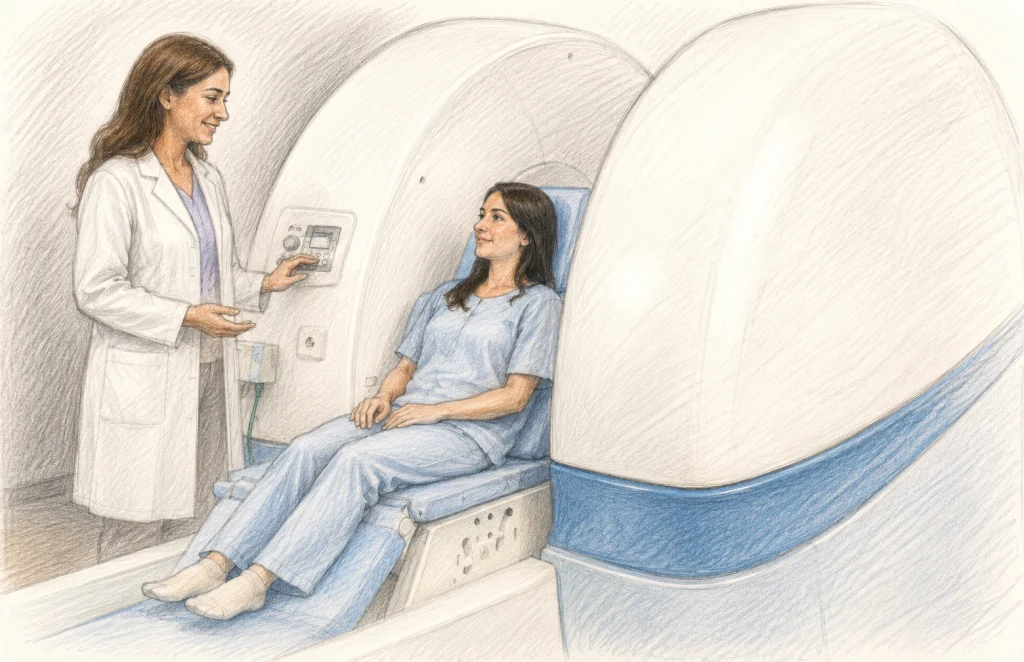
For the patient living with Ehlers-Danlos syndrome (EDS), the medical journey often follows a frustrating, repetitive script. A patient visits a specialist, reports debilitating neck pain, dizziness, or radiating neurological symptoms, and is sent for a standard MRI. The patient returns, hopeful for an answer, only to be handed a report that reads: “Cervical spine: Unremarkable. Thoracic spine: Unremarkable. Lumbar spine: Slight bulging disc at L5-S1.”
This clinical "non-finding" is a hallmark of the EDS experience—a profound mismatch between the patient’s subjective reality and the objective, static imaging provided by modern medicine. While traditional MRI is the gold standard for diagnostic imaging, it possesses a fundamental blind spot when it comes to the connective tissue pathologies associated with EDS. By capturing the body in a supine, gravity-neutralized state, these scans often fail to visualize the dynamic, mechanical instabilities that manifest only when a patient is upright.
The Diagnostic Mismatch: Why Supine MRI Often Fails
The core issue in diagnosing spinal instability in EDS is that the condition is, by nature, dynamic. EDS involves systemic connective tissue fragility, which can lead to ligamentous laxity throughout the spinal column. In a healthy spine, ligaments act as stabilizers, maintaining alignment regardless of the body’s position. In an EDS patient, those same ligaments may be unable to hold the vertebrae in place against the force of gravity.
When a patient lies down in an MRI scanner, the weight of the head and torso is removed from the spinal column. The spine is "unloaded." In this position, a spine that is functionally unstable when standing may appear perfectly aligned. The "diagnostic mismatch" occurs because the test is designed to evaluate structural pathologies (like tumors or herniated discs) that are visible at rest, rather than mechanical instabilities that are triggered by weight-bearing.
Essentially, we are asking a static camera to capture a mechanical failure that only occurs while the machine is in motion or under pressure. This does not imply that the clinician is negligent or the MRI technology is "broken"; rather, it highlights a limitation in the application of current protocols for a unique patient population.
A Chronology of the Shift Toward Positional Imaging
The movement to incorporate upright, weight-bearing MRI into the neurosurgical landscape has been a slow but steady evolution over the past two decades.
- Early 2000s: Clinicians and researchers began noting that patients with connective tissue disorders reported symptoms that were strictly positional—relieved by lying down and exacerbated by standing or sitting for prolonged periods.
- 2007: A landmark study by Milhorat et al. documented the syndrome of "cranial settling" and craniocervical instability (CCI) in patients with connective tissue disorders, setting the stage for discussions about why traditional supine imaging was failing to capture these shifts.
- 2015: Health Quality Ontario released an evidence-based analysis investigating the utility of positional MRI for EDS. The report acknowledged the potential for uncovering abnormalities that remain hidden in conventional scans.
- 2020–2025: As diagnostic awareness of CCI, Chiari malformation, and spinal instability in EDS grew, the medical community saw an uptick in interest regarding dynamic imaging.
- 2025–2026: A wave of systematic reviews, including research published in the European Journal of Radiology Open, solidified the argument that weight-bearing MRI offers distinct clinical utility for identifying posture-dependent spinal abnormalities.
Supporting Data and Clinical Utility
The argument for upright MRI (pMRI) rests on its ability to reveal changes in the spinal canal, cord position, and alignment that occur under the influence of gravity.
Detecting Weight-Bearing Abnormalities
A 2025 systematic review identified nine distinct studies confirming that dynamic and upright MRI can detect abnormalities missed by supine scans. Specifically, researchers observed:
- Spinal Alignment Alterations: Changes in the curvature of the spine that only become symptomatic when the patient is upright.
- Canal Narrowing: Transient stenosis that occurs under load.
- CSF Flow Dynamics: Obstructions in the flow of cerebrospinal fluid that may be exacerbated by the compression of the craniocervical junction when the head is upright.
While these findings are significant, it is vital to acknowledge the "trade-off" inherent in current technology. Upright MRI machines typically operate at a lower field strength (0.6T to 1.0T) compared to the high-resolution 3T machines found in most hospitals. This means the images may lack the crisp, high-contrast detail required to visualize subtle soft-tissue lesions. However, for the EDS patient, the "functional" data provided by an upright scan often provides more actionable information for a neurosurgeon than the "high-definition" anatomical data of a supine scan.
Official Responses and Medical Guidelines
Medical institutions have historically been cautious about endorsing upright MRI, primarily due to the lack of large-scale, randomized controlled trials that directly correlate these findings with surgical outcomes.
However, organizations like the CCI Foundation have begun to shift the narrative, recommending that upright MRI be included in the evaluation process for patients with suspected craniocervical instability. The consensus among these specialized groups is that while pMRI should not replace the standard diagnostic workup, it serves as a critical "second look" when a patient’s clinical history strongly suggests instability that remains invisible to standard imaging.
Implications for Patients and Providers
The implications for the EDS community are profound. If a patient is diagnosed with spinal instability, the treatment pathway—ranging from physical therapy and bracing to specialized neurosurgical stabilization—is vastly different from the pathway for someone with a standard, asymptomatic bulging disc.
When to Consider Upright MRI
An upright MRI may be a necessary diagnostic tool if:
- Symptoms are positional: Your pain, neurological symptoms (numbness, tingling, weakness), or dizziness consistently worsen as the day progresses or when you are in a vertical position.
- Symptoms do not match the imaging: You have significant functional impairment, yet your standard, supine MRI report is largely unremarkable.
- Mechanical "triggers": Your symptoms are triggered by specific head movements, bending, or lifting, and are not present while lying flat.
Navigating Access
Despite the clinical logic, access remains a significant barrier. Upright MRI facilities are geographically sparse, and insurance coverage is often inconsistent. Patients are frequently forced to navigate a complex landscape of prior authorizations and, in many cases, out-of-pocket costs. Patients are encouraged to engage in proactive, informed discussions with their specialists, specifically asking whether their regional health system has access to "dynamic" or "weight-bearing" options, or if they can provide a letter of medical necessity for a center that offers pMRI.
Conclusion: Toward a More Comprehensive View
The human spine is not a static structure; it is a dynamic, load-bearing architecture that interacts with gravity every second of the day. In the context of Ehlers-Danlos syndrome, where the integrity of the connective tissue is compromised, the "at-rest" state captured by standard MRI is rarely an accurate reflection of the patient’s lived experience.
While upright MRI is not a panacea for all diagnostic dilemmas in EDS, it represents a crucial evolution in how we approach chronic, mechanical spinal pain. By moving beyond the horizontal limitations of traditional diagnostics, we can better visualize the spine as it actually functions—in motion, under pressure, and in the upright world. The goal for the future is clear: to bridge the gap between patient experience and clinical observation through better access, more robust research, and a commitment to seeing the full picture of the spine in motion.
Key Takeaways
- The Static Problem: Traditional MRI images the spine at rest, which often masks mechanical instability caused by EDS.
- The Positional Advantage: Upright MRI allows clinicians to observe the spine under the stress of gravity, revealing posture-dependent issues like CCI and cord compression.
- The Trade-off: Upright MRI may have lower resolution than high-field hospital scanners, but the diagnostic value of seeing the spine in function often outweighs the loss of detail.
- Advocacy and Access: Patients should discuss positional imaging with their providers when clinical symptoms remain unexplained by standard imaging, while being prepared to navigate potential insurance and access hurdles.
- Future Direction: More large-scale research is required to standardize the use of upright MRI, but it remains a vital tool for those whose spinal health is profoundly influenced by movement and posture.