











For years, the gold standard for anyone serious about their physique—from powerlifters to casual gym-goers—has been the meticulous tracking of macronutrients. The logic is sound: if you measure what you eat, you can control your output, manage body composition, and ensure optimal performance. But for Dr. Gabrielle Fundaro, a PhD in Human Nutrition and a seasoned powerlifting competitor, the numbers eventually stopped adding up to health.
After a decade of coaching others and perfecting her own intake, Dr. Fundaro reached a breaking point. The very system she used to master her health had become a cage. Today, she is spearheading a movement toward "RPE-Eating," a method that swaps digital trackers for the biological wisdom of Rate of Perceived Exertion (RPE).
The Crisis of the "Perfect" Diet
The struggle began with a simple, gnawing question: What happens if I stop?
Despite her impeccable credentials and professional expertise, Dr. Fundaro found herself trapped in a cycle of dependency. Every meal was an exercise in data entry. She was exhausted by the mental labor of balancing macros and the social anxiety of navigating restaurant menus without a scale or an app. Yet, the fear of abandonment—of losing the muscle she had worked years to build or accidentally overeating—kept her tethered to the tracker.
"I worried that if I stopped tracking macros, I would lose my physique," she admits. This fear is a common silent epidemic among fitness enthusiasts: the belief that internal hunger signals are unreliable, and that without an external authority (the app), one’s body will inevitably veer toward chaos.
The Evolution of a Method: From Iron to Appetite
The breakthrough came unexpectedly in the weight room. Dr. Fundaro had shifted her training to rely on the Rate of Perceived Exertion (RPE) scale, a system that allows athletes to gauge their intensity based on how a lift feels rather than relying solely on a fixed percentage of a one-rep max.
The results were undeniable: she was recovering faster and growing stronger. It was a revelation. If an athlete could trust their body’s feedback to navigate a brutal squat session, why couldn’t they trust their body to navigate a dinner plate?
This insight birthed the RPE-Eating Scale. It wasn’t about abandoning structure; it was about shifting the source of that structure from an external database to internal intuition.
Understanding the RPE-Eating Framework
At its core, RPE-Eating is a sophisticated exercise in "interoceptive awareness"—the ability to perceive and interpret the internal sensations of the body. While traditional dieting treats the body like a machine to be calibrated, RPE-Eating treats it like a biological system to be understood.
The Scale Defined
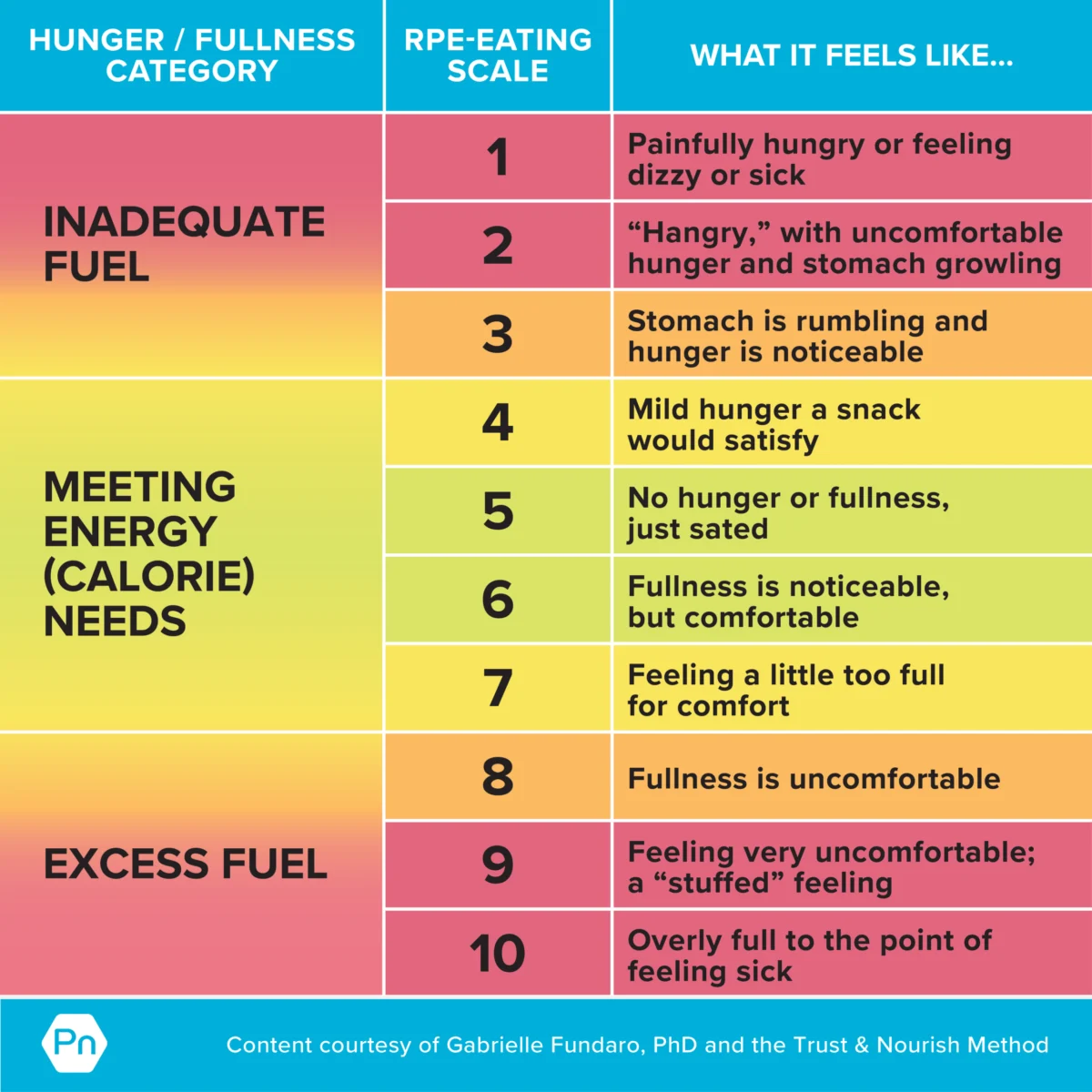
The RPE-Eating scale ranges from 1 to 10, categorizing the spectrum of fullness and hunger:
- 1–3 (Inadequate Fuel): Characterized by physical emptiness, dizziness, or intense "hangry" irritability.
- 4–7 (Adequate Fuel): The sweet spot. This ranges from mild hunger that a snack could fix, to a comfortable, noticeable fullness.
- 8–10 (Excess Fuel): Ranges from feeling "too full" to the physical discomfort of being over-stuffed or sick.
Chronology of Practice: Learning to Listen Again
Dr. Fundaro emphasizes that RPE-Eating is a skill, not a quick fix. Transitioning from years of external tracking requires a deliberate, step-by-step approach.
1. Defining the Goal
The objective of RPE-Eating is not to manipulate body fat percentage with surgical precision, but to build self-trust. It is a tool for those who want to reclaim their autonomy. As Dr. Fundaro notes, "It’s about sensing into what your body needs and giving yourself appropriate nourishment."

2. The "Notice and Name" Strategy
Before a meal, individuals are encouraged to rank their hunger on the 1–10 scale. Mid-meal, they repeat the process. By slowing down and checking in, they begin to differentiate between hunger (a physical need for energy) and appetite (the desire to eat for pleasure or emotional comfort).
3. Identifying Triggers
A critical component of this methodology is recognizing non-hunger triggers. Stress, boredom, and emotional fatigue often lead to mindless consumption. Dr. Fundaro suggests that rather than judging these impulses, one should "notice and name" them. By identifying the emotional state—such as anxiety or sadness—an individual can create a buffer, choosing a non-food coping mechanism like a short walk or breathing exercises.
4. Balancing Satiety and Satisfaction
Crucially, the system accounts for human nature. Satiety is physical; satisfaction is emotional. If you eat a plate of steamed vegetables, you may be physically full, but you remain emotionally unsatisfied. RPE-Eating encourages the inclusion of "pleasure foods" to prevent the restrictive pendulum swing that leads to binge eating.
Implications for Weight Modification
One of the most frequent criticisms of intuitive approaches is the fear of weight gain. Dr. Fundaro addresses this with a pragmatic, science-backed perspective. She does not advocate for "free-for-all" eating. Instead, she suggests that those with specific goals can still use the scale as a compass.
For weight loss, the goal is to consistently aim for the 4–5 range—staying satisfied but not over-filled. For weight gain, the target shifts to the 7–8 range. However, she warns that for extreme aesthetics, such as competitive bodybuilding, this tool may not provide the granular control required—much like using a therapeutic yoga routine to train for an Olympic powerlifting meet.
Official Response and Scientific Context
The transition from "feelings-based" eating to RPE-based eating has been met with skepticism by the "math-heavy" side of the fitness industry. Yet, the evidence supporting autoregulation in athletics is robust. Research indicates that RPE is a valid, reliable metric for managing physical output. Dr. Fundaro argues that hunger and fullness cues are similarly valid biological metrics for managing nutritional intake.
By tracking hunger levels, the individual is effectively monitoring their own internal blood-glucose and hormone fluctuations. While less precise than a continuous glucose monitor, it is infinitely more sustainable for long-term health.
Who is this for?
RPE-Eating is not a universal panacea, but it is an essential tool for:
- The "Burned-Out" Tracker: Those who feel the psychological weight of constant food logging.
- The Fearful Eater: Individuals who experience anxiety when they cannot quantify their intake.
- The Recovery-Focused: Those with a history of yo-yo dieting or disordered eating who require a gentler, more mindful approach to nourishment.
Dr. Fundaro is quick to add a caveat: for those currently struggling with active eating disorders, RPE-Eating is not a replacement for professional clinical care. It is, however, a powerful "off-ramp" for those who have spent years in the restrictive lane of dieting and are finally ready to merge onto the road of self-regulation.
The Future of Nutritional Freedom
The legacy of the macro-tracking era has been a massive increase in nutritional literacy—we know more about protein and fiber than any generation before us. But we have also become disconnected from our own bodies.
Dr. Fundaro’s work signals a shift in the fitness industry toward a more human-centric model. By treating the individual as an expert on their own biology, the RPE-Eating method offers a path out of the binary trap of "dieting" vs. "failing."
"The goal," Dr. Fundaro concludes, "is to know that you are nourishing yourself—and you don’t need a food tracker to do that." In a world obsessed with metrics, the most radical act of self-care may simply be learning to listen to what our bodies have been trying to tell us all along.