










In the landscape of modern fitness, there is an over-reliance on linear movement. From the standard front plank to the "dead bug" and the foundational Pallof press, the vast majority of core training programs emphasize sagittal plane stability—training the body to move exclusively in straight lines. While these exercises are undeniably effective for building a rigid, stable torso, they suffer from a significant blind spot: life and sports rarely happen on a single, straight plane.
Whether you are swinging a golf club, throwing a baseball, or simply reaching across your body to lift a heavy suitcase into the trunk of your car, your body is required to produce, transfer, and control rotational force. These real-world actions demand that your hips, core, and shoulders function as a single, integrated unit. When you train only in straight lines, you neglect the diagonal, rotational pathways that define human movement.
Enter the Half-Kneeling Cable Chop. This movement is the gold standard for bridging the gap between functional stability and explosive rotational power. By forcing the body to operate from a locked-in, half-kneeling position, it removes the "cheat codes" of momentum and forces the core to generate force while maintaining absolute structural integrity.
The Science of Rotation: Why Linear Training Fails
To understand why the Half-Kneeling Cable Chop is essential, one must look at the biomechanical reality of athletic movement. Traditional core work often focuses on the rectus abdominis—the "six-pack" muscle. However, rotational movement is governed by a complex synergy between the obliques, the lats, and the deep stabilizers of the spine.
When you perform a standard crunch, you are training your spine to flex. But when you rotate, you are training your spine to resist shear forces while your thoracic spine provides the necessary mobility. The Half-Kneeling Cable Chop serves as a bridge, teaching your body how to generate torque from the hips while keeping the lumbar spine protected.
Chronology of a Perfect Repetition
The effectiveness of the Cable Chop lies entirely in the precision of its execution. To derive the maximum benefit, you must approach the movement with a focus on form over load.
Phase 1: The Setup
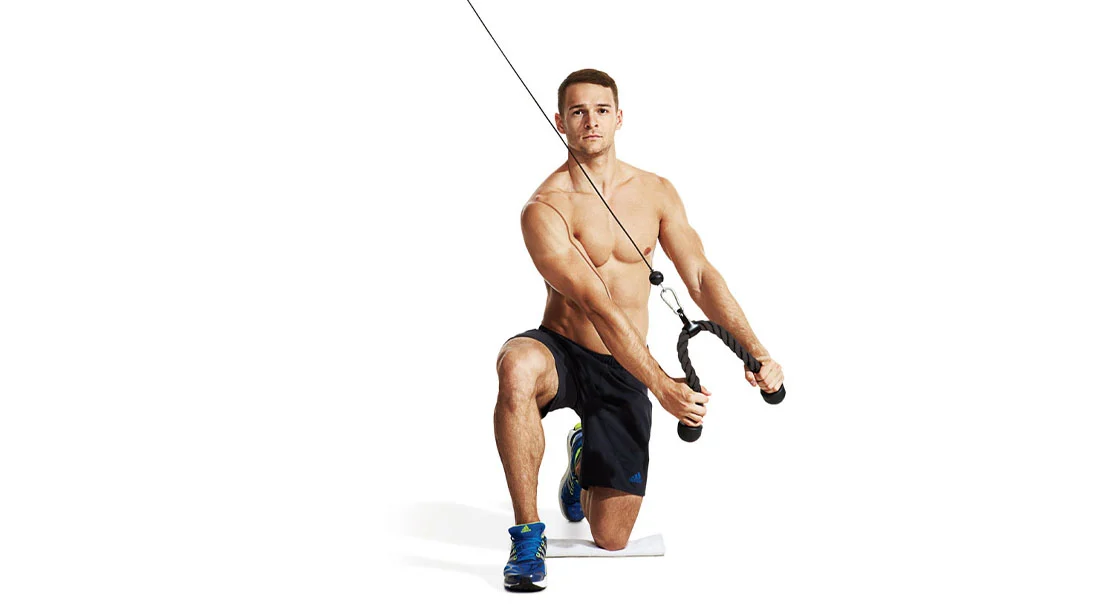
Set a cable machine pulley to a high position. Assume a half-kneeling position, with the knee closest to the cable stack on the ground. Your front foot should be planted firmly, creating a "tripod" of stability. Ensure your torso is upright, your ribs are tucked, and your core is braced.
Phase 2: The Initiation
The movement should not begin with the arms. Instead, initiate the "chop" by rotating your thoracic spine (upper back) and engaging your core. Think of your arms as simple hooks or levers—they are merely transferring the force generated by your trunk.
Phase 3: The Diagonal Arc
As you pull the handle down and across your body, guide it along a clean diagonal path toward the outside of your front knee. During this phase, focus on maintaining a neutral spine. The hips should remain locked; the rotation is coming from the mid-back, not the lower back.
Phase 4: The Controlled Return
The "eccentric" phase—or the return to the starting position—is where the real growth happens. Do not allow the weight stack to snap you back. Control the handle as it travels back to the high position, fighting the tension throughout the entire range of motion.
Supporting Data: Muscles and Mechanics
The Half-Kneeling Cable Chop is a total-core developer. To understand its impact, we must break down the specific contribution of the targeted musculature:
- The Obliques: These are the primary movers. The internal and external obliques are responsible for both the initial rotation and the deceleration of that rotation during the return phase.
- The Transverse Abdominis (TA): As the deepest layer of your abdominal wall, the TA acts as a corset. It contracts to increase intra-abdominal pressure, effectively "locking" your lumbar spine to prevent injury.
- The Glutes: The glute of the down-knee acts as an anchor. By squeezing this glute throughout the set, you stabilize the pelvis, ensuring that the rotation originates from the thoracic spine rather than the lower back.
- The Lats: Often overlooked, the lats are vital for force transfer. They allow the power generated by your torso to be effectively channeled through your arms to the cable handle.
Professional Insights: Common Mistakes and Fixes
In clinical and high-performance settings, coaches often observe the same four "red flags" when athletes attempt this movement.
1. The Lumbar Trap
Many lifters attempt to force rotation through the lower back. This is a recipe for injury.
- The Fix: Focus on keeping the rib cage stacked directly over the hips. If you feel your lower back twisting, reduce the weight immediately and emphasize thoracic rotation.
2. The "Wobbling" Base
If your front knee caves inward or your hips rock, your base of support is compromised.
- The Fix: Increase the tension in your front foot and glute. Imagine you are crushing a piece of paper under your front heel.
3. Arm-Dominant Pulling
Using the biceps to pull the cable is a common error that negates the core-strengthening intent of the exercise.
- The Fix: Visualize your arms as heavy chains. Your torso turns the chains; the chains do not turn the torso.
4. Neglecting the Eccentric
Rushing the return phase wastes 50% of the movement’s value.
- The Fix: Spend two full seconds on the return. Deceleration is just as important for athletic performance as acceleration.
Implications for Athletic Performance
For the competitive athlete, the implications of mastering the Half-Kneeling Cable Chop are profound. Whether you are a golfer looking for more clubhead speed or a combat athlete needing to strike with more force, this exercise improves your "force transfer efficiency."
Energy leakage is the silent killer of performance. When your core is weak or uncoordinated, the force you generate from your legs during a swing or throw is lost before it reaches your extremities. By training the hips, torso, and shoulders to work as a unified chain, the Cable Chop eliminates these leaks.
Furthermore, this exercise facilitates a vital concept in human movement: the separation of mobility and stability. It teaches the thoracic spine to be mobile while simultaneously teaching the pelvis and lumbar spine to remain stable. This "dissociation" is the hallmark of elite movement quality.
Programming: Integrating the Chop into Your Routine
To see results, consistency is key. The Half-Kneeling Cable Chop is highly versatile and can be programmed in three distinct ways:
- As a Warm-Up: Perform 2 sets of 10 reps per side to prime the obliques and glutes while mobilizing the thoracic spine. This prepares the body for heavier compound movements like squats or deadlifts.
- As Accessory Work: Place it after your main lifts. 3 sets of 8–12 reps with a controlled tempo is the "sweet spot" for hypertrophy and strength endurance.
- For Performance Enhancement: Athletes in rotational sports (baseball, tennis, golf) should prioritize this exercise twice a week, focusing on explosive, high-quality repetitions.
Conclusion: The Final Test
A strong core is not merely one that can withstand pressure; it is one that understands when to move, where to move, and where to remain rigid. The Half-Kneeling Cable Chop serves as an ultimate diagnostic and training tool for this capability. It strips away the ability to compensate and demands technical excellence.
By incorporating this movement into your regimen, you are moving beyond simple "ab work" and entering the realm of functional athletic development. The question is no longer whether you have the strength to rotate—it is whether you have the control to command that rotation with precision and power. The Half-Kneeling Cable Chop is your opportunity to prove that you do.