











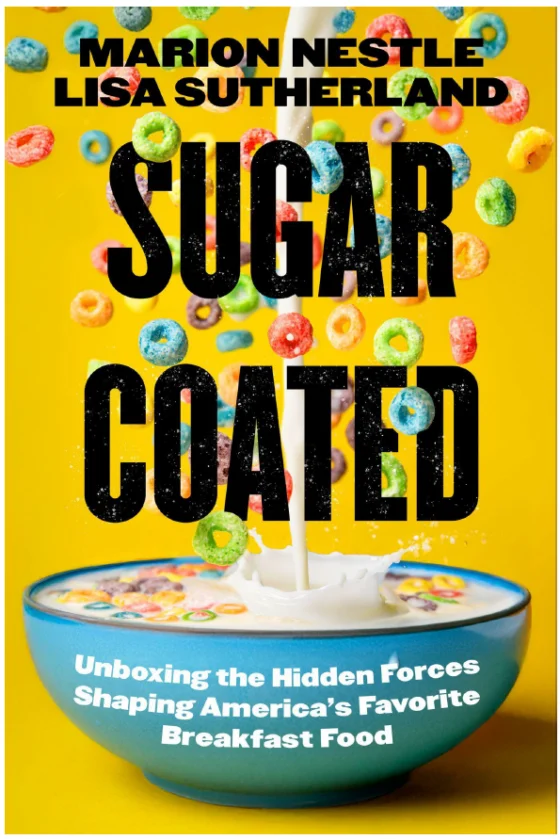
In the high-stakes arena of American nutrition policy, where corporate influence often collides with public health, the integrity of historical records has suddenly become a flashpoint. Marion Nestle, a distinguished professor emerita of nutrition, food studies, and public health at New York University, recently found herself the target of a series of inflammatory claims made by Calley Means, a top food advisor to Robert F. Kennedy Jr. and a prominent figure in the Make America Healthy Again (MAHA) movement.
The dispute, which has played out across elite panels at the Aspen Ideas Festival and the public stage of the Great American State Fair, centers on allegations that Nestle—a long-time critic of the food industry—was herself a puppet for the very sugar and tobacco interests she has spent her career exposing. Nestle, however, has pushed back with a meticulous, evidence-based refutation, labeling the charges as not merely incorrect, but "spectacularly false."
The Chronology of Conflict
The friction between these two camps reached a boiling point on June 30 at the Aspen Ideas Festival. During a panel discussion moderated by journalist Corby Kummer, Means pivoted from policy discourse to personal accusation, claiming that Nestle’s research had been bankrolled by the sugar and tobacco industries. According to Means, these industries funded her to prioritize carbohydrates and grains as the foundation of the American diet, effectively shifting the blame away from sugar.
The rhetoric escalated on July 6 at the Great American State Fair. During his speech, Means doubled down, explicitly stating that in the 1980s, the "Sugar Research Council" paid Nestle to conduct research that promoted a grain-heavy diet. He further alleged that Nestle claimed credit for being the "architect" of the 1992 Food Pyramid, a document he described as the "most destructive public health document in modern history."
When approached by Washington Post reporter Tim Carman for comment, Nestle was stunned. Having built a career on transparency and the rigorous study of industry-funded research, she found the accusations to be a complete reversal of her actual body of work. "Anyone even remotely familiar with my work would know these statements could not possibly be true," Nestle stated, adding that she is not an enemy of the MAHA movement but rather a proponent of coalition-building around shared objectives.
Deconstructing the Allegations: A Line-by-Line Rebuttal
To clear her professional record, Nestle has systematically dismantled the claims made by Means, providing documentation for each point of contention.
The "Sugar Research" Claim
Means asserted that the Sugar Research Council funded Nestle in the 1980s. Nestle points to a starkly different reality: during that decade, she was a faculty member at the University of California, San Francisco (UCSF), directing a nutrition education program funded by the National Institutes of Health (NIH) and the John Tung Foundation. Nestle maintains a strict, long-standing policy—publicly documented on her website—of refusing payments from food companies to avoid any appearance of a conflict of interest.
The Food Pyramid Fallacy
Perhaps the most significant accusation was that Nestle was the "architect" of the 1992 USDA Food Pyramid. Nestle clarifies that she held no such position. In fact, her involvement with the project was adversarial: she worked with New York Times reporter Marian Burros to expose how the meat industry successfully pressured the USDA to suppress the pyramid’s release in 1991. This effort is documented extensively in her seminal book, Food Politics.
The "Anti-Fat, Pro-Grain" Narrative
Means argued that Nestle’s research pushed Americans toward a grain-based diet while encouraging the fear of healthy fats. Nestle notes that the scientific consensus of the 1980s, reflected in the 1988 Surgeon General’s Report on Nutrition and Health (which she helped manage), was based on the limited data available at the time. The report advocated for a balanced intake of vegetables, fruits, and whole grains—a standard recommendation that aligns with nutritional science of that era, rather than a clandestine industry-driven agenda.

The "Tobacco Influence" Misunderstanding
While Means suggested the 1990s dietary guidelines were a product of the cigarette industry (which owned several major food companies at the time), Nestle offers a more nuanced correction. While the "tobacco playbook" of marketing unhealthy products is a well-documented phenomenon, the primary corporate influence on federal dietary guidelines during that era, according to Nestle’s research, was the meat and dairy lobby.
The Implications of "Deflection"
Why would a figure like Calley Means attack a veteran academic like Marion Nestle? Observers suggest that the MAHA movement is currently facing significant hurdles as it attempts to implement its ambitious, and sometimes controversial, policy agenda.
As the movement encounters pushback—both from institutional stakeholders and the realities of legislative gridlock—there is a strategic temptation to identify "villains." By painting a pioneer of food politics as an industry shill, Means may be attempting to deflect attention from the inherent difficulties the MAHA movement faces in challenging the entrenched power of the modern food-industrial complex.
Nestle’s work, which emphasizes the fiduciary responsibility of corporations to stockholders as the root cause of systemic health issues, poses a different kind of challenge to the status quo than the populism of MAHA. However, by choosing to engage in personal attacks rather than policy debates, critics like Means risk alienating the very experts whose data could help bridge the gap between ideal policy and real-world implementation.
The Gold Standard of Science
The exchange serves as a sobering reminder of the state of discourse in the digital age. When public health policy is debated through the lens of social media soundbites and Instagram reels, the nuance of historical record is often the first casualty.
"Reasonable people can disagree about elements of nutrition policy," Nestle wrote in her response. "But reasonable people cannot invent a history that did not exist."
Nestle’s career, spanning decades of advocacy and objective research, stands as a testament to the "Gold Standard" of science—a process that relies on evidence, peer review, and transparent disclosure. Her call for accountability is clear: if anyone wishes to challenge her work, they must do so with evidence, not name-calling or fabricated narratives.
As the battle for the future of American health continues, the ability to discern between industry-backed propaganda and the rigorous, sometimes inconvenient truths of nutritional science will remain paramount. The MAHA movement, if it intends to be a serious player in the national conversation, may eventually find that building bridges with established experts is more effective than burning them with false accusations.
For now, the record stands corrected: Marion Nestle remains a steadfast critic of the food industry, and the history of the 1992 Food Pyramid remains, as always, a matter of public record—not a work of political fiction.