







Even after hanging up her competition heels, two-time Olympia Figure champion Erin Stern remains a towering influence in the fitness industry. While the stage lights of the Olympia have dimmed for her, her commitment to physical excellence has only intensified. Stern has pivoted from the grueling demands of bodybuilding prep toward a more nuanced, sustainable goal: the pursuit of longevity.
In a recent, widely shared instructional post on Instagram, Stern demystified the aging process, offering a masterclass in maintaining physical "bounce." The highlight of her message? You don’t need a rack of dumbbells or a heavy barbell to cultivate a resilient, high-functioning body. By focusing on agility, mobility, and core control, Stern is providing a roadmap for fitness enthusiasts to ensure their bodies remain as capable at 60 as they were at 30.
The Philosophy of "Bounce": Understanding Physical Decline
The Mechanics of Aging and the Loss of Elasticity
To understand why Stern’s recent routine is generating such buzz, one must first understand the biological reality of aging. According to Stern, the traits that define athletic vitality—agility, mobility, bounce (plyometric capacity), and core stability—are the first casualties of the aging process.
As the human body enters its fourth and fifth decades, sedentary habits and a lack of specific, high-intensity stimuli often lead to a decline in fast-twitch muscle fiber recruitment. This decline manifests as a loss of power, a stiffening of the joints, and a diminished ability to react to environmental stressors—such as the risk of a fall.
"Agility, mobility, bounce, and core—these are the traits that we lose with age," Stern noted. "The solution is to intentionally add exercises that ensure you will continue to move with speed, flow, and control."
By prioritizing these specific domains, Stern isn’t just training for aesthetics; she is training for independence. The "bounce" she refers to is synonymous with neuromuscular efficiency—the body’s ability to communicate between the brain and the musculature to execute movements with precision.
Chronology: A Step-by-Step Breakdown of the Longevity Protocol
Stern’s approach is systematic, beginning with joint health and progressing into explosive, reactive movements before cooling down with restorative mobility work. Here is how to replicate her routine, designed to be performed either as a standalone session or as a high-performance warm-up.
1. Hip Flexor Activation (Cable High Knees)
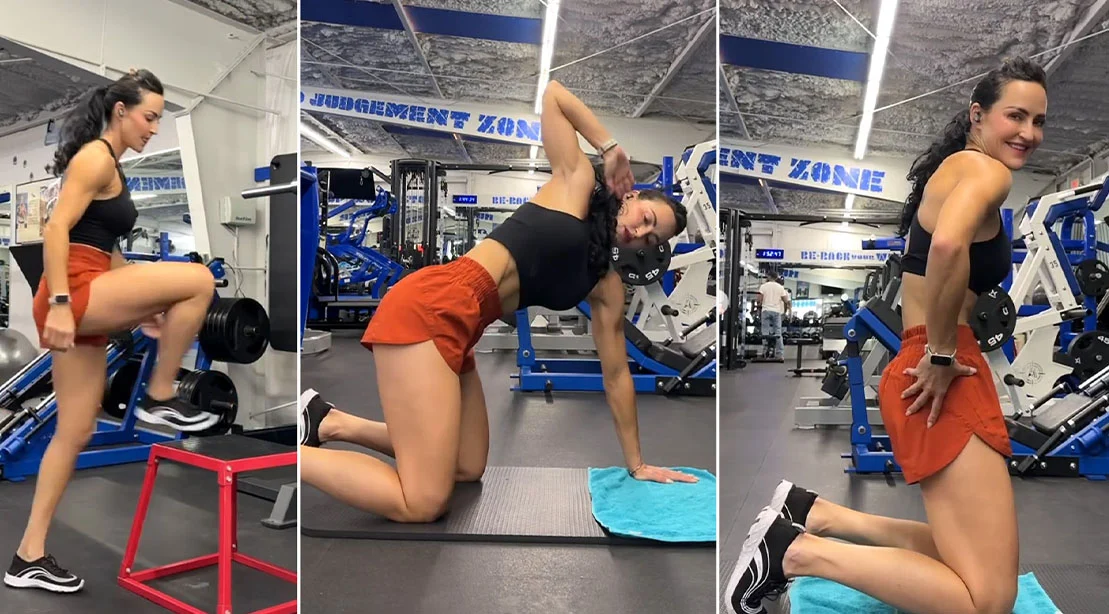
Stern utilizes a cable station with a foot cuff for this movement. By adding a low-level of resistance to a high-knee motion, she emphasizes "hip flexor health and strength." Strong hip flexors are vital for gait efficiency and posture, acting as a bridge between the lower and upper body.
2. Pogo Box Jumps
"Pogo jumps are for fast-twitch muscle recruitment and bone density," Stern explains. By utilizing an aerobic stepper or a low box, she focuses on minimal ground contact time. The goal is to touch both feet to the surface simultaneously, emphasizing a quick, "spring-like" reaction that keeps the tendons elastic and the bones stimulated.
3. Depth Jumps
Building on the pogo jumps, depth jumps are a more advanced exercise for "improved reaction time and bone density." This move teaches the body how to land under pressure, effectively prepping the central nervous system to absorb force—a critical skill for preventing injuries in daily life.
4. T-Spine Rotations
Transitioning to the floor, Stern utilizes a mat for T-spine (thoracic spine) rotations. As we age, the upper back often becomes kyphotic (rounded). Improving thoracic mobility is essential for shoulder health, better posture, and overall rotational power.
5. Cat-Cow Stretches
A staple in physical therapy and yoga, the cat-cow stretch serves as a restorative bridge. By moving through spinal flexion and extension, Stern activates the muscles surrounding the spine while releasing chronic tension in the lower back, ensuring the core remains supple rather than rigid.
6. The Stomach Vacuum
The final movement in her routine is the vacuum, a classic bodybuilding technique used to strengthen the transversus abdominis. This is not just for the aesthetic goal of a smaller waist; it is a fundamental exercise for core control, which stabilizes the spine and protects the internal organs.
Supporting Data: Why This Approach Works
The Intersection of Science and Experience
While free weights are the gold standard for hypertrophy, the "longevity mix" proposed by Stern aligns with current research in sports science regarding sarcopenia (muscle loss) and osteopenia (bone density loss).
Research published in the Journal of Aging and Physical Activity consistently shows that as individuals reach their 50s and beyond, the inclusion of plyometric-style training—like the Pogo and depth jumps highlighted by Stern—is essential. While heavy lifting builds the "bricks" (muscle tissue), plyometrics act as the "mortar," reinforcing the connective tissue, tendons, and neurological pathways that prevent the frailty often associated with advanced age.
Furthermore, the focus on the thoracic spine and core control addresses the two most common sites of injury in older adults: the lower back and the shoulder girdle. By keeping the T-spine mobile and the deep core strong, an individual can maintain a vertical posture, which in turn reduces the compensatory stress placed on the lumbar spine.
Official Responses and Industry Implications
The Shift Toward Longevity-First Training
Industry experts have lauded Stern’s pivot, noting that the "more is more" mentality of professional bodybuilding often ignores the long-term wear and tear on the joints.
"What Erin is doing is bridging the gap between high-level athletic performance and functional wellness," says a leading strength and conditioning coach. "We are seeing a massive shift in the fitness industry where the goal is no longer just how much you can lift, but how long you can keep lifting. Stern is a perfect ambassador for this because she has already achieved the peak of aesthetic success and is now showing the world the ‘after-career’ phase."
The implications for the general public are clear: You do not need to be an Olympian to train like one. The beauty of this routine lies in its scalability. A beginner can perform these movements with minimal height on their jumps and slower tempos, while an athlete can increase the intensity to maintain explosive power.
The Path Forward: Integrating the Routine
If you are looking to revitalize your training, Stern advises against rushing. The focus should be on "breath work and slowing things down." In the beginning, the objective is to master the movement pattern—learning how to land, how to engage the core, and how to rotate the spine without discomfort.
As confidence grows, these exercises can be integrated into a larger workout schedule. Many of Stern’s followers are now using this sequence as a 15-minute warm-up before hitting their traditional heavy compound lifts. By "waking up" the nervous system with plyometrics and lubricating the joints with mobility work, lifters are reporting better performance in their squats and deadlifts, along with a significant reduction in post-workout joint pain.
A New Standard for Aging
Erin Stern’s transition from the Olympia stage to a longevity advocate is more than just a career move; it is a signal that the fitness industry is maturing. The "buff beauty" of the 2010s has become the "smart trainer" of the 2020s. By prioritizing the bounce in our step and the mobility in our spines, we aren’t just fighting the clock—we are making the time we have count.
For those inspired by this approach, the message is simple: Stop focusing solely on the weight on the bar. Start focusing on the quality of your movement. As Stern’s Instagram feed continues to serve as a beacon for high-level fitness, her followers are reminded that longevity is not a destination—it is a daily practice of movement, control, and, above all, the willingness to keep bouncing.
For those interested in following Erin Stern’s ongoing journey and staying updated on her specific training methodologies, you can find her on Instagram at @2x_ms_olympia.