










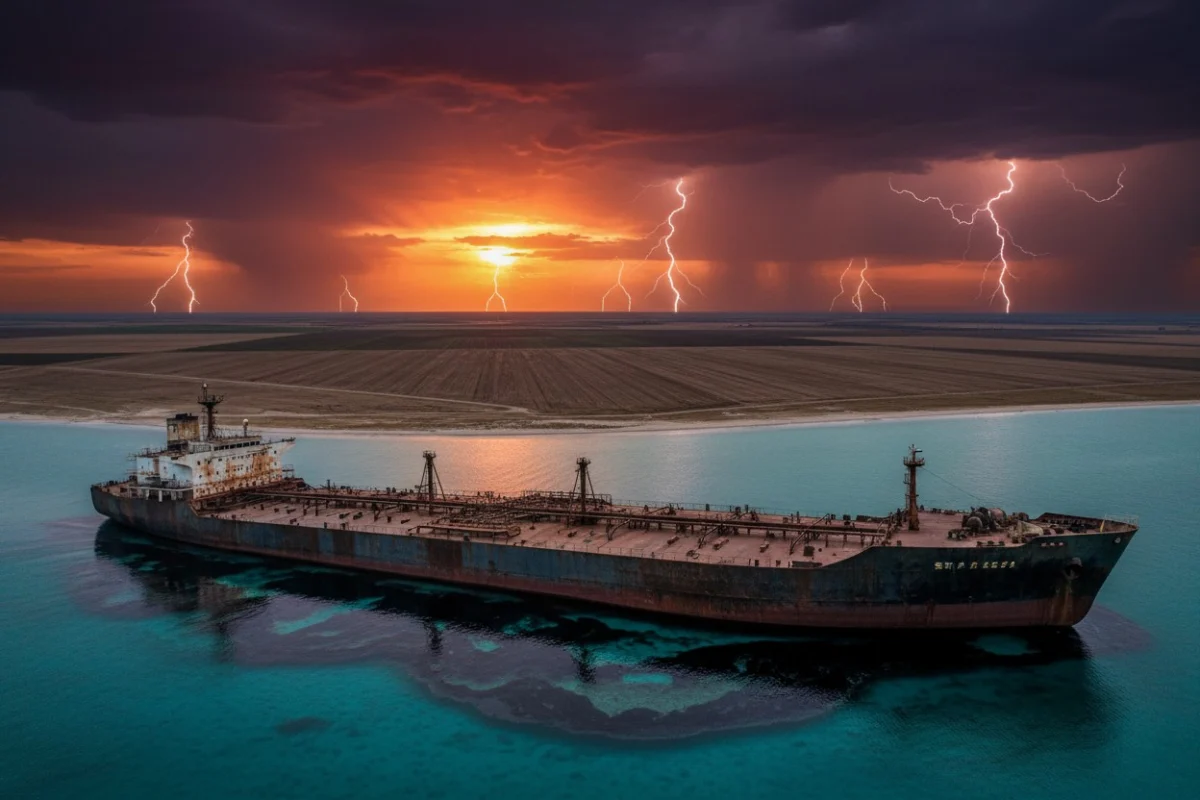
While global financial media remains fixated on the daily fluctuations of crude oil prices, a much more profound and irreversible tragedy is unfolding beneath the surface of the international economy. The ongoing conflict involving Iran and the closure of the Strait of Hormuz has acted as a tourniquet on the global supply chain, severing the arteries that deliver the essential "upstream" commodities upon which modern civilization is built.
We are not merely witnessing a regional military confrontation; we are sleepwalking into a systemic, global collapse. When the flow of natural gas, refined petroleum, and industrial metals is choked, the cascading failures that follow are not theoretical—they are mathematically inevitable.
The Anatomy of a Structural Collapse: Main Facts
The modern world operates on a fragile "just-in-time" delivery model. This system relies on the assumption that energy—specifically natural gas and oil—will always be available to power the Haber-Bosch process for fertilizer, the smelting of aluminum, and the production of plastics.
The current geopolitical climate has invalidated these assumptions. By choking off the Persian Gulf, the conflict has created a "bottleneck effect." Because the infrastructure of the global economy is so deeply integrated with Middle Eastern energy, the inability to move these raw materials means that production lines from Shenzhen to Detroit are facing a structural death sentence. We are currently observing a transition from an era of abundance to an era of permanent, forced scarcity.
A Chronology of the Hormuz Crisis
The acceleration toward this precipice can be traced through several critical milestones over the past 24 months:
- Early 2025: Tensions escalate in the Persian Gulf, leading to the first major disruption of LNG tanker routes.
- Late 2025: The Ras Laffan LNG field in Qatar—a cornerstone of global energy—sees operations severely curtailed as shipping lanes become untenable.
- January 2026: The Strait of Hormuz effectively closes to civilian commercial traffic, trapping massive quantities of hydrocarbon feedstock.
- March 2026: Global aluminum producers report a 40% reduction in smelting capacity due to energy shortages, sending prices on the London Metal Exchange (LME) into a parabolic climb.
- May 2026: Aluminum hits a four-year record of $3,672 per metric ton.
- June 2026: Semiconductor manufacturers, particularly those reliant on specialized cooling gases like helium, signal a critical inventory deficit, leading to a 15% valuation crash in major tech stocks.
Supporting Data: The Industrial Inputs in Peril
Aluminum: The Backbone of Infrastructure
Aluminum is the most ubiquitous industrial metal on the planet, vital for everything from the aerospace industry to the construction of data centers for artificial intelligence. Because aluminum smelting is an energy-intensive process that relies heavily on natural gas, the energy crisis in the Gulf has hit the sector with surgical precision. With natural gas prices volatile and supply routes severed, smelters are idling at an unprecedented rate. This is not a "blip"; it is a systemic reduction in the world’s capacity to build and repair physical infrastructure.
The Fertilizer Famine
Perhaps the most harrowing aspect of this crisis is the threat to global food security. Modern industrial agriculture is entirely dependent on nitrogen-based fertilizers produced via the Haber-Bosch process. This process requires hydrogen, which is derived from natural gas. Simultaneously, phosphorus fertilizer production relies on sulfuric acid, a byproduct of oil refining.
Data models suggest a 30% to 50% reduction in global fertilizer availability. Agriculture experts estimate that staples—wheat, corn, and soy—are facing yield declines of up to 20%. In regions already dependent on food imports, such as sub-Saharan Africa and parts of Southeast Asia, this decline is not merely an economic statistic; it is a harbinger of mass famine.
Helium and the Tech Bubble
The high-tech sector, currently the primary engine of global market growth, is uniquely vulnerable. Helium is essential for cooling the high-bandwidth memory chips required for AI data centers and for the operation of medical MRI machines. With 25% of the world’s helium originating from the Persian Gulf, the supply chain has been crippled. The recent volatility in semiconductor stocks, characterized by double-digit drops in key manufacturers like SK Hynix, reflects a growing realization: without the raw material inputs, the AI infrastructure buildout cannot continue.
Official Responses and Geopolitical Stance
The diplomatic response to the crisis has been characterized by a stark disconnect between public posturing and private alarm. While Western governments emphasize "strategic patience" and the maintenance of maritime security, the reality on the ground contradicts these narratives.
International observers, including reports from the Middle East Eye, suggest a growing consensus that the strategic objectives of the conflict have largely failed to materialize. A significant portion of the electorate in both the United States and Israel has begun to express deep skepticism regarding the utility of continued escalation. Recent polling suggests that upwards of 60% of U.S. voters and a staggering 92% of Israelis perceive the current strategic situation as a loss of stability, with Iran maintaining significant leverage over the global flow of commodities.
Implications: The Cascading Failure
The implications of this supply chain failure extend far beyond high prices; they touch upon the very survival of the current social order.
The Energy-Food Nexus
As noted in the seminal work Depletion and Abundance, our food system is, in effect, a delivery system for oil and gas. If the fuel to power tractors, the natural gas to synthesize ammonia, and the petroleum-based plastics to package goods disappear, the supermarket shelves will not simply become more expensive—they will become empty.
Economic Contagion
The "tech-driven recovery" that has buoyed equity markets is now facing a structural ceiling. If the semiconductor industry cannot source the cooling gases or the structural components required for manufacturing, the valuation of the entire tech sector—which constitutes a massive percentage of current indices—will undergo a brutal correction. This is a "systemic shock" that no central bank can print its way out of.
The Human Cost
If the conflict continues to escalate, the math points toward a worst-case scenario: a significant reduction in global population due to the convergence of famine and the breakdown of medical supply chains. We are looking at a potential humanitarian catastrophe that could claim upwards of two billion lives if the systemic rot is not halted by an immediate restoration of trade.
Conclusion: The Only Path Forward
The math of the current crisis is inescapable. We have reached a point where the cost of military posturing exceeds the value of the geopolitical objectives being pursued. The global "war machine" is currently consuming the very resources that sustain its own population.
The only viable path forward is a fundamental pivot toward de-escalation and the restoration of open trade. This requires more than just rhetoric; it demands a significant shift in diplomatic policy, prioritizing the stabilization of shipping lanes and the resumption of commodity flows over ideological rigidity.
As we stand on this precipice, the call to action for the individual is clear: prioritize resilience. Store essential food supplies, secure tangible assets, and gain proficiency in local, small-scale production. However, the macro-solution remains in the hands of leadership. We must demand peace before the arteries of modern society are clogged beyond the possibility of repair. The collapse is not a distant threat—it is an unfolding reality. It is time to act before the infrastructure of civilization itself unravels.