









The U.S. government has officially released the 2025–2030 Dietary Guidelines for Americans (DGAs), a landmark document intended to steer the nation toward healthier eating habits. With the overarching tagline “eat real food,” the new edition takes a significantly firmer stance against the pervasive influence of ultra-processed items and added sugars. However, beneath the consumer-friendly surface and simplified digital interface, the document has ignited a firestorm of controversy among nutrition scientists, public health experts, and policy analysts.
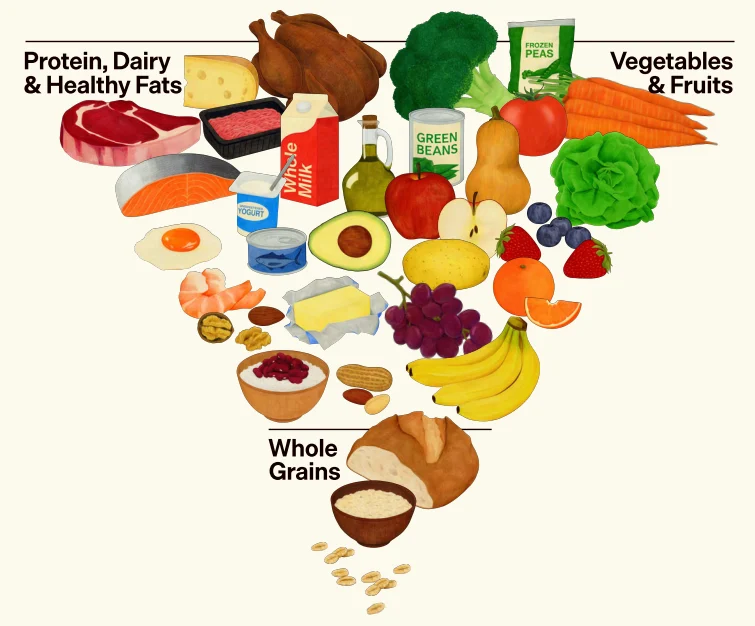
While the Guidelines successfully mirror modern scientific consensus on the dangers of refined carbohydrates and excess sugar, they are simultaneously being criticized for a confusing, potentially contradictory visual hierarchy. Most notably, the return of a “food pyramid” graphic—flipped on its head—features a visual prominence of red meat, full-fat dairy, and butter that many experts argue undermines the very health goals the document aims to achieve.
Main Facts: A New Approach to Dietary Guidance
The 2025–2030 Dietary Guidelines represent a shift in tone for federal nutrition policy. Recognizing that Americans are struggling with a health crisis fueled by metabolic disease, the authors have explicitly called out “highly processed foods” as a primary target for reduction. This is a significant evolution from previous iterations, which often focused on nutrients in isolation rather than the degree of industrial processing.
Key features of the new guidelines include:
- The War on Added Sugar: The document takes a hard line, stating that no amount of added sugar or non-nutritive sweetener is part of a healthy diet. It suggests a limit of no more than 10 grams per meal and advises that children avoid added sugars entirely until age 10—a massive jump from the previous age-2 threshold.
- Refined Carbohydrate Reduction: There is a renewed emphasis on fiber-rich, whole-grain options, urging consumers to swap out refined grains like white bread and pastries for complex alternatives.
- A "New" Food Pyramid: The government has reintroduced a pyramid-style graphic. Unlike the original, which prioritized grains at the base, this version is inverted, placing various proteins and fats in a position of visual prominence.
- Protein Hype: The guidelines suggest an increase in protein intake, targeting 1.2 to 1.6 grams per kilogram of body weight, which is 50–100% higher than previous minimums.
Chronology of Development: A Departure from Tradition
The development of the DGAs typically follows a rigorous, multi-year, transparent process. Every five years, the U.S. Departments of Agriculture (USDA) and Health and Human Services (HHS) convene an independent Dietary Guidelines Advisory Committee (DGAC). This committee consists of leading nutrition scientists who synthesize the latest peer-reviewed evidence.
However, the 2025–2030 cycle deviated sharply from this standard. The committee’s initial, independent Scientific Report—the result of two years of research—was ultimately rejected by the administration. In its place, a supplemental scientific analysis was conducted by a group of individuals selected via a “federal contracting process.”
This pivot has drawn intense scrutiny. Deirdre Tobias, an assistant professor in the Department of Nutrition at the Harvard T.H. Chan School of Public Health and a member of the 2025–2030 Advisory Committee, has publicly lamented the lack of transparency. She noted that the final version of the guidelines was produced without the replicable, unbiased methodology that typically defines federal nutrition policy. Furthermore, investigative reports have highlighted that several of the individuals involved in the supplemental review panel maintained disclosed financial ties to the beef and dairy industries—a reality that many critics argue is reflected in the prominent placement of these products in the new food pyramid.
Supporting Data: The Saturated Fat Mathematics
One of the most glaring contradictions in the 2025–2030 DGAs is the disconnect between the written text and the visual imagery. While the text retains the long-standing scientific recommendation that saturated fat should be limited to 10% of total daily calories, the graphic depicts steak, cheese, and butter as foundational dietary staples.
To understand the mathematical conflict, consider a standard 2,000-calorie diet. At a 10% limit, an individual should consume no more than 22 grams of saturated fat per day. The guidelines simultaneously recommend three servings of dairy per day. If a consumer follows the visual cue to prioritize full-fat options:
- One 8-ounce cup of whole milk provides 5 grams of saturated fat.
- ¾ cup of full-fat Greek yogurt provides 6 grams.
- 1 ounce of cheddar cheese provides 6 grams.
This simple, three-serving combination reaches 17 grams of saturated fat—nearly 80% of the daily limit. Adding a single tablespoon of butter (7 grams) for cooking immediately pushes the consumer over the 10% threshold before they have even consumed a piece of fruit, a vegetable, or a lean protein source.
Dr. Frank Hu, chair of the Department of Nutrition at Harvard, emphasizes that the “protein package” matters. "When we eat foods for protein, we also eat everything that comes alongside it—the fats, sodium, and fiber," says Dr. Hu. "The guidelines fail to distinguish between protein sources, potentially leading consumers toward red meat and high-fat dairy, which are linked to higher LDL cholesterol and cardiovascular risk, rather than healthier plant-based or fish-based alternatives."
Official Responses and Scientific Critique
The government maintains that the new guidelines are designed to be more consumer-friendly and actionable. The push for higher protein, according to some proponents, addresses the needs of an aging population prone to sarcopenia (muscle loss). However, critics argue that the lack of nuance regarding protein quality is a major oversight.
The scientific community’s critique centers on the “re-litigation” of established nutritional science. By ignoring the consensus on saturated fats and the importance of healthy oils (like olive or canola) over animal fats, the current iteration of the DGAs risks confusing the public.
Moreover, the guidelines have been criticized for their total omission of environmental and socioeconomic factors. Despite the clear link between food systems, climate change, and health outcomes, the 2025–2030 document remains silent on the environmental impact of its dietary recommendations, a stance that puts it at odds with many global health organizations.
Implications for Public Health
The primary concern regarding these new guidelines is that, in the world of nutrition, visual cues are often more memorable than technical appendices. If Americans view the new pyramid as an endorsement of unrestricted steak and butter consumption, the risk of cardiovascular disease—already a leading cause of death in the U.S.—could be exacerbated.
Furthermore, the ambiguity regarding alcohol consumption—merely advising people to “consume less”—provides little actionable guidance for the millions of Americans looking for clear boundaries on what constitutes moderate, safe intake.
For the average consumer, the mixed messages present a significant challenge. When the government provides advice that seems to prioritize the economic interests of certain food sectors over the consensus of the scientific community, public trust in nutritional advice diminishes.
Moving Forward: Navigating the Confusion
If the history of dietary guidelines is any indicator, compliance will remain a hurdle. Statistics from the CDC show that even in years with clearer, more consistent messaging, the vast majority of the U.S. population fails to adhere to federal guidelines. With the current confusion, that trend is unlikely to reverse.
For those seeking to navigate this landscape, health experts recommend looking beyond the government’s simplified pyramid. Organizations such as the Harvard T.H. Chan School of Public Health offer alternative resources, such as the Healthy Eating Plate, which provides a more evidence-based, balanced approach to nutrition.
Ultimately, the 2025–2030 Dietary Guidelines serve as a reminder that nutritional policy is rarely just about science—it is a complex intersection of industry lobbying, political pressure, and evolving public health needs. As these guidelines are implemented, the responsibility falls on individual consumers and healthcare providers to critically evaluate the advice, prioritize whole, plant-forward foods, and maintain a cautious approach to the conflicting messages emanating from Washington. Consulting a registered dietitian remains the gold standard for those seeking personalized, science-backed nutritional guidance in an era of increasingly murky federal policy.