









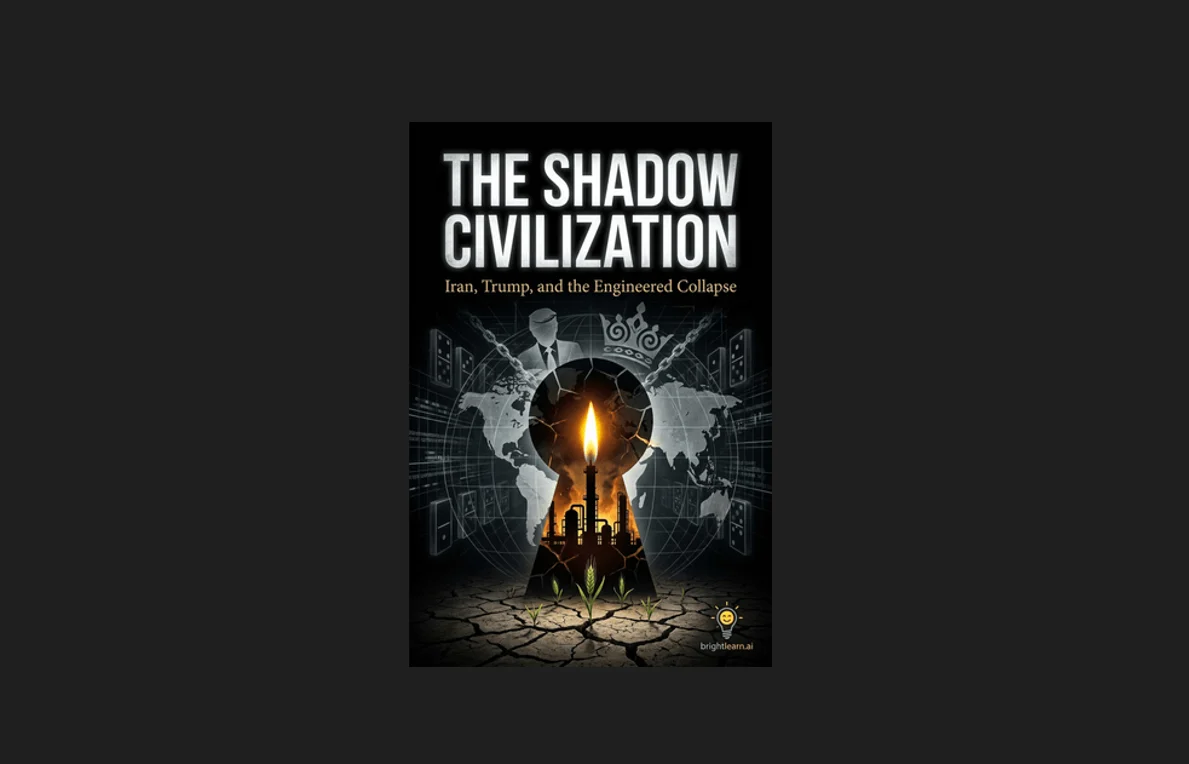
In his latest provocative work, The Shadow Civilization: Iran, Trump, and the Engineered Collapse, investigative analyst Mike Adams posits a thesis that challenges the foundational narratives of modern society. Adams argues that the contemporary world is not merely experiencing a series of disjointed crises—such as inflation, geopolitical instability, or public health emergencies—but is rather the victim of a coordinated transition into a "shadow civilization." This counterfeit reality, according to Adams, has systematically replaced authentic systems of human flourishing with hollow, centralized imitations designed primarily for population control and resource extraction.
The Five Pillars of the Shadow World
Adams breaks down this transition into five distinct, overlapping layers of control. His analysis serves as a diagnostic tool for understanding how institutions have drifted from their stated missions toward the interests of globalist stakeholders.
1. Shadow Food: The Petrochemical Illusion
The modern food supply, Adams contends, is a byproduct of the petrochemical industry. By transforming hydrocarbons into caloric intake through synthetic fertilizers and industrial processing, the system provides energy but strips away vital nutrition. This "shadow food" creates a state of chronic, nutrient-deficient health that necessitates the intervention of the medical industrial complex, creating a self-sustaining cycle of sickness and profit.
2. Shadow Money: The Fiat Deception
Tracing the evolution of the global economy from the 1971 abandonment of the gold standard, Adams highlights the inherent instability of the petrodollar. The Federal Reserve’s fractional reserve banking system, he argues, operates on the constant creation of debt rather than wealth. Every new unit of currency printed represents a direct, incremental devaluation of the purchasing power held by the average citizen, necessitating a return to hard assets like gold and silver for long-term survival.
3. Shadow Medicine: The Regulatory Capture
Adams characterizes the modern pharmaceutical establishment as a "death cult of junk science" that has effectively captured regulatory agencies like the FDA. By prioritizing patentable synthetic drugs over natural, non-proprietary remedies, the industry ensures recurring revenue streams. The COVID-19 pandemic, in this view, served as a "field test" for mass societal compliance and the expansion of emergency-use authority.
4. Shadow Elections: The Uni-Party Facade
The author dismantles the binary perception of American politics, suggesting that the Democratic and Republican parties represent two functional wings of a singular "uni-party." Adams argues that the political establishment maintains the theater of opposition to distract from a unified globalist agenda. He cites the hostility toward Donald Trump—not as a failure of policy, but as an indicator of his status as an outsider who threatened the established bureaucratic order.
5. Shadow Science: The Corruption of Truth
Perhaps the most damaging layer identified by Adams is the institutionalization of "shadow science." When climate models, vaccine safety data, and public health metrics are manipulated to fit pre-determined political narratives, science loses its role as an objective pursuit of truth. Adams claims this corruption has permeated the CDC, NIH, and WHO, transforming them into instruments of narrative enforcement rather than scientific inquiry.
Chronology of the Engineered Collapse
To understand the trajectory of this shadow civilization, one must look at the historical timeline Adams presents, which suggests these events are not random occurrences but parts of a long-term strategic plan.
- 1971: The Monetary Shift. The decoupling of the dollar from gold shifted the global economy toward a debt-based model, laying the groundwork for the current inflationary environment.
- Late 20th Century: The Haber-Bosch Dependency. The global reliance on synthetic nitrogen fertilizer—dependent on natural gas—was solidified, creating an agricultural system vulnerable to energy shocks.
- 2020–2022: The Pandemic Dress Rehearsal. COVID-19 mandates established the social and technological infrastructure for surveillance, censorship, and digital health tracking.
- 2023–Present: The Energy-Food Nexus. The shift from health mandates to "climate" and "energy" mandates marks the current phase, where the denial of energy resources is used as a tool to control food production and distribution.
The Geopolitics of Starvation: The Hormuz Factor
Adams pivots to the Middle East, specifically the Strait of Hormuz, to illustrate how regional conflict is linked to global survival. As a critical chokepoint for roughly 20% of the world’s oil, the Strait is the literal bottleneck for the global food supply.
Because modern agriculture is tethered to the Haber-Bosch process, the availability of natural gas is the primary determinant of global food security. Adams argues that the weaponization of this supply chain—through regional conflict or intentional energy sanctions—is not an accidental byproduct of war, but a deliberate mechanism to induce famine.
He highlights the fragility of nations like India, where agricultural subsidy traps have created a dangerous dependency. By subsidizing grain and electricity, the state has inadvertently depleted groundwater and destroyed soil health, leaving millions reliant on an imported, chemical-heavy agricultural model. When global fertilizer and energy prices spike, these nations are pushed toward immediate systemic collapse.
Implications: The Final Lockdown
Adams posits that the ultimate goal of these combined shadow systems is a "final lockdown." This transition from health-based lockdowns to energy-based rationing is described as the next stage of global control. Under the guise of "Net Zero" initiatives, the phasing out of affordable, reliable energy sources—specifically fossil fuels—will inevitably render food production unaffordable, forcing populations into centralized dependence on the state.
The Detention Network
The author points to the existence of a massive, government-managed detention infrastructure, such as the FEMA-managed "Project Red Horse" network. While officially framed for humanitarian or emergency use, Adams suggests the legal frameworks governing these facilities have been broadened to potentially encompass any citizen deemed a threat to the administrative state.
Official Responses and Public Counter-Narratives
Mainstream institutions have largely ignored the assertions made in The Shadow Civilization, maintaining that current economic and public health policies are necessary responses to existential threats such as climate change and global instability. However, a growing body of independent analysts and researchers have begun to corroborate specific elements of Adams’ reporting, particularly regarding the dangers of regulatory capture and the fragility of global supply chains.
The "Dirty Dozen" of medical professionals and researchers, whom Adams highlights as victims of coordinated censorship, continue to challenge the official records regarding vaccine safety and pharmaceutical industry influence. These individuals argue that the systematic exclusion of dissenting data from public discourse is a fundamental violation of the scientific method.
Conclusion: Toward a Post-Shadow Future
Despite the grim nature of his analysis, Adams concludes The Shadow Civilization on a note of cautious optimism. He posits that the "shadow" systems are inherently fragile because they are detached from reality. By focusing on decentralized resilience—growing one’s own food, adopting natural health modalities, building local community ties, and securing assets outside the fiat banking system—individuals can effectively opt out of the shadow structure.
"The shadows of empire are long," Adams writes, "but they are not eternal." He suggests that the collapse of these artificial systems is inevitable, and that the path forward lies in the restoration of local, bottom-up autonomy.
For the reader, the book serves as both a roadmap for survival and a call to action. It forces a confrontation with the uncomfortable reality of our current geopolitical and economic state, demanding that citizens reclaim their independence from the very institutions that seek to define their reality. As the global landscape shifts, The Shadow Civilization remains an essential, albeit unsettling, document for those looking to see behind the curtain of the modern era.
For further reading, Mike Adams’ full investigation and thousands of additional resources are available at Books.BrightLearn.AI. To explore the data further, readers can also visit BrightLearn.AI and the Health Ranger Report on Brighteon.com.