








For twenty years, a fierce ideological and scientific battle has raged within the halls of psychiatry and the pages of public health journals. At the center of this conflict is the U.S. Food and Drug Administration’s (FDA) 2004 "black box" warning, which cautioned that antidepressants could increase the risk of suicidal thoughts and behaviors in children and adolescents.
While the warning was intended to protect vulnerable youth, a powerful counter-narrative emerged almost immediately: that the warning itself was a "tragic mistake" that scared doctors away from prescribing life-saving medication, thereby causing an "epidemic" of untreated depression and subsequent suicides. However, a growing body of evidence, bolstered by recent stinging rebukes from former FDA medical officers, suggests that this counter-narrative may be built on a foundation of statistical manipulation and a refusal to acknowledge raw clinical data.
Main Facts: The Warning and the Counter-Narrative
In 2004, following a series of clinical trials and public hearings, the FDA issued its most stringent warning—the black box—for Selective Serotonin Reuptake Inhibitors (SSRIs) and other antidepressants prescribed to minors. The decision was based on a meta-analysis of 24 trials involving over 4,400 patients, which found that the risk of suicidal ideation and behavior was nearly twice as high (a relative risk of 1.95) for those taking antidepressants compared to those taking a placebo.
Despite this statistically significant finding, a "pro-prescribing" narrative quickly took hold in mainstream media. This narrative asserts that the FDA warning led to a sharp decline in antidepressant prescriptions for youth, which in turn caused a spike in suicide rates. This claim has been repeated so frequently that it has become the "standard" answer provided by Artificial Intelligence models and major news outlets.

The conflict, therefore, is not merely over medical practice, but over the integrity of data. On one side are researchers who argue that the drugs themselves carry an inherent risk of inducing suicidality in young people. On the other are those who claim that the lack of drugs is the true killer. Recent developments, however, suggest that the latter group may have ignored the very data they claim to defend.
Chronology: Two Decades of Disputed Data
The history of this controversy is marked by the repeated publication of studies claiming "unintended harm" from the FDA warning, followed by less-publicized rebuttals from critics who point out fundamental flaws in those studies.
2004–2007: The Genesis of the "Sleight of Hand"
Shortly after the warning was issued, Robert Gibbons, Director of the Center for Health Statistics at the University of Chicago, became the primary architect of the counter-narrative. In a 2007 article in the American Journal of Psychiatry, Gibbons argued that youth suicide rates in the U.S. rose by 14% between 2003 and 2004, while SSRI prescriptions dropped.
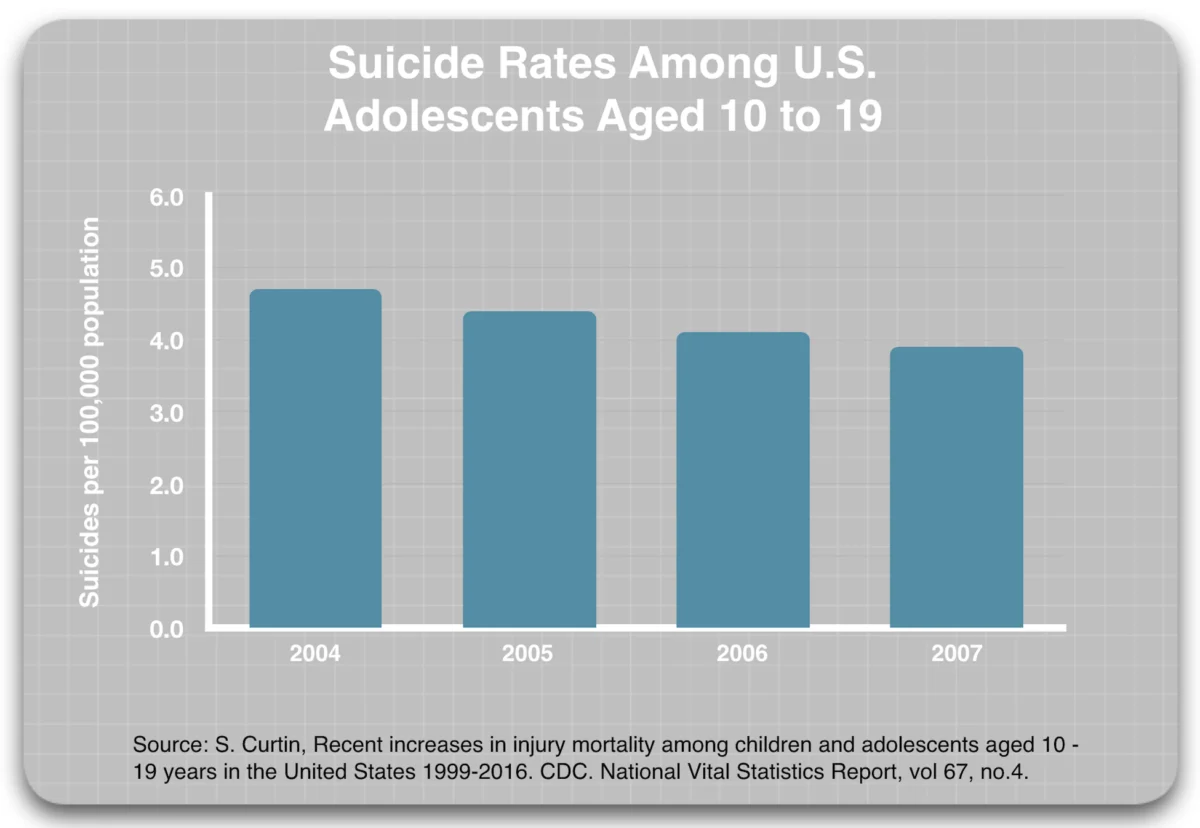
Critics immediately pointed out a chronological mismatch: the increase in suicides occurred before the drop in prescribing that followed the FDA warning. In fact, between 2005 and 2007—the period when prescribing actually declined following the black box issuance—the youth suicide rate notably decreased. This crucial distinction was largely ignored by the mainstream press.

2012–2018: The Narrative Solidifies
In 2012, Gibbons published further papers in the Archives of General Psychiatry asserting that antidepressants were effective and safe for youth. Despite detailed critiques from figures like David Healy and Mickey Nardo—who cited "opaque methodology" and "obvious arithmetic errors"—the journals often relegated these rebuttals to online "Reader’s Replies," which are not indexed in PubMed, effectively burying the dissent.
In 2018, the health news outlet STAT published an opinion piece by Stephen Soumerai (Harvard) and Ross Koppel (University of Pennsylvania). They presented a graphic intended to be a "smoking gun," showing a trend line of rising suicides following the 2004 warning. However, independent analysis of the raw data points in their own graphic showed that suicide rates actually dipped for several years post-warning and only began to rise much later, coinciding with a resumption in high prescribing rates.
2024: The Khan Article and the FDA Rebuttal
The latest flashpoint occurred in the spring of 2024, when psychiatrist Arif Khan published an article in Regulation, a policy magazine by the CATO Institute. Khan claimed that the black box warning had "discouraged" treatment, leading to the "excess deaths" of nearly 6,000 children and young adults. This prompted an unprecedented response from three former FDA medical officers—Marc Stone, Andrew Mosholder, and Tarek Hammad—who published a detailed defense of the warning, accusing Khan of factual inaccuracies that were "directly verifiable" from his own evidence.
Supporting Data: Prescribing Rates vs. Suicide Trends
The argument that the black box warning caused suicides relies on the assumption that less medicine equals more death. However, when the data is plotted chronologically, a different pattern emerges.

The 2005–2007 Window
Following the 2004 warning, there was a documented 20% decline in antidepressant prescribing to youth. According to the data highlighted by Stone and his colleagues:
- Suicide rates for girls aged 10–14 decreased by 46%.
- Suicide rates for girls aged 15–19 decreased by 30%.
- For boys in the same age groups, the declines were 29% and 13%, respectively.
This inverse correlation—prescribing goes down, suicide goes down—directly contradicts the "unintended consequences" theory.
The 2008–Present Rise
Prescribing rates for youth began to climb again in 2008, returning to pre-warning levels by 2011 and soaring to new heights thereafter. Paradoxically, it was during this period of increased prescribing that the youth suicide rate began its steady, tragic rise.
The Clinical Trial Evidence
The FDA’s original meta-analysis remains a cornerstone of the "pro-warning" side. In 372 double-blind randomized controlled trials (RCTs) of antidepressants, the risk of a suicide attempt for those under age 25 was found to be 2.3 times higher in the antidepressant group than in the placebo group. Stone and his colleagues emphasize that this is not a "mixed" or "inconclusive" finding; it is a statistically significant biological signal that the drugs can trigger suicidal behavior in a subset of young patients.

Official Responses and Expert Rebuttals
The most significant development in this saga is the intervention of former FDA medical officers. Marc Stone, Andrew Mosholder, and Tarek Hammad are not outside agitators; they are the experts who originally analyzed the data for the government.
In their rebuke of Arif Khan’s 2024 article, they noted that Khan’s own figures showed suicide rates decreasing for years after the warning. They wrote: "The causal account advanced by Khan et al. is inconsistent with trial evidence, prescribing data, timing patterns, and healthcare-contact realities."
Perhaps the most damning revelation was a "telling anecdote" regarding the peer-review process. Before Khan published his article in Regulation, he sent a draft to Stone and Mosholder for feedback. They returned a critique identifying specific errors and directing Khan to published literature that contradicted his conclusions. According to the FDA officers, Khan ignored the feedback entirely and published the uncorrected errors. This suggests a "disinterest in reviewing facts that belied the claim they were poised to publish."
Implications: The High Cost of Misinformation
The implications of this two-decade debate are profound. If the critics of the black box warning are wrong—as the data from 2005-2007 suggests—then the push to increase prescribing may have contributed to the very rise in youth suicides that the medical community seeks to prevent.

The "Blood on Hands" Argument
The source article suggests a reversal of accountability. While Khan and others accuse the FDA of causing "excess deaths" through caution, the data suggests that the "excess deaths" began to accumulate only when the warning was increasingly ignored and prescribing rates reached record highs. If antidepressants carry a 1.95x to 2.3x risk of inducing suicidality in youth, then the aggressive campaign to discredit the black box warning may have placed thousands of children at risk.
Institutional Inertia and Media Failure
The persistence of the "warning caused suicides" narrative, despite being easily debunked by chronological data, points to a failure in both medical journalism and scientific publishing. Major outlets like The Chicago Tribune, NPR, and STAT have historically amplified the pro-prescribing narrative while failing to provide equal weight to the rebuttals.
Furthermore, the role of pharmaceutical influence cannot be ignored. Robert Gibbons, the researcher who initiated the "sleight of hand" data in 2007, served as an expert witness for pharmaceutical giants Wyeth and Pfizer in cases involving antidepressants and suicide. This conflict of interest highlights the financial stakes involved in maintaining the "safety" narrative of SSRIs.
Conclusion: A Call for Evidence-Based Caution
The defense of the black box warning by former FDA officials serves as a call for a return to rigorous, data-driven psychiatry. As prescribing rates for children and adolescents continue to hit all-time highs, the correlation with rising suicide rates remains a haunting reality. For the safety of the next generation, the medical community must decide whether it will follow a narrative of convenience or the uncomfortable truths found in the raw data of clinical trials and public health statistics. Myriad experts now argue that the "triumph of bad science" has gone on long enough, and the focus must return to the drug-caused harms that the FDA first identified twenty years ago.