Maintaining peak physical performance after the age of 55 requires a shift in perspective. While standard gym equipment—bench presses, seated leg curls, and cable rows—certainly builds muscle, these machines often restrict the body to fixed, linear planes of motion. To truly thrive in the second half of life, one must prioritize "functional longevity": the ability to move with grace, stability, and power in the unpredictable, three-dimensional world of daily living.
Moving well while standing, shifting your weight under load, and managing resistance tells you significantly more about your physiological capability than any stationary machine ever could. If you want to remain agile, independent, and strong, you must train your feet to stay connected to the floor while your core and limbs handle the external load.
The Philosophy of Standing Strength
When you move away from the safety of a bench or a machine, you introduce a new variable: the necessity of coordination. For those over 55, the primary objective of training should not be to chase ego-driven personal records or maximal-effort testing. Instead, the goal is "mastery"—the ability to control a movement, sustain proper positioning throughout a set, and perform exercises that translate directly to real-world tasks, such as carrying groceries, picking up a grandchild, or navigating uneven terrain.
If you can master the following three movements—the dumbbell lateral lunge, the dumbbell push press, and the suitcase carry—you are likely in an elite tier of functional health for your age group.
1. The Dumbbell Lateral Lunge: Unlocking Hip Mobility
Most daily movement occurs in the sagittal plane (forward and backward). However, life happens in every direction. The lateral lunge is essential because it forces your hips to accept load in the frontal plane, requiring mobility and strength that often distinguishes those who move with ease from those who experience stiffness and hesitation.
Mechanics and Execution
The lateral lunge trains the glutes, quads, adductors, and hamstrings. To perform it correctly:
- Stand tall with your feet wider than shoulder-width.
- Hold a dumbbell at your chest (goblet style) or at your sides.
- Shift your weight to one side, pushing your hips back as if sitting into a chair while keeping the opposite leg straight.
- Drive through the heel of the bent leg to return to the starting position.
Mastery Standard: Aim for 8 controlled repetitions per side with a weight that feels challenging but manageable. You should achieve significant depth without letting your heel lift off the floor or your torso collapse forward.

2. The Dumbbell Push Press: Building Explosive Power
The push press is the ultimate bridge between lower-body force production and upper-body strength. By using a brief "dip" of the knees, you transfer power from the legs through the core and into an overhead press. This movement tests your coordination and ensures your strength still possesses the "snap" or speed required for functional athletic performance.
Mechanics and Execution
This movement targets the shoulders, triceps, quads, glutes, and core.
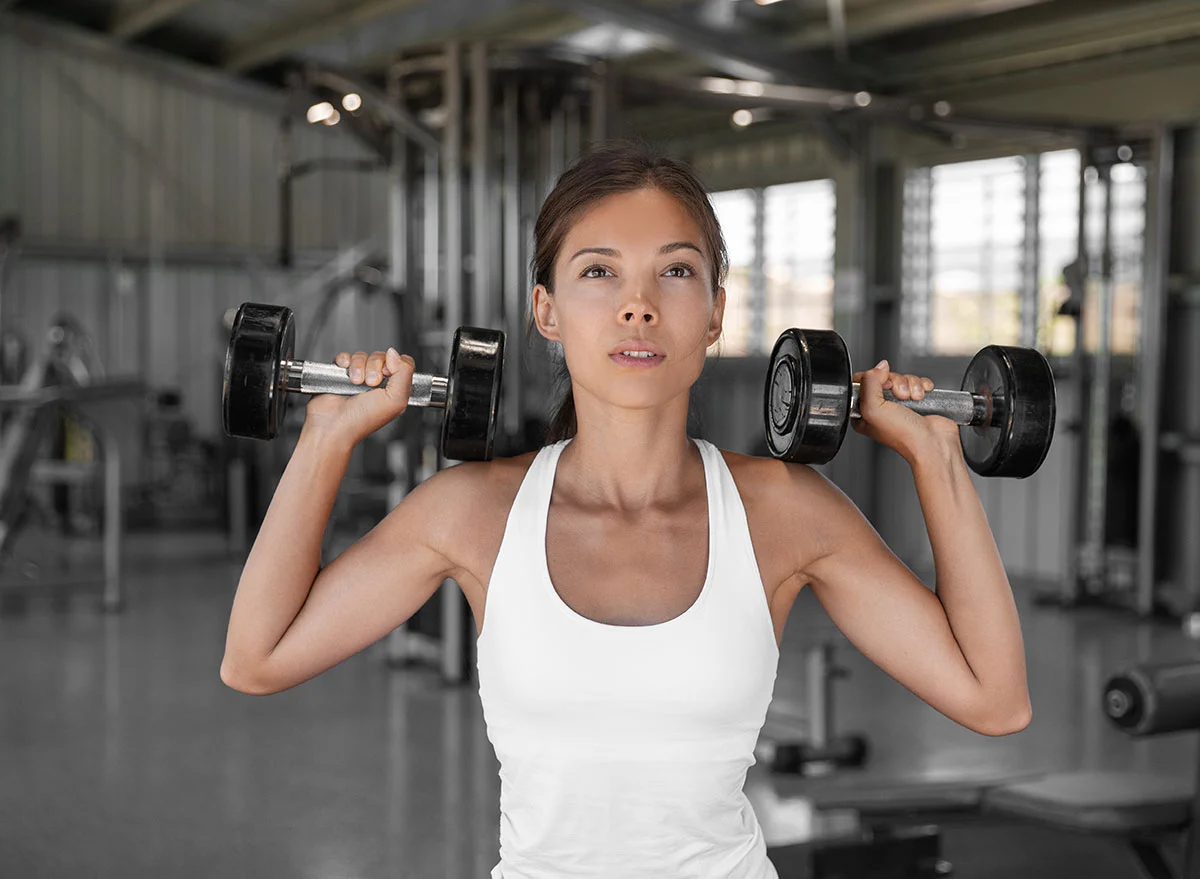
- Stand with feet shoulder-width apart, dumbbells at shoulder height.
- Perform a shallow, quick dip with your knees—not a full squat.
- Immediately drive upward through your heels, using the momentum to help press the weights overhead.
- Finish with your biceps by your ears, arms fully locked out, and your torso tall.
Mastery Standard: Complete 8 clean, fluid repetitions with a challenging load. The leg drive should feel like an extension of the press, creating a seamless kinetic chain from floor to ceiling.
3. The Suitcase Carry: The Gold Standard for Stability
The suitcase carry appears deceptively simple—it is essentially walking while holding a weight in one hand. However, this is perhaps the most critical movement for long-term health. The offset load naturally pulls your body toward the weighted side; your core and obliques must engage to counteract this, keeping your spine neutral and your gait steady.
Mechanics and Execution
This move builds grip strength, core stability, and shoulder integrity.
- Hold a heavy dumbbell in one hand, keeping your arm straight.
- Stand perfectly upright, resisting the urge to lean toward or away from the weight.
- Walk with a normal, steady stride for 30 to 45 seconds.
- Maintain a tall posture throughout, as if you are being pulled upward by a string attached to the crown of your head.
Mastery Standard: You should be able to walk for the full 45 seconds without any visible "hitch" in your gait or lateral lean in your torso. If your stride shortens or your posture breaks, the weight is too heavy or your core endurance needs more work.
Supporting Data and Physiological Implications
Research published in journals such as the NCBI highlights that after age 55, the loss of muscle mass (sarcopenia) and the decrease in proprioception (the body’s ability to sense its position in space) are the two primary drivers of frailty. By incorporating standing exercises, you are not just building muscle; you are training your nervous system.

When you train on a machine, your stabilizer muscles are often bypassed. When you train standing up, your core acts as a stabilizer, your ankles adjust for balance, and your brain is forced to coordinate these efforts in real-time. This neurological engagement is exactly what protects against falls and injury as we age.
Addressing Weak Links
If you find that one of these movements is significantly more difficult than the others, treat it as a diagnostic tool.
- If the lateral lunge is hard: You likely have limited hip mobility or adductor tightness. Focus on deep bodyweight squats and hip-opening stretches.
- If the push press is challenging: Your kinetic chain—the connection between your legs and your upper body—may be disconnected. Practice the "dip and drive" movement without weight until the timing feels natural.
- If the suitcase carry is difficult: You may have a weakness in your obliques or grip. This is a vital area to improve, as grip strength is statistically correlated with longevity and overall health markers.
Chronology of Improvement: How to Progress
Do not rush the process. Mastery is a marathon, not a sprint. Follow this progression to ensure safety:
- Phase 1 (Weeks 1–4): Focus strictly on form. Use no weight or very light resistance. The goal is to learn the "pattern" of the movement.
- Phase 2 (Weeks 5–8): Introduce moderate weight. Monitor your fatigue. If your form breaks down on the final two reps, decrease the weight for the next session.
- Phase 3 (Weeks 9+): Once you can hit the "Mastery Standards" outlined above, begin increasing the weight in small, incremental steps.
Conclusion: The Path Forward
Mastering these three exercises is a powerful indicator that your body is not just surviving, but thriving. You have successfully integrated lateral movement, vertical power, and unilateral stability into your fitness routine.
Remember, these standards are not meant to be daunting; they are meant to be empowering. By holding yourself to these metrics, you are ensuring that your body remains a capable vessel for all the adventures life has to offer well into your 60s, 70s, and beyond. Keep the movements clean, keep the intensity honest, and let the quality of your training serve as the best possible evidence of your vitality.