











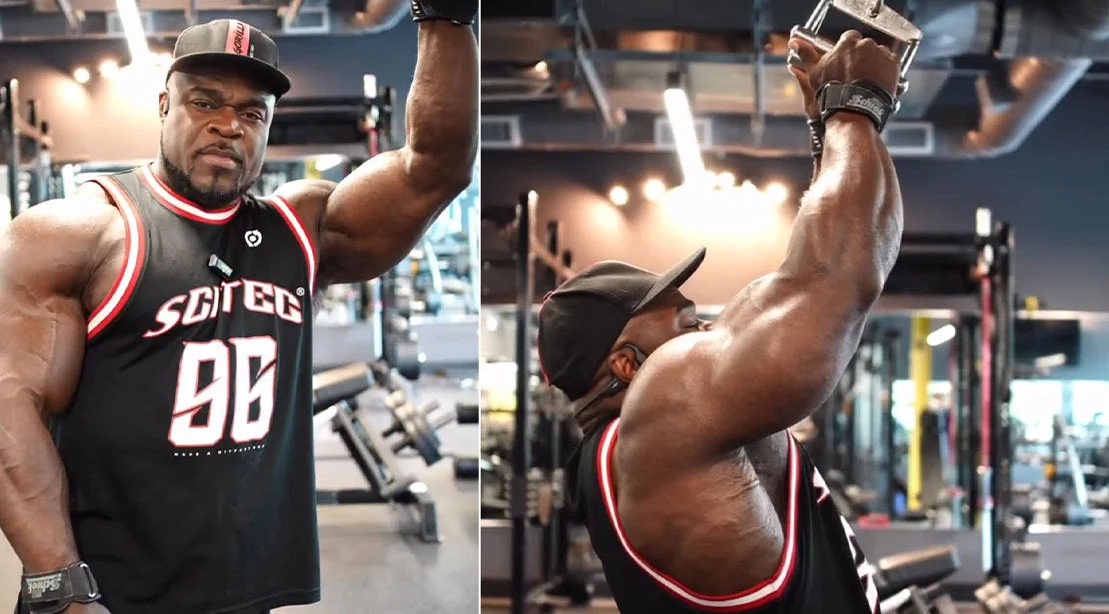
In the realm of elite bodybuilding, where every millimeter of muscle fiber counts toward a Sandow trophy, technique is rarely black and white. Recently, a heated debate erupted across social media platforms regarding the execution of the narrow-grip lat pulldown—a staple exercise for building mid-back thickness. When amateur fitness enthusiasts began criticizing IFBB legend Victor Martinez for his “bent-arm” form, 2019 Mr. Olympia champion Brandon Curry felt compelled to intervene.
Curry, a man whose physique is built on the foundation of functional, high-intensity training, utilized his platform to set the record straight. He argued that the “form police” on social media often mistake advanced, nuance-driven technique for poor execution. By breaking down the biomechanics of the movement, Curry has provided a masterclass in how to prioritize muscle activation over ego-lifting.
The Anatomy of a Controversy: A Chronological Breakdown
The discourse began when a training video of the “Dominican Dominator,” Victor Martinez, circulated online. In the clip, Martinez performed narrow-grip lat pulldowns while maintaining a constant slight bend in his elbows. Almost immediately, the comments section was flooded with critiques from self-proclaimed experts who insisted that the arms must reach full extension—a straight-arm position—at the top of the movement to maximize the range of motion.
For a veteran like Brandon Curry, these comments were not just incorrect; they were symptomatic of a broader misunderstanding of hypertrophy training. Recognizing that such misinformation could hinder the progress of aspiring bodybuilders, Curry responded with his own instructional video.
- The Observation: Curry identified the critical error in the public’s perception: the belief that the arms are the primary lever in a lat pulldown.
- The Defense: He publicly backed Martinez, stating, “I realize a lot of people look at (Martinez) and say that he’s doing it wrong. Well, I think he’s doing it right.”
- The Demonstration: Curry took to the gym to visually demonstrate the difference between “arm-dominant” training and “lat-dominant” training, focusing on scapular elevation rather than elbow extension.
Why the Narrow-Grip Lat Pulldown Matters
The narrow-grip lat pulldown is a specialized movement. While wide-grip pulldowns are universally recognized for building the “V-taper” by targeting the outer lats, the narrow grip serves a more surgical purpose: adding density and thickness to the middle and lower back.
When an athlete uses a narrow grip, the mechanical leverage changes. If the movement is performed incorrectly—specifically by focusing on pulling with the biceps and straightening the arms—the tension shifts away from the lats and onto the brachialis and the long head of the biceps. To truly isolate the back, the practitioner must treat the arms as nothing more than “hooks” or connection points between the load and the target musculature.
The Biomechanics of the "Bent-Arm" Philosophy
Curry’s primary contention with the “straight-arm” advice is that it creates a mechanical dead-zone. When the arms fully extend, the lats reach a point of passive tension, and the shoulder joint often becomes the primary stabilizer, potentially leading to impingement or excessive strain on the tendons.
By keeping the elbows slightly creased, the trainee ensures that the lats remain under constant, active tension throughout the entire set. This is a concept known as "time under tension" (TUT). In the context of hypertrophy, keeping the muscle loaded without giving it a chance to rest at the top of the rep is a highly effective way to trigger growth.
Expert Analysis: Focusing on the Scapula
The core of Brandon Curry’s training philosophy lies in the movement of the scapula. He emphasizes that for back growth, the arms are, quite literally, “besides the point.”
The Scapular Drive
During a properly executed pulldown, the movement should initiate from the shoulder blades. Before the elbows even begin to drive downward, the lifter should elevate and then depress the scapula. This "scapular drive" ensures that the lats are the primary movers. If the trainee is focused on achieving a full arm extension, they are often tempted to "reach" at the top, which causes the shoulder blades to round forward and the lats to disengage.
The "Hook" Concept
Curry instructs his followers to visualize their hands as hooks attached to the cable. By removing the conscious effort of flexing the biceps and instead focusing on the retraction of the shoulder blades, the lifter can bypass the arms entirely. As Curry noted, “You’re trying to train your back, not trying to train your arms.”
Implications for Modern Bodybuilding Training
The public correction provided by Curry highlights a growing divide in the fitness industry between “performative fitness” and “hypertrophy-based training.” On platforms like Instagram and TikTok, there is a tendency to reward exercises that look “correct” by traditional textbook standards, even if those standards are outdated or biomechanically suboptimal for elite muscle growth.
The Dangers of "Textbook" Form
Many trainees grow frustrated when they don’t see results despite following “perfect” form guidelines. Often, this is because the form they are emulating is designed for injury prevention in a clinical setting, rather than maximum muscle recruitment in a bodybuilding setting.
Curry’s intervention serves as a reminder that:
- Context is King: What works for a powerlifter (who needs to utilize every muscle group to move a weight) does not necessarily work for a bodybuilder (who needs to isolate a specific muscle group to exhaust it).
- Nuance is Essential: The difference between a “good” back workout and a “championship-level” back workout often lies in tiny adjustments, such as the degree of elbow flexion.
- Expert Validation: When icons like Victor Martinez and Brandon Curry use a specific technique, it is rarely by accident. Their success is built on decades of empirical testing in the weight room.
Closing the Loop: A Message to the "Experts"
Curry’s concluding remarks were aimed at the armchair trainers who populate social media comment sections. He pointed out that criticism often stems from a lack of understanding regarding the intent of the exercise.
“Whenever you think somebody’s doing something wrong, you may just not know the nuance to what they’re really doing right,” Curry stated. This is a vital lesson for any athlete. The human body is complex, and the path to a pro-level physique requires moving beyond static, one-size-fits-all rules.
By defending the “bent-arm” pulldown, Curry hasn’t just defended a training technique; he has defended the legitimacy of professional experience over the superficiality of social media critiques. For those looking to build a thicker, more detailed back, the lesson is clear: stop worrying about your arm extension and start listening to your lats.
As the industry continues to evolve, the mentorship provided by athletes like Brandon Curry remains invaluable. They remind us that the pursuit of excellence isn’t just about how much weight is on the bar—it’s about how you move that weight to manipulate the muscle.
For more training tips and to keep up with his Olympia-prep journey, you can follow Brandon Curry on his official Instagram account.