








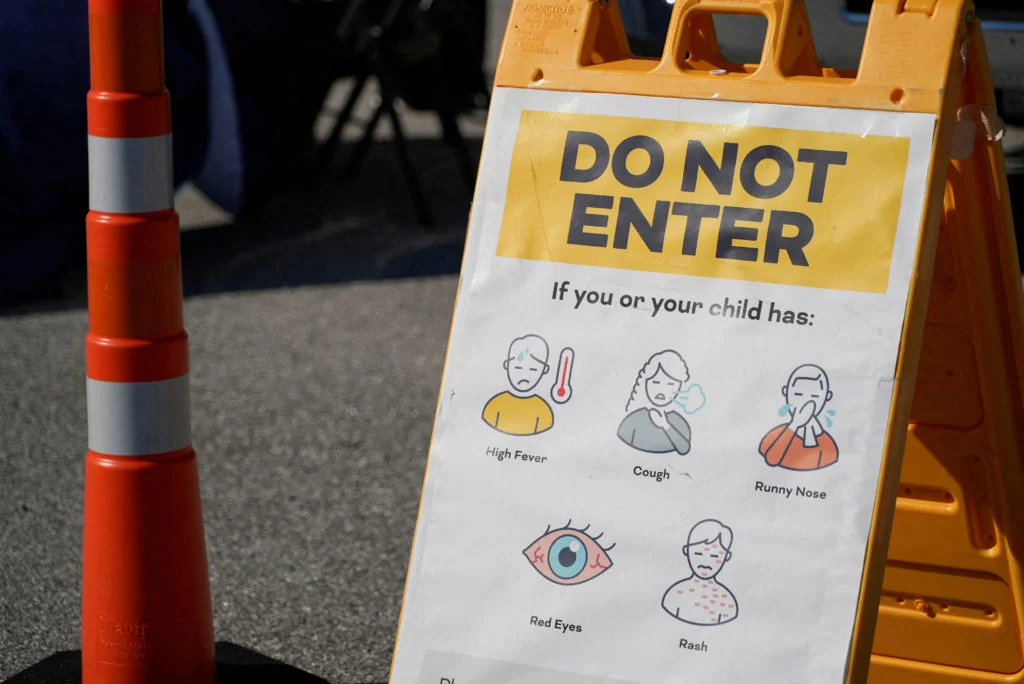
The United States is currently grappling with a public health crisis of significant proportions as measles, a highly contagious and once-eliminated virus, continues its aggressive resurgence. According to the latest data released by the U.S. Centers for Disease Control and Prevention (CDC) this Friday, the nation has officially surpassed the total number of measles cases recorded throughout the entirety of 2025. With five months still remaining in 2026, the country has reached a grim milestone: 2,318 confirmed cases, cementing 2026 as the worst year for the virus in the United States since 1991.
This rapid escalation follows a troubling 2025, which itself was documented as the most severe year for measles in over three decades, with 2,289 confirmed cases. The current trajectory suggests that the viral spread is not only persistent but gaining momentum, driven by major outbreaks in South Carolina, Utah, and Arizona, alongside numerous smaller clusters appearing across the country.
The Chronology of a Resurgence
The path to the current crisis began with a slow but steady decline in national vaccination rates. For over two decades, the U.S. maintained its "measles-free" status, a designation achieved in 2000 through rigorous public health initiatives and high community immunity. To prevent outbreaks of a virus as transmissible as measles, public health experts maintain that a vaccination coverage rate of at least 95% is required.
However, the 2024-25 school year saw national vaccination rates for the measles, mumps, and rubella (MMR) vaccine dip to 92.5%, a noticeable drop from the 95.2% coverage recorded in the 2019-20 school year. This aggregate number, while concerning, hides even more dangerous "pockets" of under-vaccinated populations.
As these immunity gaps widened, the virus found fertile ground. By late 2025, health departments in Texas and Utah were already sounding the alarm. In Utah, officials have been battling a persistent outbreak for over a year, with more than 700 confirmed cases. Simultaneously, South Carolina experienced what would become the largest single-state outbreak in 35 years. The arrival of 2026 did not bring the anticipated cooling of these outbreaks; instead, they have intensified, drawing the attention of international health bodies.
Looming International Consequences
The crisis has now reached a point where the international status of the United States is in jeopardy. In November 2026, international health officials are scheduled to meet to determine whether the U.S. and Mexico have lost their "measles-free" status. Losing this designation would be a catastrophic blow to the nation’s public health reputation and would signal to the global community that the U.S. can no longer guarantee the control of a vaccine-preventable disease.
The elimination of local measles transmission in 2000 was a landmark achievement for American medicine. Reversing that progress represents a failure of public health communication and a dangerous shift in societal attitudes toward immunization.
The Hidden Reality: Why Official Data Underreports the Truth
One of the most pressing challenges facing epidemiologists and public health officials is the realization that the official case count is almost certainly a significant underestimation of the true scale of the crisis. Public health departments acknowledge that many individuals who contract the virus experience mild symptoms or lack access to healthcare, leading them to recover without ever being tested or reported to the CDC.
Mathematical Modeling and Genetic Analysis
In states like Utah and Texas, researchers are employing advanced mathematical modeling and genetic analysis to estimate the "true" number of infections. Dr. Leisha Nolen, the Utah state epidemiologist, has noted that the large outbreak occurring on the Utah-Arizona border could be three to four times larger than the official tally currently suggests.
Similarly, in South Carolina, where 997 cases have been confirmed, state health officials admit that the real number is higher, though they concede that quantifying the exact gap is "impossible to know" because the level of underreporting fluctuates depending on the stage of the outbreak.
Data Gaps and Surveillance Challenges
The difficulty in tracking the virus is compounded by the fact that hospitalizations are not required to be reported in every state. Damon Toth, an applied mathematician at the University of Utah’s medical school, argues that without a standardized reporting metric for severity—such as hospitalization rates—it is nearly impossible to develop a "gold standard" for calculating the actual size of an outbreak.
In Texas, researchers working on the state’s 2025 outbreak found that the total number of infections was likely double the 762 confirmed cases. Rémy Pasco, a mathematical epidemiologist at the University of Colorado Boulder, points out that the CDC’s definition of an "outbreak"—three or more linked cases—is often a lagging indicator. "By the time three cases are identified in a community with low vaccination rates," Pasco explains, "either you’ve already missed the previous ones, or you are going to see a lot more."
Official Responses and the Burden on Healthcare Systems
State epidemiologists across the country are echoing a singular, urgent message: vaccination is the only reliable defense against the virus. Dr. Varun Shetty, the chief state epidemiologist in Texas, has been vocal about the logistical nightmare of contact tracing in an environment where people are often hesitant to seek testing or provide information.
In March 2025, for instance, health officials in Gaines County, Texas, were forced to label 182 cases as "probable" but unconfirmed because they lacked sufficient information to verify the patients’ medical history. This administrative gap highlights the "muddiness" of current public health data, where the virus moves faster than the bureaucratic mechanisms designed to track it.
The Ethical Implications: Protecting the "Innocent Bystanders"
Beyond the raw statistics and policy debates lies a profound ethical concern regarding the most vulnerable members of society. Dr. Mark Roberts, the retired director of the Public Health Dynamics Lab at the University of Pittsburgh School of Public Health, emphasizes that the burden of these outbreaks is not distributed equally.
"The people who bear the brunt of these outbreaks are the ‘innocent bystanders,’" Dr. Roberts says. "These are the young babies who are too young to be vaccinated, individuals with compromised immune systems who cannot receive the vaccine, and those who, due to biological factors, do not develop a robust immune response despite being vaccinated."
Dr. Roberts offers a compelling analogy to explain the social responsibility of vaccination. "Some people view the decision to skip vaccination as a personal choice, like choosing not to wear a seatbelt," he explains. "But not vaccinating your child is more like saying, ‘I don’t want my car to have brakes.’ It isn’t just about the person in the car; it’s about the other people you can hit."
Looking Ahead: A Call to Action
As the U.S. faces the prospect of losing its measles-free status, the path forward appears clear to the scientific community. The decline in immunization coverage has created a systemic vulnerability that only a concerted, nationwide effort to improve vaccine confidence and accessibility can fix.
The current 2026 data serves as a stark warning. With over 2,300 cases, the U.S. has moved beyond a series of isolated incidents and into a state of sustained, widespread transmission. As researchers continue to analyze the data and prepare for the November international review, the question remains: will the nation prioritize the collective health of its most vulnerable citizens, or will the surge continue into 2027, marking a permanent decline in the standard of public health the country has enjoyed for a generation?
For now, public health officials continue to stress that the only way to stop the spread is to bridge the immunity gaps in communities, ensuring that the 95% threshold is once again the baseline, rather than an elusive goal. The crisis is not just a medical challenge; it is a test of whether a society can still unite behind the proven science of immunization to protect its own future.