



For years, the gold standard for achieving a lean, muscular physique has been absolute precision. In the world of competitive powerlifting and physique sports, the mantra is simple: "If you don’t track it, it doesn’t count." But what happens when the tools meant to empower us—our macro trackers and calorie logs—become the very chains that restrict our relationship with food?
Dr. Gabrielle Fundaro, a powerhouse in the nutrition world with a PhD in Human Nutrition and a decorated career in competitive powerlifting, recently confronted this uncomfortable reality. Despite her deep expertise, she found herself trapped in a cycle of digital dependence. Her journey from rigid macro-counting to a more intuitive, sustainable approach—dubbed "RPE-Eating"—is challenging the fitness industry to reconsider how we define nutritional success.
The Myth of the "Perfect" Diet
For over a decade, Dr. Fundaro lived by the numbers. She treated her body like a chemistry experiment, balancing proteins, fats, and carbohydrates with surgical precision. To the outside world, she was the picture of health and discipline. Internally, however, the reality was different.
"I worried that if I stopped tracking macros, I would lose my physique," she admits.
This anxiety is not unique to her; it is a pervasive phenomenon among high-performing athletes and fitness enthusiasts. The fear of "going sideways"—losing muscle mass, gaining unwanted fat, or simply losing one’s identity as an "expert"—kept her tethered to tracking apps long after the utility of those tools had expired. The breaking point came when she realized she could no longer simply enjoy a meal at a restaurant without mentally calculating the macronutrient breakdown of every bite. She was physically fueled, but emotionally exhausted.
A Chronology of a Shift
The transition away from tracking was not an overnight epiphany. It was a gradual evolution born from her work in the weight room.
In her training, Dr. Fundaro had begun utilizing the Rate of Perceived Exertion (RPE) scale. Originally developed by Gunnar Borg in the 1960s, RPE is a subjective metric used by athletes to gauge effort. Instead of relying on a rigid percentage of a one-rep max, an athlete learns to listen to their body: How does this weight feel today? Is this a 7 out of 10 effort, or a 9?
By applying this to her lifting, she found she was not only stronger but recovering more efficiently. The autonomy provided by RPE allowed her to push harder on good days and pull back when her body signaled fatigue.
One day, the connection became undeniable: If RPE could optimize physical performance, could it not also optimize nutritional intake? This realization marked the birth of the RPE-Eating framework. By moving away from external, rigid metrics and toward internal, biofeedback-driven awareness, Dr. Fundaro began the process of de-programming her reliance on technology.
The Mechanics of RPE-Eating
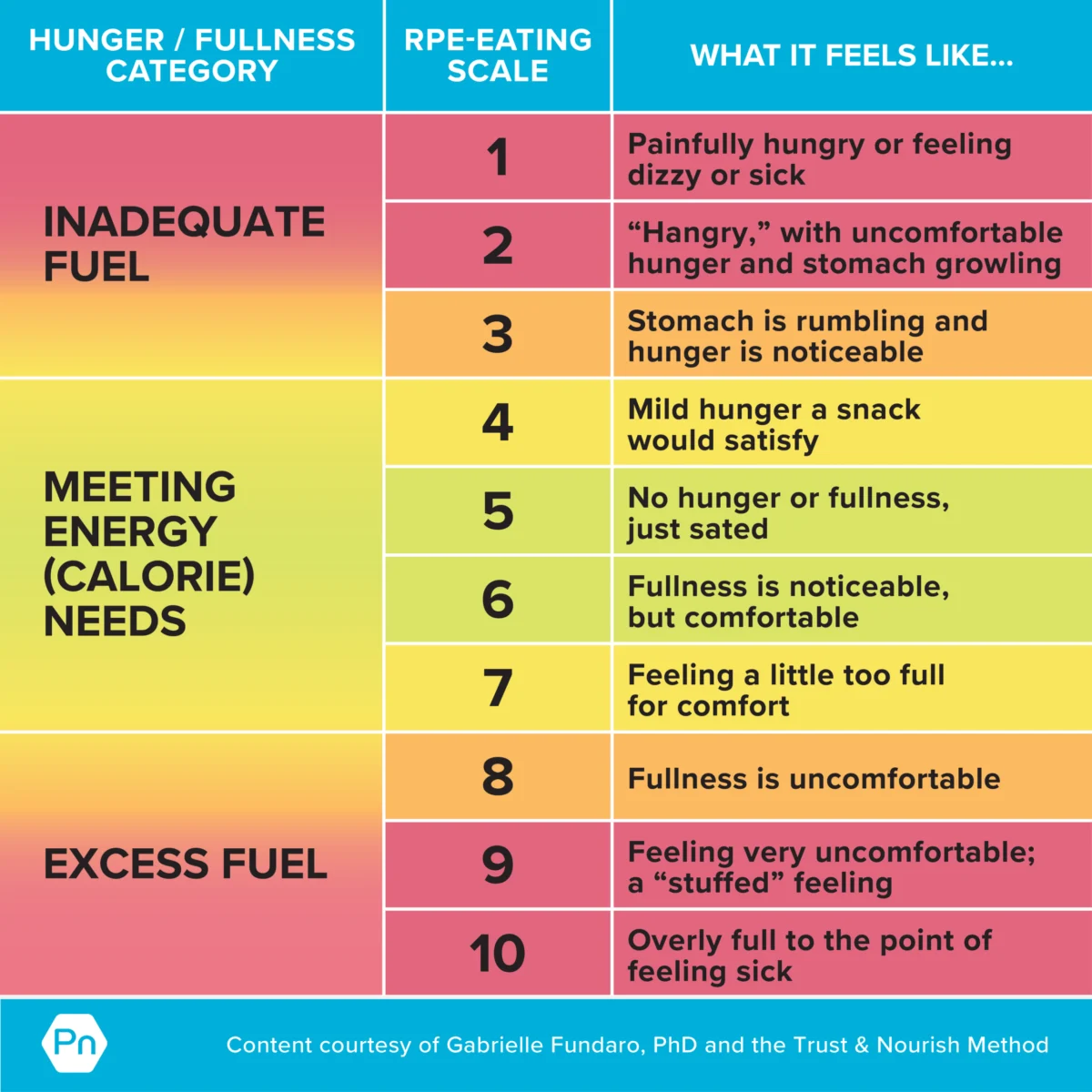
At its core, RPE-Eating is a pedagogical tool designed to restore "interoceptive awareness"—the ability to perceive and interpret internal physical sensations. The RPE-Eating scale functions on a 1-10 spectrum, mirroring the intensity of hunger and satiety rather than physical exertion.
- 1–3 (Inadequate Fuel): Characterized by physical distress, dizziness, or intense "hangry" irritability.
- 4–7 (Adequate Fuel): The "sweet spot." This range represents physical comfort, where energy needs are met without the sluggishness of overconsumption.
- 8–10 (Excess Fuel): Ranges from comfortable fullness to the physical discomfort of being "stuffed" or sick.
The methodology requires practitioners to pause before, during, and after meals to "download" these sensations. It is a practice of mindfulness that separates physical hunger (the body’s need for energy) from appetite (the desire to eat for pleasure or emotional comfort).

Supporting Data and Psychological Implications
Critics often dismiss such approaches as "feelings over facts." However, the scientific community is increasingly recognizing the role of autoregulation in long-term health. Research indicates that chronic, rigid dietary tracking can increase the risk of orthorexia and other disordered eating patterns, particularly in those with a history of yo-yo dieting or high body dissatisfaction.
RPE-Eating offers a safety net. By focusing on satiety (physical fullness) and satisfaction (the emotional component of enjoying food), it addresses the "pendulum effect." When people restrict "forbidden" foods, they often oscillate between intense restriction and binge eating. By integrating these foods into an RPE-aware lifestyle, the psychological urgency to binge diminishes.
Official Responses and Industry Reception
The fitness industry has been slow to embrace the shift away from tracking, largely because the business of "optimization" relies on data. However, coaching circles are beginning to take note. Many coaches now view RPE-Eating as an essential "off-ramp" for clients who have reached a point of diminishing returns with traditional tracking.
Dr. Fundaro emphasizes that this is not a one-size-fits-all solution. "RPE-Eating is not about feeling more control over your diet," she explains. "It’s about sensing into what your body needs." For some, such as parents or shift workers, the "labor" of mindfulness can be high. In these instances, she suggests using the tool in isolation—perhaps just for a weekend lunch or a quiet dinner—to build the skill over time.
Implications for the Future of Fitness
The implications of this shift are profound. If we can successfully transition athletes and the general public from external trackers to internal cues, we may see a significant reduction in the prevalence of food-related anxiety.
Furthermore, this method proves that one can maintain a healthy, athletic physique without being a slave to a spreadsheet. While RPE-Eating may not be the most efficient route for someone prepping for a professional bodybuilding show—where the margins for error are razor-thin—it is arguably the most efficient route for long-term health and psychological sustainability.
The Verdict on Self-Trust
Ultimately, Dr. Fundaro’s message is one of empowerment. The goal of the RPE-Eating scale is not to make you a "perfect" eater, but to make you a competent one.
"The goal," says Dr. Fundaro, "is to know that you’re nourishing yourself—and you don’t need a food tracker to do that."
For those who have spent years living by the numbers, the idea of "feeling" their way through nutrition is daunting. Yet, for those who take the leap, the result is a rare commodity in the modern fitness landscape: genuine, lasting peace with food. The future of nutrition may not be found in the latest app update or the most sophisticated wearable device; it may simply be found in the quiet, honest dialogue between our physical needs and our mindful responses.
As we continue to navigate the intersection of science and intuition, the RPE-Eating framework stands as a beacon for those looking to reclaim their autonomy, one meal at a time. The numbers are no longer the master; the individual is. And in that shift lies the true definition of a sustainable, healthy life.