











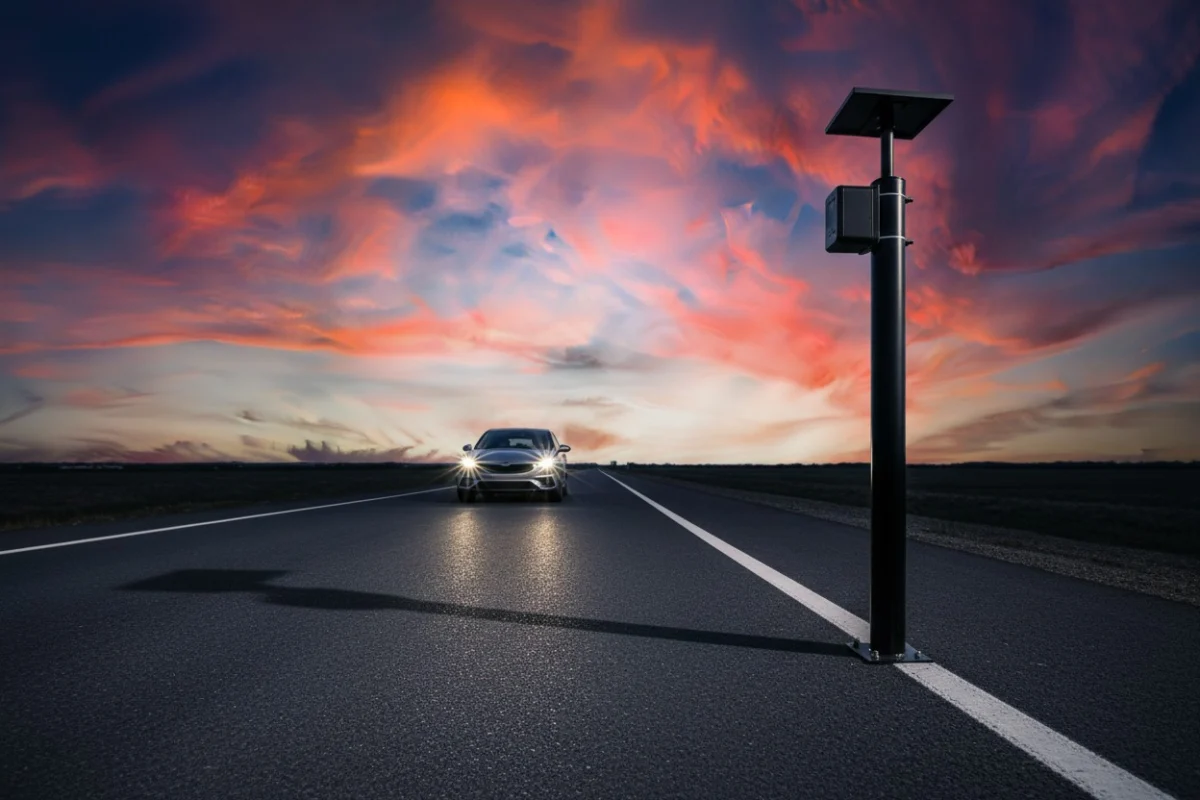
Across thousands of American municipalities, a new piece of street furniture has become as common as the stop sign: the dark, slender, solar-powered pole of a Flock Safety Automated License Plate Reader (ALPR). While these cameras serve as a cornerstone for modern law enforcement, promising a high-tech net to catch criminal activity, a growing chorus of safety advocates and engineering experts are raising an alarming question: Are these security assets becoming roadside hazards that turn minor accidents into fatal catastrophes?
From rural backroads in Ohio to suburban arterial streets in California, questions regarding the structural integrity, placement, and compliance of these installations are mounting. Critics argue that by prioritizing surveillance, companies like Flock Safety—and the municipalities that host them—may be bypassing critical federal highway safety mandates, leaving motorists vulnerable to lethal, fixed-object collisions.
The Anatomy of the Risk: Why Placement Matters
At the heart of the controversy is the "clear zone"—a concept in civil engineering that mandates a buffer of unobstructed, forgiving space between a travel lane and any rigid fixed object. Federal Highway Administration (FHWA) standards require that any roadside support structure located within this clear zone must be "breakaway"—meaning it is engineered to snap or yield upon impact, dissipating the kinetic energy of a vehicle rather than acting as an unyielding barrier.
Steve Eimers, a Tennessee-based road safety advocate known online as the "Guardrail Guy," has spent years documenting what he describes as a systemic failure to adhere to these life-saving standards. Eimers’ crusade is deeply personal; his 17-year-old daughter was killed a decade ago when her vehicle struck a non-compliant roadside structure on Interstate 75.
"The guardrail had to go through a heavy vetting process—they had to do a whole series of crash tests, they had to submit the crash test results in full with photos which are reviewed by state department of transportation engineers," Eimers explains. "These ALPR poles, in many cases, have none of that."
According to Eimers, many Flock Safety poles are installed with little to no regard for the clear zone, often standing mere feet from the edge of the asphalt. Without a functional breakaway mechanism, he warns, these hollow metal pipes act as a "spear" in the event of a lane departure. "If you hit a non-breakaway pole at speed, it doesn’t give," he notes. "It can core through a vehicle. It’s an unacceptable risk to the motoring public."
A Case Study in Greene County, Ohio
The tension between modern policing needs and physical road safety was recently crystallized in Greene County, Ohio. On a narrow, tree-lined rural road, a black-painted metal rod equipped with a camera and solar panel stands approximately two feet from the edge of the travel lane.
According to an investigative report, this specific installation lacks any visible breakaway plate or signage indicating it has been inspected by safety authorities. The placement stands in stark contrast to guidelines provided by the Ohio Department of Transportation (ODOT), which specifies that on uncurbed facilities, such equipment must be positioned at least eight feet from the nearest edge of a travel lane.
When reached for comment, the Beavercreek Police Department—Flock’s local customer—deferred responsibility. The department stated that Flock Safety is responsible for all installations and maintained that all cameras within its jurisdiction had "received the appropriate approval." This "pass-the-buck" dynamic is a common theme in the industry, where municipal police departments rely on vendors to handle the technical logistics of installation, while vendors claim they are working within the constraints provided by their municipal clients.
Industry Response and The "Clear Zone" Dilemma
Flock Safety, a company that has rapidly expanded to include an estimated 80,000 to 100,000 cameras across more than 6,000 U.S. communities, maintains that it acts in accordance with the law.
Paris Lewbel, a spokesperson for Flock Safety, disputed the allegations of widespread non-compliance. "We do not agree with the premise that Flock regularly installs poles in violation of federal, state, or local safety requirements," Lewbel said in a statement. "The appropriate pole type and installation specifications depend on the roadway, speed, location, jurisdiction, and requirements of the relevant transportation or permitting authority."

Lewbel noted that while the company works with local customers to determine camera placement based on public safety priorities, it has begun a process of reviewing pole installations across its network. However, the company has remained tight-lipped regarding the exact number and location of its installations, citing security concerns.
Safety experts argue that "following local requirements" is insufficient if those requirements do not align with federal safety standards for roadside hardware. In many cases, ALPR poles are treated as "utility poles" or "temporary signs" rather than safety-critical traffic hardware, allowing them to bypass the rigorous crash-testing protocols required for guardrails or breakaway sign posts.
Broader Implications: Privacy and Surveillance
While the physical danger of the poles is a significant concern, the controversy over Flock Safety is compounded by long-standing anxiety regarding mass surveillance. The ability of these systems to track, log, and analyze the movement of vehicles on a nationwide scale has drawn the ire of privacy advocates and civil libertarians.
In Oakland, California, the proposed installation of 480 new Flock cameras along city freeways triggered a massive public outcry. Critics argue that the cumulative effect of these cameras is a "dragnet" that treats every motorist as a suspect. In Costa Mesa, California, the opposition reached such a fever pitch that Mayor John Stephens reported that "virtually 100%" of residents urged the city council to reject the technology.
The concern is that the convenience of automated policing is eroding the expectation of privacy in public spaces. As noted by observers like Kris Vallotton in his work regarding the intersection of algorithms and human behavior, these systems do more than just record data—they actively shape the landscape of public life, potentially chilling participation in democratic activities like rallies or political protests if citizens fear their attendance is being cataloged by third-party applications.
A Call for Regulatory Oversight
The National Safety Council reported that crashes between motor vehicles and fixed barriers accounted for 26% of vehicle deaths nationwide in 2024. As thousands more poles are planted along the nation’s roadways, the statistical probability of a vehicle impacting a poorly placed ALPR pole is increasing.
Eimers, who has traveled the country documenting these installations, argues that the lack of oversight is the true failure. "We know that a lot of people leave the road, so we want a forgiving roadside," he says. "We need a standard that forces these companies to prove their equipment won’t kill someone if they happen to drift off the pavement."
Eimers points to his finding in Erie County, Ohio—the only location where he successfully identified a pole with a breakaway plate. Even there, he noted, the plate was positioned at a height that could potentially catch the underside of a low-profile vehicle, rendering the breakaway mechanism ineffective.
As the deployment of ALPR systems shows no sign of slowing, the debate is shifting toward the need for state and federal intervention. Currently, these cameras exist in a regulatory "gray zone." They are not classified as permanent roadway infrastructure, yet they are permanently installed on public land.
For many, the path forward is clear: if these devices are to remain a permanent feature of the American landscape, they must be subjected to the same rigorous engineering standards as any other roadside hardware. Anything less, advocates warn, is a gamble with human life that the public did not agree to take.
Until then, the black, slender poles continue to multiply, silently watching the traffic—and standing as potentially lethal obstacles for the drivers they are meant to monitor.
References
- National Surveillance and ALPR Deployment Trends, Department of Justice Research Bulletin.
- Oakland Freeway Surveillance Expansion Review, City of Oakland Public Safety Committee.
- Impact of Unanticipated Roadside Collisions, Journal of Transportation Engineering & Safety.
- Poverty, Riches and Wealth, Kris Vallotton (on the influence of algorithmic societal shaping).
- Costa Mesa City Council Meeting Minutes: ALPR Removal Proposals.
- Third-Party Data Tracking and Civic Engagement, Investigative Review on Privacy.