



In an era where modern medicine often leans heavily on pharmaceutical intervention, the ancient Indian healing system of Ayurveda offers a profound alternative: the therapeutic application of intentional touch. Ayurvedic massage is far more than a luxury spa treatment; it is a sophisticated, highly individualized medical practice rooted in thousands of years of tradition. By utilizing herbalized oils, specific pressure techniques, and the stimulation of vital energy points, this ancient modality seeks to align the body and mind, facilitating a return to a state of blissful homeostasis.
The Foundations of Ayurvedic Healing
Ayurveda, often translated as the "science of life," views the human body as a microcosm of the universe. According to Vedic texts—most notably the Brhat Trayi (the "Great Three" texts authored by Caraka, Sushruta, and Vagbhata)—all matter is composed of five great elements: space, air, fire, water, and earth.
These elements manifest in the human physiology as the Tridoshas:
- Vata: Composed of space and air, governing movement and communication.
- Pitta: Composed of fire and water, governing metabolism and transformation.
- Kapha: Composed of water and earth, governing structure and lubrication.
Ayurvedic massage operates on the principle that disease occurs when these doshas fall out of balance. The practitioner’s primary goal is to restore equilibrium by applying the "Law of Opposites." If a patient exhibits an excess of dry, cold Vata, the practitioner uses warm, heavy, unctuous oils. If a patient suffers from excess Kapha (heavy, sticky), they might forgo oil entirely in favor of dry, stimulating herbal powders. This "like-increases-like" philosophy ensures that every stroke and substance is calculated to counteract specific physiological imbalances.
A Chronological Perspective: From Ancient Warriors to Modern Wellness
The history of Ayurvedic massage is as vast as the culture from which it emerged. Historically, these techniques were not merely for relaxation; they were essential tools for human optimization. In the ancient world, massage was employed to support the physical conditioning of warriors and athletes, ensuring their bodies remained supple and resilient.
Beyond athletic performance, these methodologies served significant roles in societal health:
- Virilization: Promoting vitality and reproductive health.
- Postpartum Care: Supporting mothers during the physically taxing recovery period.
- Preventative Medicine: Maintaining the body’s natural immunity against seasonal fluctuations.
- Palliative and Purificatory Therapy: Serving as a crucial component of Panchakarma, the comprehensive detoxification process of Ayurveda.
Throughout centuries, texts like the Bhavaprakasha and Yogaratnakara meticulously documented these protocols, passing down a lineage of knowledge that remains remarkably relevant in today’s high-stress, sedentary environment.
The Art of Individualized Care
What separates Ayurvedic massage from standardized western modalities is its radical commitment to individualization. No two sessions are identical because no two human constitutions are identical. Before a drop of oil touches the skin, the practitioner must assess the recipient’s Prakruti (their unique inherent constitution) and Vikruti (their current state of imbalance).
Diagnostic Considerations
The practitioner evaluates the state of the Agni (digestive fire) and the presence of Ama (toxins). If Ama is high, traditional oil massage is often contraindicated. The heavy, sticky nature of oil can "trap" toxins within the tissues. In such cases, the practitioner will opt for Udvartana—a dry massage utilizing heated herbal powders that scrub the skin and stimulate lymphatic drainage without adding further moisture.
The Pharmacy of Oils
The choice of oil is a therapeutic intervention in itself.
- Vata: Heavy, warming oils like sesame are used in generous quantities to ground the nervous system.
- Pitta: Cooling oils such as coconut or sunflower are applied in moderate amounts to soothe inflammation and heat.
- Kapha: Light, stimulating oils like mustard are used sparingly to increase circulation and break up congestion.
These oils are frequently infused with medicinal herbs—a process that allows the skin, the body’s largest organ, to act as a delivery system. By nourishing the skin, the practitioner is essentially "feeding" the deeper tissues, including the nerves, muscles, and bones, thereby improving the resilience of the entire organism.
Special Considerations: Vata, The Mind, and The Skin
In Samkhya philosophy, the element of air is intrinsically linked to the sense of touch (Sparshendriya). Because Vata is composed of air and space, it is uniquely susceptible to touch therapy. When a person is anxious, scattered, or suffering from insomnia—all classic signs of Vata imbalance—massage acts as a sedative for the nervous system.
Furthermore, the skin is governed by Bhrajaka Pitta, which dictates the complexion and luster of the body. Regular oil application nourishes this "external digestion," allowing substances to penetrate deeply into the nervous system. This explains why Ayurvedic massage is frequently used as a treatment for mental health concerns; by stabilizing the skin and the nervous system, the mind naturally follows into a state of calm.
Essential Techniques and Categories
While there are numerous ways to manipulate the body, a few key categories form the backbone of the practice:
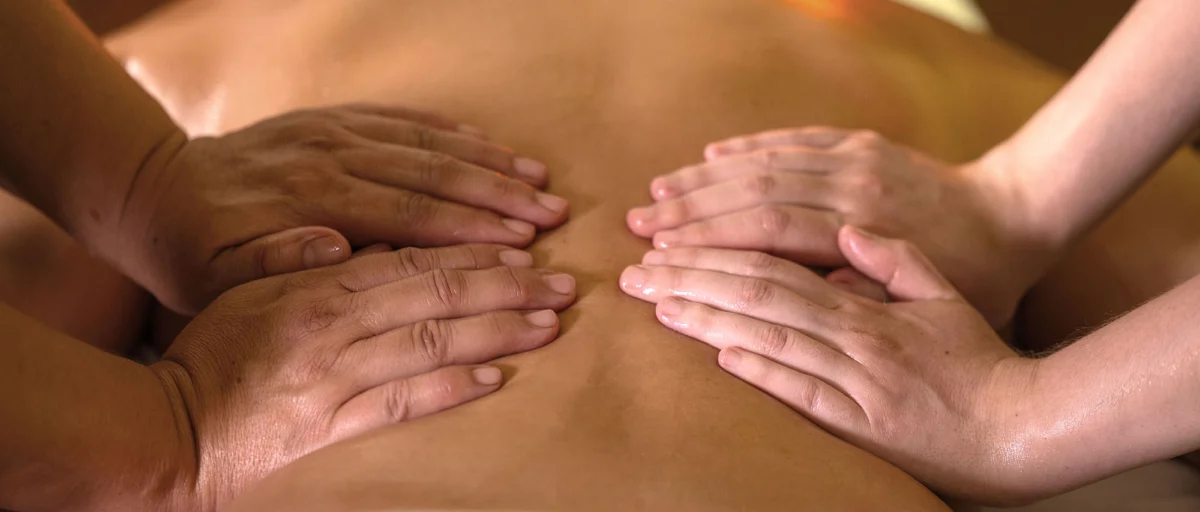
- Abhyanga: The quintessential practice of oiling the body. It can be performed as self-massage or administered by one or two practitioners. The word Snehan in Sanskrit literally means both "oil" and "love," reflecting the belief that the application of oil is a physical manifestation of compassion that harmonizes the cells.
- Udvartana and Udgharshana: Massage with dry or paste-like herbal preparations. These are essential for detoxification and skin rejuvenation.
- Directionality (Anuloma vs. Pratiloma): Strokes directed away from the heart (Anuloma) are used for grounding and calming, whereas strokes directed toward the heart (Pratiloma) are employed to stimulate lymph flow and improve circulation.
The practitioner also utilizes a specific vocabulary of movements, including Garshana (friction), Peedana (kneading), Udvesthana (wringing), Praharana (percussion), and Sandhi Calana (joint mobilization).
The Power of Marma Therapy
Perhaps the most distinctive element of the Ayurvedic toolkit is Marma Therapy. Marma points are anatomical sites where the physical and energetic layers of the body intersect. By stimulating these points, practitioners can clear obstructions in the nadis (energy channels), restoring the flow of Prana (life force).
While often compared to Chinese acupuncture, Marma therapy is distinct in its application and scope. Marma points vary in size and are generally larger than acupoints, often requiring specific pressure techniques that influence organs, glands, and the subtle emotional state of the individual. As Beatrice Voss, a Clinical Ayurvedic Practitioner, notes, "Marmani allow us to awaken the body’s inner pharmacy and heal the physical, mental, and emotional layers of our being."
Implications for Modern Healthcare
The implications of integrating Ayurvedic massage into modern health protocols are significant. As chronic stress, autoimmune conditions, and inflammatory disorders continue to rise, the need for therapies that address the whole person—rather than just symptom management—has never been more urgent.
By treating the body as an interconnected system, Ayurvedic massage offers a preventative solution that mitigates the need for more invasive interventions. It provides a sanctuary for the nervous system and a method for maintaining the structural integrity of the skin and tissues.
Conclusion: A Living Tradition
Ayurvedic massage is not a relic of the past; it is a living, evolving science. It asks us to slow down, to listen to our bodies, and to recognize that health is not merely the absence of disease, but a state of radiant, balanced living. Whether through the self-application of Abhyanga or the skilled hands of a trained practitioner, the "healing touch" remains one of the most effective, accessible, and profound ways to maintain the sanctity of the human experience. As we look toward the future of holistic medicine, the ancient wisdom of the Vedas provides a roadmap to wellness that is as relevant today as it was five thousand years ago.