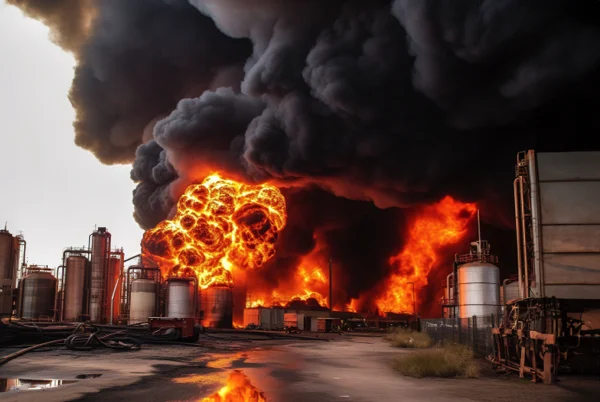
The orange, flickering horizon over the coastal city of Jizan on Sunday morning served as a grim punctuation mark in the ongoing, multifaceted conflict consuming the Middle East. As plumes of smoke billowed from a sprawling Saudi Aramco refinery complex, the visual impact was matched only by the strategic reverberations felt across regional capitals. Yemen’s Houthi movement has claimed responsibility for a sophisticated drone strike, transforming what could have been a localized industrial accident into a high-stakes geopolitical provocation.
This assault, which Riyadh confirms was contained without immediate casualties, is far more than a tactical skirmish. It represents a bold, calculated escalation that challenges the integrity of Saudi Arabia’s critical energy infrastructure and tests the resolve of a nascent regional security architecture. As the dust settles, the attack reveals a theater of war that now spans from the vital maritime arteries of the Red Sea to the heart of the Persian Gulf, forcing global powers to recalibrate their understanding of asymmetric warfare in the age of drone proliferation.
Chronology of the Escalation
The Jizan attack did not occur in a vacuum; it followed a flurry of diplomatic and military activity that set the stage for the current crisis.
- Friday, August 7: Saudi Arabia, Turkey, and Pakistan formalize a collective defense pact in Mecca. Hailed as a "regional deterrent," the agreement draws comparisons to NATO’s Article 5, signaling a shift toward a unified defense posture against external threats.
- Sunday, August 9, 04:00 AST: Multiple unidentified aerial vehicles—later confirmed as Houthi-launched—penetrate defensive perimeters, striking the Jizan refinery.
- Sunday, August 9, 06:30 AST: Saudi Ministry of Energy confirms a fire at the facility, stating that emergency response teams have brought the situation under control.
- Sunday, August 9, 08:00 AST: Simultaneously, reports emerge from the port of Mocha, Yemen, detailing a massive ballistic missile and drone barrage targeting Saudi-backed military positions.
- Sunday, August 9, 14:00 AST: The Houthi military spokesperson formally claims the Jizan and Mocha operations, labeling them "precision strikes" against "aggressors."
- Monday, August 10: Diplomatic fallout begins as the Saudi-backed Presidential Leadership Council of Yemen calls for an urgent international review of the regional security framework.
The Strategic Anatomy of the Attack
The Jizan refinery is not merely an industrial asset; it is the financial lifeblood of the Saudi state. By targeting Aramco, the Houthis have shifted their strategy from traditional territorial warfare to "economic warfare," aimed at eroding international confidence in the Kingdom’s stability.
Targeting the Economic Engine
The refinery at Jizan, with a processing capacity of approximately 400,000 barrels per day, is a vital node in the Saudi downstream network. Houthi leadership appears to be operating on a doctrine of "symbolic asymmetry"—the idea that a low-cost drone, costing a fraction of a million dollars, can disrupt a multi-billion dollar economic entity and force the Kingdom into an expensive, defensive posture. This strategy is designed to inflate insurance premiums, deter foreign direct investment, and create an atmosphere of perpetual insecurity that undermines Saudi Vision 2030.
The Mocha Flashpoint
While Jizan grabbed the headlines, the concurrent attack on the Red Sea port of Mocha illustrates a broadening of the conflict’s geographic scope. Mocha is a strategic gateway; its paralysis threatens to further squeeze supply chains already reeling from Houthi maritime harassment in the Bab el-Mandeb Strait. With reports of seven casualties and severe damage to port infrastructure, the Houthi movement has demonstrated an improved capacity for multi-front coordination—a development that intelligence analysts suggest indicates enhanced logistical support and tactical guidance.
Official Responses and Diplomatic Tensions
The official response from Riyadh has been characterized by a studied, almost opaque, caution. The Saudi Energy Ministry’s statement on X was brief, focusing on the "completion of necessary procedures" rather than assigning direct blame or detailing the extent of the damage. This reticence is indicative of a government attempting to prevent a "fear-driven" spike in global oil prices while simultaneously preparing for a robust, perhaps covert, military response.
The "NATO-Style" Pact under Pressure
The timing of the strikes—mere 48 hours after the Mecca pact—is widely interpreted as a direct gauntlet thrown down by the Houthis. Turkish Foreign Minister Hakan Fidan’s recent assertions that the pact serves as a deterrent were tested almost immediately. The inability of this new alliance to intercept the incoming drones raises fundamental questions about the efficacy of "paper" treaties against non-state actors. For the regional public, the burning refinery serves as a stark reminder that formal diplomatic signatures do not always translate into operational air superiority.
The Plea for International Action
Rashad al-Alimi, head of Yemen’s presidential council, has emerged as a vocal advocate for a more muscular international response. In his briefing with U.S. envoy Neil Hop, al-Alimi shifted the narrative, arguing that the world must stop "containing" the Houthis and start dismantling their "sources and instruments." This reflects a growing fatigue among Saudi allies, who feel the current international policy of de-escalation has only provided the Houthis with the time and space to refine their lethal capabilities.
Implications for Global Security and Energy Markets
The long-term implications of these strikes extend far beyond the Saudi border. We are entering an era where regional conflicts are no longer constrained by conventional military boundaries.
The Energy Security Paradox
Aramco CEO Amin Nasser recently dismissed recent strikes as having "no material impact" on production. While this may hold true for immediate quarterly reports, it fails to account for the "strategic risk premium." If global investors perceive that the most critical energy infrastructure in the world is permanently vulnerable to inexpensive, off-the-shelf drone technology, the cost of capital for future projects in the region will rise. This shift fundamentally alters the energy landscape, potentially forcing producers to invest more in localized air defense than in production expansion.
The Asymmetric Challenge
The Houthis are currently leveraging the Bab el-Mandeb Strait—a chokepoint for 10% of global maritime oil trade—to hold the international community hostage. By combining naval blockades with strikes on land-based refineries, they have created a "pincer movement" on the global energy market. This dual-threat posture forces world powers to allocate significant naval and air assets to the region, draining resources and complicating the geopolitical calculations of the United States, Europe, and Asia.
Future Outlook: A Fragile Balance
As the smoke clears in Jizan, the region finds itself at a crossroads. The failure of the 2022 truce, coupled with the escalating audacity of Houthi strikes, suggests that the conflict is entering a phase of sustained volatility.
The Saudi-led coalition, now bolstered by Turkey and Pakistan, faces a difficult choice: engage in a direct, high-intensity confrontation that could set the entire Gulf ablaze, or continue the current policy of reactive defense—a policy that has clearly failed to deter the Houthi command structure.
The "sources and instruments" of Houthi power remain the central issue. Until the international community, including regional powers and their Western allies, reaches a consensus on how to address the underlying supply chains that allow such advanced weaponry to reach non-state actors, the fires at Jizan may only be a precursor. The modern battlefield has become decentralized, and in this new reality, the ability to protect one’s assets is no longer a matter of military strength alone, but of technological resilience, intelligence integration, and the political will to confront the reality of a new, persistent, and highly mobile threat.
The world watches with apprehension, knowing that the next strike might not be as easily contained, and the next glow on the horizon could signify a far greater collapse than that of a single refinery.