






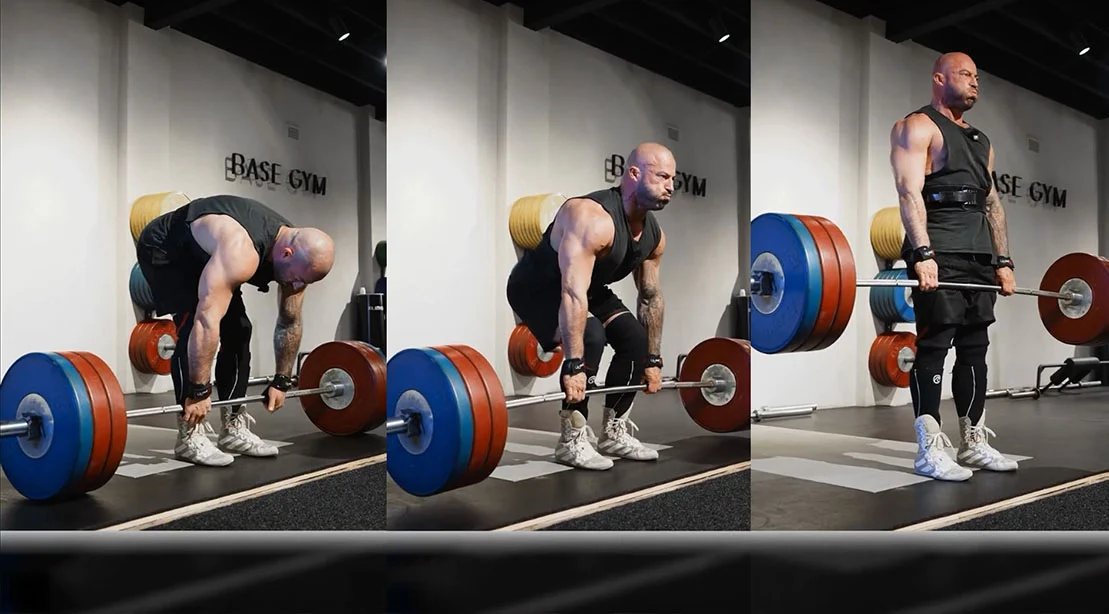
The deadlift is widely considered the "king of exercises." It is a fundamental movement pattern that recruits nearly every major muscle group in the human body, from the powerful posterior chain—glutes, hamstrings, and spinal erectors—to the lats, traps, and core. Yet, despite its reputation for raw, primal strength, the deadlift is a sophisticated biomechanical puzzle. For many gym-goers, the transition from lifting "heavy" to lifting "technically" is the difference between a plateau and a world record.
Sebastian Oreb, internationally renowned as "The Australian Strength Coach," has spent his career refining the mechanics of the pull. Perhaps most notably, Oreb is the architect behind the staggering success of Hafþór "Thor" Björnsson, the Icelandic strongman whose deadlifting records—including his historic 501kg (1,104lb) feat—have redefined the limits of human potential. Oreb argues that whether you are an elite athlete or a recreational lifter, the physics of the deadlift remain constant. By dissecting the technical system he used to propel Björnsson to the pinnacle of strength, Oreb provides a blueprint that can prevent injury and unlock exponential gains for lifters of all experience levels.
The Foundation: Why Technique Trumps Brute Force
In the world of professional strongman, where the stakes involve massive loads that can cause catastrophic injury, there is no room for "sloppy" lifting. Oreb emphasizes that a lack of technical discipline is the primary cause of both diminished performance and long-term joint health issues.
"This is the exact technical system used by the world’s greatest deadlifter, Hafþór Björnsson," Oreb explains in a recent technical breakdown. "And before you think, ‘He’s a 200kg, 6-foot-9-inch Icelandic giant, so it doesn’t apply to me,’ think again. The techniques that he uses are the same techniques that I teach my daughter."
Oreb’s philosophy rests on the concept of efficiency. By aligning the body with the barbell in a way that respects the laws of leverage, the lifter minimizes energy leaks and maximizes power transfer. When a lifter ignores these biomechanical cues, they often fall into a "seesaw" pattern—a compensatory movement where the body shifts weight forward to accommodate an improper start position, leading to wasted energy and increased risk of lumbar strain.
Chronology of a Perfect Deadlift: The Oreb System
To master the deadlift, one must treat the movement not as a single exertion, but as a sequence of deliberate, calculated phases. Oreb’s methodology follows a strict chronological progression that ensures the body is in the optimal position before the weight ever leaves the floor.
1. Establishing the Base of Support
The most common error Oreb observes is the improper placement of the barbell relative to the feet. Many lifters set the bar too far in front of their shins. When the bar is too far forward, the hips must shift forward to meet the bar, causing the torso to tilt and the bar to roll toward the lifter as the pull begins. This creates a "rolling" effect that forces the spine into a compromised position.
"The barbell must be inline with my midfoot," Oreb instructs. "That is the base of support. At maximal loads, that bar won’t leave the ground until it is inline with that base." By anchoring the barbell over the midfoot, the lifter ensures that the center of gravity is perfectly aligned with their own, creating a vertical, efficient path for the bar.
2. Optimizing Arm Geometry
Once the stance is set, the arm position becomes the next critical variable. Oreb advocates for straight, relaxed arms hanging parallel along the outside of the legs. The width of the stance is paramount here; if the stance is too wide, the arms are forced to angle outward, effectively shortening their reach and forcing the lifter to travel a greater distance to complete the rep.
Furthermore, Oreb warns against the common instinct to bend the elbows or "pre-pull" the tension into the biceps. "If the elbows are bent, your biceps are on, and your biceps are not strong enough to deadlift what your back can deadlift," he warns. "That is exactly where you risk bicep tears." By maintaining locked, straight arms, the lifter treats their limbs as rigid cables, transferring force directly from the floor to the bar.
3. The Shin-to-Bar Engagement
The final phase of the setup involves the descent of the hips. Oreb advises lifters to squat down until their shins make gentle contact with the barbell. This is the "stop point." If the shins touch the bar too aggressively, the barbell rolls forward, undoing the work done in the first step.
Once the shins are touching, the lifter must engage the lats by pulling the armpits toward the pelvis. The crown of the head should be directed toward the ceiling, creating a rigid, neutral spine. Only then, with a deep breath to brace the core, does the movement begin.
Supporting Data: The Physics of Leverage
The efficacy of Oreb’s system is supported by the physics of moment arms. In biomechanics, a "moment arm" is the perpendicular distance between the axis of rotation (the joint) and the line of force. When a lifter pulls the bar away from their shins, they increase the moment arm between the barbell and their lower back. This forces the erector spinae muscles to work exponentially harder to stabilize the torso, which often leads to the dreaded "rounded back" that limits strength and causes injury.
By keeping the barbell in contact with the shins and aligned with the midfoot, Oreb’s method keeps the bar as close to the body’s center of mass as possible. This minimizes the moment arm at the lumbar spine, allowing the legs and hips—the most powerful muscles in the body—to perform the heavy lifting. This is precisely why Thor Björnsson, despite his massive frame, can move weights that exceed half a metric ton: he has minimized the mechanical disadvantage inherent in his height by perfecting the "closeness" of the load.
Official Responses and Industry Impact
The fitness community has responded to Oreb’s technical insights with overwhelming enthusiasm. On social media, the breakdown has been lauded as a "masterclass" in strength training. Professional coaches and amateur lifters alike have noted that the clarity of Oreb’s cues—specifically the instruction to "push the world away" rather than "pull the bar up"—changes the mental approach to the lift.
By shifting the focus from pulling (which often causes the upper back to round) to pushing (which emphasizes leg drive and floor-based force production), Oreb has helped countless individuals break through personal plateaus. The consensus among those who have applied these techniques is that the lift feels "lighter" when the setup is perfect, even when the intensity on the bar increases.
Implications for Future Training
The implications of Oreb’s "Australian Strength Coach" method are significant for the broader athletic community. We are entering an era where strength training is increasingly informed by high-level biomechanical analysis. The days of "just lift heavy" are being replaced by a more nuanced understanding of anatomy and leverage.
For the average lifter, the takeaway is clear: before attempting to set a new personal record, one must audit their technical foundation. If your bar path is inconsistent, if your shins are bruising from the bar moving forward, or if you feel your biceps engaging during a deadlift, you are losing potential strength.
As Oreb suggests, the deadlift is a science. It is a system of inputs—foot position, arm length, shin contact, and bracing—that produce a singular output: maximum power. By stripping away the ego and focusing on the rigid execution of these technical steps, any lifter can mimic the efficiency that helped Hafþór Björnsson dominate the world stage.
Whether you are a newcomer to the barbell or a seasoned powerlifter looking to shave seconds off your recovery and add kilograms to your total, the message is the same: Slow down, respect the geometry of the lift, and push the world away. As Oreb continues to document his methodology, he reinforces a vital truth: true strength is not just about the weight on the bar, but the intelligence applied to moving it.
For those looking to refine their technique further, Sebastian Oreb continues to share elite-level programming and biomechanical insights through his official Instagram channel, serving as a bridge between the world’s strongest men and the everyday athlete.