






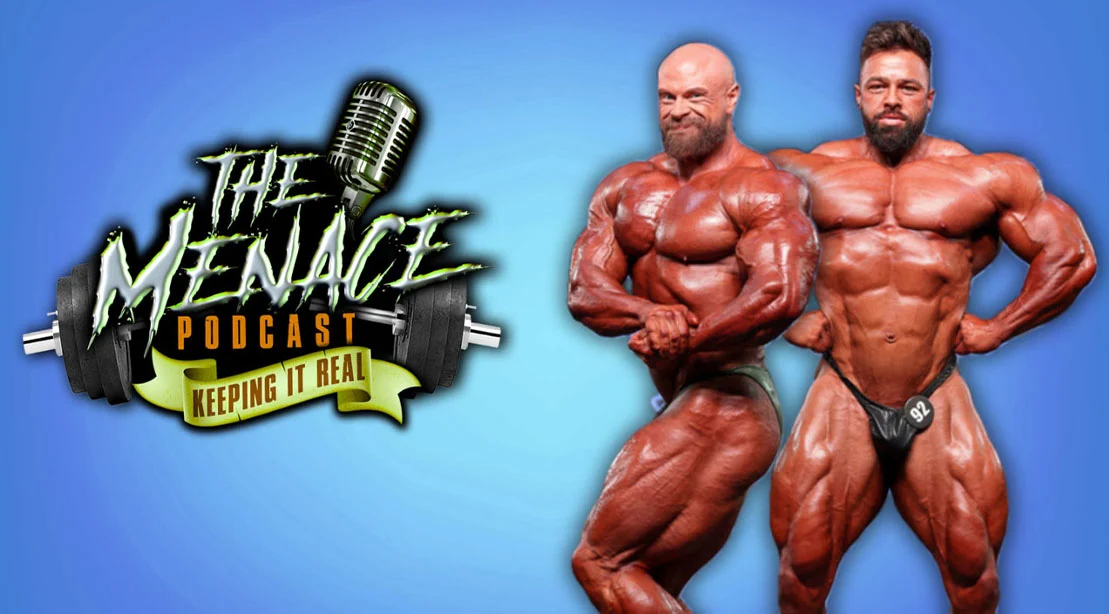
The professional bodybuilding landscape is currently undergoing a period of intense scrutiny, particularly regarding the disconnect between social media stardom and stage success. This tension reached a boiling point on Episode 298 of The Menace Podcast, where host Dennis James—alongside bodybuilding legends Milos Sarcev and Chris Cormier—conducted a post-mortem on the 2026 Atlanta Pro. The central focus of their critique was the shifting hierarchy of the Men’s Open division, highlighted by James Hollingshead’s decisive victory over runner-up Regan Grimes, and the broader, more concerning question of whether modern competitors are prioritizing digital engagement over the grueling discipline of professional training.
The Atlanta Pro: A Shift in the Guard
The Atlanta Pro served as a critical juncture for several athletes vying for a coveted qualification spot at the 2026 Mr. Olympia. James Hollingshead, the powerhouse from the United Kingdom, delivered a performance that the panel unanimously agreed was the most effective package on stage.
Milos Sarcev, known for his keen eye for symmetry and aesthetic balance, went as far as to label the performance as the best of Hollingshead’s career. While Dennis James and Chris Cormier offered a nuanced dissent—arguing that the Brit had displayed slightly more granular detail during his previous outing in China—there was no debate regarding the outcome.
“I thought his legs helped him win,” Chris Cormier noted, emphasizing that the sheer density and lower-body development of Hollingshead created a separation between him and the rest of the pack that the judges could not ignore. By securing the win, Hollingshead successfully punched his ticket to Las Vegas, leaving the rest of the field to grapple with the reality of their own shortcomings.
Chronology of a Competitive Slump
The disappointment for Regan Grimes in Atlanta was not an isolated incident. The timeline of his recent competitive efforts reveals a concerning trend of stagnation. Following his runner-up finish in Atlanta, the conversation inevitably drifted to his recent performance at the Texas Pro, where he was once again bested by Patrick Moore.
The panel expressed genuine confusion regarding the current judging standards as applied to Grimes. Dennis James, frustrated by the lack of upward momentum for a bodybuilder with Grimes’ genetic profile, pointed out that the competition in Atlanta was stiff. He noted that Patrick Moore, who secured fourth place, looked arguably more competitive than his placement suggested.
“I don’t quite see how he did not place higher, to be honest,” James remarked, echoing the sentiment of many fans who feel that the judging criteria in the current era of the IFBB Pro League can be opaque. However, the panel eventually pivoted from questioning the judges to questioning the athlete, shifting the focus toward a pattern of behavior that suggests Grimes may be losing his competitive edge.
The "Instagram vs. Stage" Dilemma
Perhaps the most damning critique leveled against Regan Grimes during The Menace Podcast was the discrepancy between his social media presence and his stage reality. Dennis James, who has been a vocal critic of this trend for two years, did not mince words.
“He loves to pose a rear lat spread and get the camera in the right angle to make it look like he’s unbeatable from the back, same with the back double biceps,” James observed. “And he never, not once, looked like that on stage.”
This observation touches on a growing phenomenon in professional bodybuilding: the "Instagram Physique." With the rise of high-definition cameras, specific lighting rigs, and carefully curated angles, athletes can craft an image of perfection that disappears the moment they step onto a stage under harsh, overhead judging lights. James argues that this is not merely a marketing tactic but a psychological trap. By convincing himself—and his millions of followers—that he is "Olympia ready" based on filtered content, the athlete may be insulating himself from the cold, hard feedback of the judges’ scorecards.
Supporting Data: When Content Outweighs Training
The most jarring anecdote of the episode came from Chris Cormier, who provided a firsthand account of a training session involving himself, Milos Sarcev, and Grimes in Las Vegas.
Cormier, a man with a resume of over 100 professional shows, recounted the frustration of visiting a facility to mentor a younger athlete, only to find that the priority was not the iron, but the camera. “Regan wants to do some content instead of training and doing posing,” Cormier stated, clearly exasperated. “We got 170 shows between the two of us, me and Milos. You mean to tell me you want to just do content?”
This behavior suggests a fundamental misalignment of priorities. In an era where sponsorship deals are often tied to social media reach, the temptation to spend three hours filming a "vlog" rather than two hours executing a high-intensity, depletion-focused training session is immense. However, as the panel agreed, the stage is the ultimate equalizer. No amount of YouTube views or Instagram likes can compensate for a lack of conditioning or muscle density when standing next to the elite of the IFBB.
Official Responses and Expert Analysis
While the critique was harsh, it was not devoid of hope. Milos Sarcev, often considered one of the most technical coaches in the sport, provided a counter-balance to the cynicism of James and Cormier. He suggested that Grimes’ issues might not be a lack of work ethic, but rather a performance anxiety or "nerves" that prevent him from displaying the full, rounded physique he possesses in the privacy of the gym.
“His back is very much underrated,” Sarcev noted. “Very good calves. People don’t talk about Regan’s calves.”
Cormier agreed, acknowledging that the "IT Factor" is undeniably present in Grimes. The consensus among the three experts was that the raw materials—the genetics, the shape, and the structure—are all there. The issue is entirely internal. It is a matter of discipline, focus, and a willingness to embrace the "suffering" required to reach the next level. As Cormier summarized, “You’ve got to be willing to do that from your mind and your heart.”
The Implications for the Modern Bodybuilder
The case of Regan Grimes serves as a cautionary tale for the next generation of professional bodybuilders. The sport is currently at a crossroads where the line between "influencer" and "athlete" is becoming increasingly blurred.
The Cost of Distraction
The primary implication of this trend is the dilution of the competitive standard. If top-tier athletes spend their limited energy reserves on content creation, they are inevitably taking away from the recovery and precision required for peak conditioning. In a sport where the difference between first and fifth place is often a matter of a few millimeters of skin thickness or the fullness of a specific muscle belly, even minor distractions can have catastrophic results on the scorecard.
Financial Realities vs. Sporting Excellence
Dennis James offered a pragmatic perspective on why athletes like Grimes might lean into content: money. With the prize pools in professional bodybuilding often failing to cover the exorbitant costs of preparation—supplements, travel, coaching, and life expenses—social media provides a vital revenue stream. However, James’ warning is clear: “Don’t go on stage, acting like you that guy, because you got to do it in the gym.”
The implication here is one of integrity. An athlete can be a successful influencer, but they cannot use the stage as a prop for their personal brand if they are not willing to do the work. If the results continue to decline, the brand itself will eventually lose its value, as the audience will eventually tire of watching an athlete who consistently underperforms their own hype.
Conclusion: The Path Forward
The discussion on The Menace Podcast was not merely an attack on a single athlete; it was a rallying cry for a return to the roots of bodybuilding. The panel’s collective expertise—built over decades of winning shows and coaching champions—provided a roadmap for what is required to win.
For Regan Grimes, the path forward is clear: the cameras must be secondary to the training. The posing practice, which is the most grueling and often the most neglected aspect of a prep, must become the focus of his daily routine. He has the potential, the frame, and the support of some of the sport’s most respected minds. Whether he can pivot from being a content creator to a legitimate title contender at the 2026 Olympia remains to be seen.
As the sport continues to evolve, the athletes who will stand on the podium are those who recognize that while the internet may build a career, it is the iron that builds a legacy. The judges are not watching the Instagram feed; they are watching the stage. And for now, the stage is demanding more from Regan Grimes than he is currently willing to give.