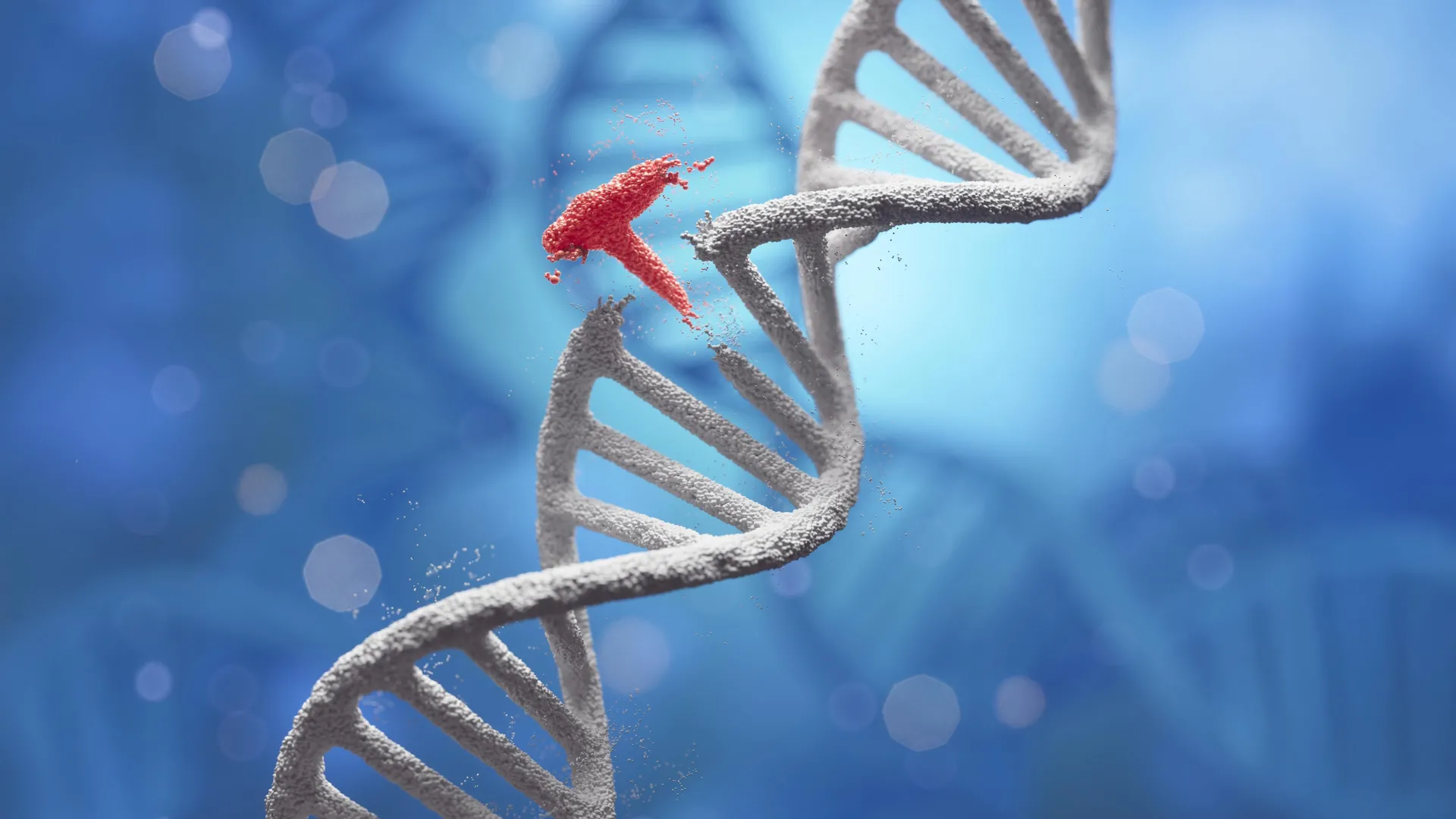
DNA—the fundamental blueprint of life—is a remarkably long and complex molecular chain. While the ability to manipulate these chains has ushered in the modern era of biotechnology, our "molecular scissors" have long been limited by the precision and efficiency of the tools at our disposal. Now, a breakthrough from researchers in Japan is set to change the landscape of genetic engineering. By harnessing the unique properties of silver nanoparticles, scientists have developed a new method for cutting and reconnecting DNA that outperforms traditional enzymatic techniques by up to five times.
The study, published in the journal Nucleic Acids Research, details a method that not only achieves superior efficiency but also overcomes the persistent challenges of DNA recovery and fragment joining. This advancement promises to streamline applications ranging from the development of advanced cancer vaccines and gene therapies to the creation of robust, genetically modified crops.
The Limitations of Traditional Genetic Engineering
For decades, the standard protocol for assembling DNA has relied heavily on restriction enzymes—proteins that function as biological scissors, cutting DNA at specific, pre-determined sequences. Once cut, these fragments are joined together using an enzyme called T4 DNA ligase.
While this "cut-and-paste" method has been the workhorse of biotechnology since the 1970s, it is far from perfect. Restriction enzymes are inherently restrictive; they only recognize specific, short DNA sequences. If a target site does not contain the exact sequence required, the enzyme cannot make the cut. Furthermore, these enzymes typically produce "sticky ends"—the short, single-stranded overhangs that allow DNA fragments to bind to one another—that are very brief. These short overhangs are often unstable, leading to low assembly efficiency and difficulty in stitching together complex, multi-fragment structures.
The research team, led by Professor Hiroshi Abe and Assistant Professor Masahito Inagaki at Nagoya University, alongside Professor Natsuhisa Oka at Gifu University, sought to break free from these biological constraints by replacing proteins with chemical reactions.
A Chronology of Discovery: From Ions to Nanoparticles
The path to this breakthrough began with a deep dive into historical chemical literature. In the early 1990s, researchers discovered that silver ions could catalyze the cleavage of DNA specifically at 3′-thiol-modified sites. The Japanese team hypothesized that this chemical reaction could be repurposed to create the long, stable sticky ends necessary for advanced DNA assembly.
The Initial Hurdle
The team’s initial experiments with silver ions were a proof-of-concept success but a practical failure. While the silver ions successfully cut the DNA at the target sites, they proved difficult to control. The ions tended to bind non-specifically to other parts of the DNA molecule, causing unwanted interference. Even more problematic was the precipitation of the DNA-silver complex, which hindered recovery. In these early trials, only 14% of the target DNA could be retrieved—a yield far too low to be useful for laboratory or industrial applications.
The Nanoparticle Solution
Recognizing that the problem lay in the solubility and reactivity of the silver ions, the team pivoted to silver nanoparticles. By using nanoparticles instead of free ions, the researchers could leverage the high surface-area-to-volume ratio of the silver while maintaining a stable, recoverable substrate. Centrifugation—a process that separates materials by density—allowed the team to easily remove the nanoparticles from the reaction mixture once the DNA was cut, significantly improving the recovery rate of the desired genetic material.
Optimizing the "Molecular Scissors": The Role of PEG
Transitioning to nanoparticles was only the first step. The team initially found that while the nanoparticles worked, they required high temperatures—up to 95°C—to achieve near-complete cleavage. Such temperatures pose a significant risk of damaging delicate, long-chain DNA molecules, rendering them biologically inactive.
To address this thermal sensitivity, the researchers turned to polyethylene glycol (PEG), a water-soluble polymer known for its ability to stabilize nanoparticles and improve their dispersion in liquid. By coating the silver nanoparticles with PEG, the team transformed the reaction’s efficiency.
The results were transformative:
- Without PEG: Cleavage efficiency hovered at approximately 36% at 37°C over 31 hours.
- With PEG: Efficiency skyrocketed to 92% under the same conditions.
- Final Optimization: The team eventually refined the process to achieve over 91% efficiency at a moderate 50°C in just one to two hours, proving that the method could be both fast and gentle.
Moreover, the "built-in" purification effect of the nanoparticles—whereby unwanted, non-cleaved DNA remained anchored to the nanoparticle surface while the desired, cut fragments floated in the solution—raised the final recovery rate from a dismal 14% to a staggering 98%.
Supporting Data: Longer Overhangs and Higher Efficiency
One of the most significant advantages of the silver nanoparticle method is its ability to generate "sticky ends" of customizable lengths. Conventional restriction enzymes usually produce very short overhangs (often 4 bases long). The new method allowed the team to produce 8-base and even 18-base sticky ends.
When the researchers used T4 DNA ligase to connect these longer fragments, the efficiency gains were clear:
- The 4-base standard: Using conventional methods resulted in a joining efficiency of roughly 8%.
- The 8-base nanoparticle method: Efficiency doubled to roughly 16%.
- The 18-base nanoparticle method: Efficiency soared to 44%, representing a fivefold increase over traditional enzymatic techniques.
To validate these findings, the team assembled a functional DNA fragment encoding Green Fluorescent Protein (GFP). This synthetic construct was introduced into human HeLa cells, which successfully expressed the protein, demonstrating that the DNA assembled by the silver nanoparticle process remained fully functional and biologically accurate.
Official Responses and Future Implications
"We believe this technology will be useful for synthesizing genomic DNA, with many possible applications in areas such as mRNA library establishment for cancer vaccines and gene therapy, as well as the development of artificial protein drugs and genome crops," stated Assistant Professor Masahito Inagaki, the study’s first author.
The implications for the pharmaceutical and agricultural industries are vast. As the world moves toward personalized medicine, the ability to rapidly and accurately assemble large, synthetic DNA constructs is becoming a bottleneck. This technology effectively widens that bottleneck, offering a more modular, efficient, and cost-effective approach to synthetic biology.
However, the team is not resting on these results. The current success involves joining two DNA fragments; the true "holy grail" of this technology lies in its ability to assemble multiple fragments simultaneously. "We have shown that two DNA fragments can be joined," Inagaki explained. "Now, we need to confirm whether multiple fragments can be joined at the same time—a key step for building genome-scale DNA."
Conclusion: A New Era for Genetic Assembly
The research, supported by a wide array of grants including the Japan Science and Technology Agency (JST) and the Japan Agency for Medical Research and Development (AMED), marks a significant departure from the reliance on natural enzymes. By utilizing the physical and chemical properties of silver nanoparticles, the Japanese team has provided a glimpse into the future of genetic engineering—a future where molecular construction is as precise as it is scalable.
As the team continues to refine their method, the potential to build complex, synthetic genomes from the ground up moves from the realm of science fiction to a tangible, near-term reality. Whether through creating life-saving vaccines or engineering crops capable of thriving in a changing climate, this silver nanoparticle technique stands as a testament to the power of interdisciplinary research in solving the most complex challenges of our time.