For millennia, human beings navigated the landscape of health and performance using a singular, sophisticated instrument: the body itself. Our ancestors gauged their physical state through internal signals—the heaviness of breath, the dull ache of fatigue, the sharp sting of hunger, and the restorative clarity of deep sleep. These subjective markers were the primary indicators of one’s readiness to hunt, gather, or retreat.
Today, however, that internal compass is increasingly being sidelined by the digital dashboard. We live in the era of the "Quantified Self," where a sleek band on the wrist or a ring on the finger provides a constant stream of metrics: resting heart rate (RHR), sleep latency, HRV, VO2 max, and caloric expenditure. While these devices offer a bridge between subjective feeling and objective reality, they also introduce a modern dilemma: Are we becoming more in tune with our physiology, or are we outsourcing our intuition to an algorithm?
The Promise and Peril of Precision
The appeal of wearable technology is undeniable. It provides a layer of "cold precision" to human behavior, which—as history and science show—is notoriously prone to bias. We are frequently poor judges of our own habits. Consider the case of the "invisible calories": a colleague once believed he was adhering to a strict caloric deficit, only to discover through meticulous logging that he was consuming an additional 500 calories daily, hidden entirely in his generous portions of barbecue sauce.
In such instances, technology serves as an essential mirror. It forces a confrontation with reality that our internal biases might otherwise obscure. Yet, there is a spectrum of human capability. Ben Johnson, the famed Canadian sprinter, was reportedly so attuned to his own physiology that he could predict his 100-meter sprint times within a tenth of a second. This is an outlier level of self-awareness, but it begs the question: Can we use technology to bridge the gap between our current, often flawed, self-assessment and the level of internal accuracy possessed by elite performers?
Data Reliability: Not All Metrics Are Created Equal
Before relying on these devices to dictate health decisions, one must understand the inherent limitations of the hardware. The fitness industry is currently experiencing a "data gold rush," but the quality of the information being mined varies wildly.
The Hierarchy of Accuracy
Data reliability typically falls into two categories: high-fidelity and estimated metrics.

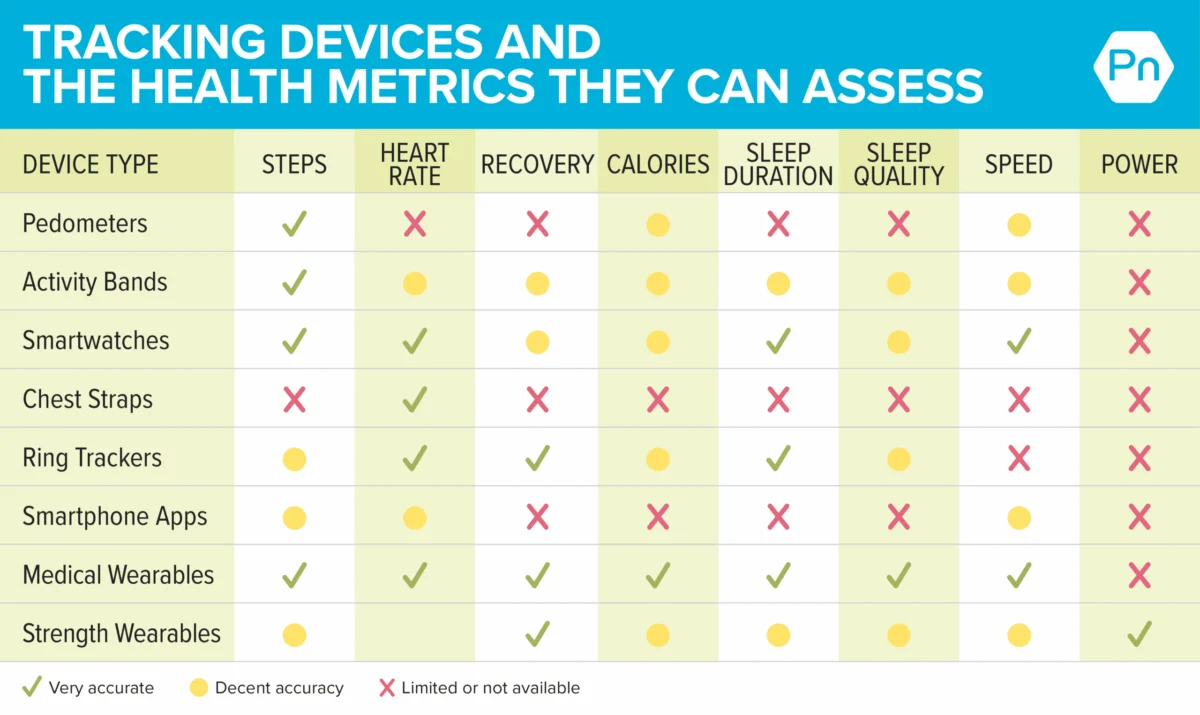
- Highly Reliable: Metrics such as heart rate and step counts have reached a level of maturity where most reputable consumer devices provide consistent, actionable data.
- Estimates with Margins for Error: Metrics such as calories burned, sleep quality scores, and movement velocity are often based on proprietary algorithms rather than direct measurement. These are "best-guess" calculations and should be treated as directional trends rather than absolute truths.
As seen in the industry-standard comparisons of pedometers versus clinical-grade medical wearables, the device itself—and the software backing it—matters. A chest-strap heart rate monitor remains the gold standard for accuracy, whereas a basic smartphone accelerometer may lack the sophisticated processing power to distinguish between a walk to the kitchen and a purposeful workout.
The Paradox of Choice and Information Overload
The core conflict of modern tracking is the "Inverted U-Curve" of decision-making. In this psychological model, performance is optimized at the "sweet spot"—a moderate amount of information. When we have too little data, we are guessing; when we have too much, we suffer from "analysis paralysis."
Computer scientist Samantha Kleinberg, a researcher in the field of decision-making, has noted that even a marginal amount of surplus, irrelevant information can significantly degrade our ability to make sound choices. We see this in the grocery aisle, where the choice of a healthy snack becomes overwhelming, and we see it in the gym, where an athlete becomes so fixated on their recovery score that they lose the ability to listen to their own energy levels.
Three Signs Tracking Is Serving You (And When It Isn’t)
To determine if your relationship with your wearable is healthy, consider these three indicators:
1. Validation and Calibration
Tracking is beneficial when it confirms what you suspect or corrects a false perception. If a high-performing athlete, like "Zak," feels exhausted but believes they must push harder, the data—showing a plummeting heart rate variability and rising resting heart rate—provides the evidence needed to justify a recovery day. In this context, the tracker acts as a coach, giving the user permission to rest.
- The Bad Omen: If the data creates stress for things outside your control—such as a new parent receiving a "poor sleep" score—the tracking is not helping; it is adding a layer of psychological burden to a physiological necessity.
2. The Prompt for Behavior Change
Tracking is most effective when it provides a "prompt" that triggers a positive action. For many, the visualization of data is the nudge needed to break a cycle. If a user realizes through a sleep tracker that their nightly glass of wine is actively degrading their sleep architecture, the data serves as a catalyst for change.

- The Bad Omen: When the tracker becomes the master, motivation suffers. If a cyclist stops riding for the joy of the trail and only rides to "beat a record" on a tracking app, the intrinsic reward is replaced by an extrinsic pressure that leads to burnout.
3. Deepening Self-Knowledge
The ultimate goal of tracking should be to render the tracker obsolete. By consistently checking in with your internal state—how you feel, your energy levels, your hunger cues—and then comparing that to the objective data, you eventually "calibrate" your intuition.
- The Bad Omen: Over-reliance creates a dependency. The "MyFitnessPal Blackout" of 2019 serves as a cautionary tale: thousands of users felt paralyzed because they no longer trusted their own hunger signals without an app to quantify them.
Integrating Tech with Human Intuition
The most successful approach to fitness is to treat technology as a secondary observer. The human body is equipped with an extraordinary sensory network: proprioception (awareness of movement), interoception (awareness of internal states), and a nervous system capable of complex pattern recognition that no algorithm has yet matched.
How to Calibrate Your Internal Compass:
- Check in First: Before glancing at your watch after a run or a meal, pause. Ask yourself: "How do I feel? What is my level of effort? Am I satiated?" Then, and only then, check the data.
- Develop Heuristics: Use Rate of Perceived Exertion (RPE) as your primary tool. If you can develop a mental "shortcut" for effort (e.g., "I can talk in full sentences," or "This is a 7/10 intensity"), you will find that you need the gadget less and less.
- Use Tech as a Coach, Not a Dictator: Use the data to spot trends over weeks and months, not to obsess over daily fluctuations. If your "recovery score" is low but you feel great, trust your body. Your senses are the primary data; the watch is merely the secondary feedback loop.
Implications for the Future of Wellness
As we move further into an era of biometric monitoring—with continuous glucose monitors (CGMs) and sophisticated recovery rings becoming mainstream—the challenge will be maintaining our humanity. The danger is not in the data itself, but in the potential loss of our ability to live without it.
For those who wish to build a truly sustainable, lifelong practice, the goal must remain the same: to foster a body that is strong, capable, and resilient, and a mind that is attuned to the nuances of its own experience. The technology can provide the map, but you must be the one to drive the car. By using wearables to refine our intuition rather than replace it, we can achieve a higher level of health—one that is measured not just in numbers, but in the quality of the life we lead.
For those interested in mastering the art of lifestyle and nutrition coaching—balancing the science of data with the art of human behavior—further resources on professional certification are available through industry-leading programs like the Precision Nutrition Level 1 Coaching Certification.