For over a decade, Dr. Gabrielle Fundaro was the gold standard of nutritional discipline. With a PhD in Human Nutrition, an extensive history as a high-level nutrition coach, and the grit of a competitive powerlifter, she was the person others turned to for the "perfect" macro breakdown. Yet, behind the scenes, a quiet crisis was unfolding. Despite her credentials, Dr. Fundaro felt increasingly disconnected from her own biology.
After years of meticulously logging every gram of protein, carbohydrate, and fat, the very system that provided her with "control" began to feel like a cage. She found herself unable to navigate a restaurant menu without anxiety, paralyzed by the fear that a single unmeasured meal would jeopardize her physique. She realized she had traded her internal compass for an external database.
This realization sparked a professional and personal pivot: the development of "RPE-Eating," a framework designed to replace rigid tracking with the intuitive, data-backed principles of Rate of Perceived Exertion.
The Chronology of a Paradigm Shift
The journey toward RPE-Eating began in the gym. As a powerlifter, Dr. Fundaro adopted the Rate of Perceived Exertion (RPE) scale—a system used to quantify the intensity of a workout based on how a lifter feels in the moment, rather than relying solely on a pre-calculated percentage of a one-rep max. She noticed that when she allowed her training to be dictated by her daily recovery and energy levels, her performance actually improved.
She began to wonder: If I can trust my body to tell me how much weight to move, why can’t I trust it to tell me how much food to eat?
The transition wasn’t immediate. Dr. Fundaro spent months experimenting, first with herself and then with select clients. She moved away from the binary "tracking vs. not tracking" mentality. She identified that the traditional alternative, "Intuitive Eating," was often too abstract for high-achievers who required a structured transition. By borrowing the 1–10 scale from exercise science, she created a bridge—a way to maintain structure while fostering interoceptive awareness. Today, Dr. Fundaro represents a growing movement of nutritionists who argue that true health is not found in an app, but in the ability to listen to one’s own body.
Supporting Data: The Science of Interoception
At the heart of the RPE-Eating methodology is the science of interoceptive awareness. This refers to the nervous system’s ability to sense and interpret internal signals, such as stomach distension, blood sugar fluctuations, and hormonal hunger cues.
Research suggests that long-term reliance on external tracking devices can "blunt" these signals. When an individual eats according to an app’s predetermined numbers rather than their own physiological feedback, the brain stops prioritizing internal cues.
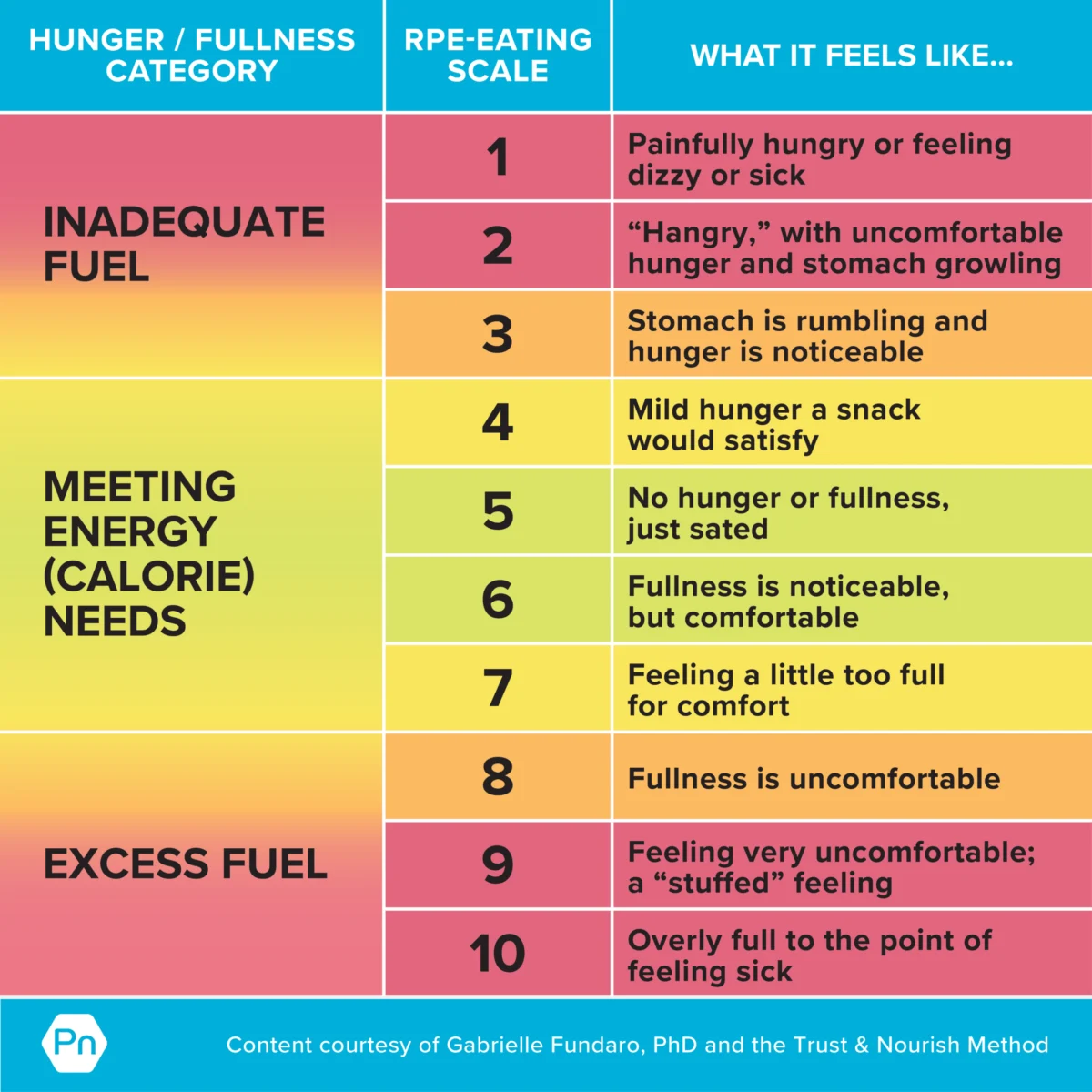
The RPE-Eating scale functions as a re-training tool for the nervous system:
- 1–3 (Under-fueled): Characterized by physical emptiness, lightheadedness, or acute hunger pangs.
- 4–7 (Adequate fuel): The "sweet spot" where hunger is satiated and the body feels energized but not burdened.
- 8–10 (Excess fuel): Ranging from comfortable fullness to physical discomfort and sickness.
By logging these feelings alongside meals, practitioners aren’t just "guessing"; they are building a data set of their own biological responses. This practice mimics the methodology of modern strength coaches who use "autoregulation"—adjusting training intensity based on daily readiness—to prevent burnout and injury.
Professional Perspectives and Industry Impact
Dr. Fundaro’s approach is garnering attention for its nuanced stance on body composition. While many "anti-diet" advocates reject any form of measurement, Dr. Fundaro remains pragmatic. She acknowledges that for some, the goal is not just maintenance, but intentional weight management.
"I am not anti-weight modification; I am pro-safe weight modification," she notes. Her framework allows individuals to aim for specific RPE ranges—such as staying within a 4–5 range for fat loss or a 7–8 range for muscle gain—without the psychological toll of micro-managing macronutrients.

However, the medical community remains cautious. Experts in the field of eating disorders emphasize that while RPE-Eating is a powerful tool for those recovering from "tracking fatigue," it should not be a substitute for clinical intervention for those with diagnosed eating disorders. Dr. Fundaro concurs, explicitly stating that her framework is a pedagogical tool for self-awareness, not a medical treatment for disordered eating.
The Mechanics of Practice: A Four-Step Approach
To transition from external tracking to RPE-Eating, Dr. Fundaro outlines a clear, actionable path:
1. Defining the "Why"
RPE-Eating is not a "hack" for rapid weight loss. It is a tool for building self-trust. Before starting, one must define their objective: Is it to stop being a slave to an app? Is it to gain confidence in social eating? Clarity here is essential to avoid using the scale as just another way to obsess over numbers.
2. Identifying Hunger vs. Appetite
Distinguishing between physical hunger (the body’s need for energy) and appetite (the desire for the sensory experience of food) is a cornerstone of the practice. By checking in before, during, and after a meal, individuals learn to identify the exact point where "satiety" meets "satisfaction."
3. The "Notice and Name" Strategy
Emotional eating is a reality of human life. Instead of shaming herself when she reaches for comfort food during a stressful period, Dr. Fundaro teaches her clients to "notice and name" the emotion. By identifying the trigger—such as professional stress or interpersonal conflict—the individual can decide if food is the appropriate remedy or if a different coping mechanism, like a walk or a conversation, would better serve their needs.
4. Prioritizing Satisfaction
A diet that ignores pleasure is a diet that will eventually be abandoned. RPE-Eating encourages the inclusion of foods that are emotionally satisfying, arguing that restricting "fun" foods leads to the classic pendulum swing of restriction and binging. By using the RPE scale to eat these foods mindfully, the "forbidden" allure fades, replaced by a sense of autonomy.
Implications for the Future of Nutrition Coaching
The shift toward RPE-Eating signals a broader change in the fitness industry. We are moving away from the "one size fits all" spreadsheet era and toward a model that values individual biological feedback.
For the average person, the implications are profound:
- Longevity: By developing the skill of hunger management, individuals are less likely to fall into the "yo-yo" trap that plagues habitual dieters.
- Mental Health: Reducing the obsessive focus on caloric data can lead to a significant decrease in anxiety and body dysmorphia.
- Flexibility: Life is unpredictable. RPE-Eating provides a system that works at a business lunch, a holiday dinner, or a quick breakfast, ensuring that nutrition remains a supportive part of life rather than a source of stress.
Conclusion: The Ultimate Goal is Autonomy
Dr. Fundaro’s own evolution from a rigid macro-counter to an intuitive, RPE-based eater serves as a blueprint for thousands. She hasn’t abandoned her expertise; she has refined it. By integrating the rigorous structure of the RPE scale with the fluidity of human experience, she has created a method that honors both the science of nutrition and the art of living.
As Dr. Fundaro often tells her clients, the goal is not to be perfect at the scale. The goal is to reach a point where you know you are nourishing your body, and you don’t need an app to validate that you’ve done it correctly. In a world of infinite data, perhaps the most radical act is learning to trust one’s own internal metrics.
For those ready to step off the treadmill of constant tracking, RPE-Eating offers a path forward—one that prioritizes peace, competence, and a sustainable relationship with the food we eat.