









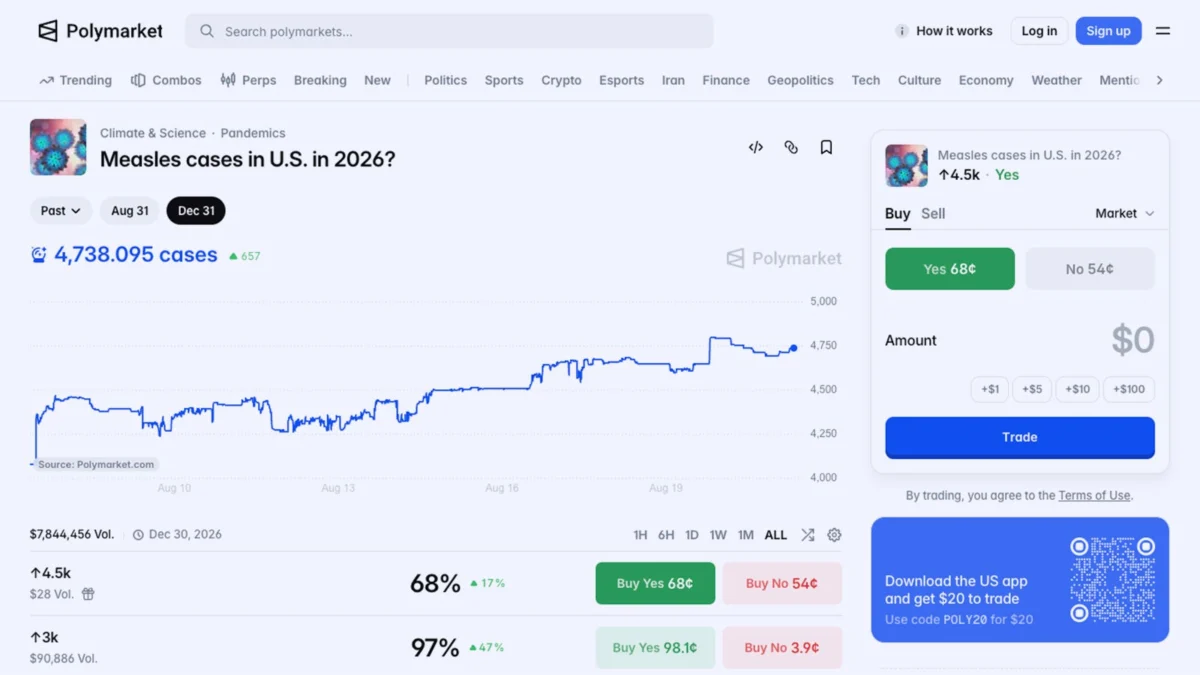
As public health officials grapple with the resurgence of vaccine-preventable diseases, a new and troubling phenomenon has emerged: the financialization of morbidity. Polymarket, a prominent prediction market platform, has launched a $7.8 million betting pool focused on the number of measles cases expected in the United States in 2026. While the platform operates within the bounds of current financial regulations, the exercise has sparked a fierce debate among medical professionals regarding the ethics of commodifying human suffering.
For those on Wall Street or in the world of decentralized finance, these numbers represent mere data points on a speculative ledger. However, for clinicians like Dr. Robert B. Shpiner, a professor of medicine in pulmonary and critical care at the David Geffen School of Medicine at UCLA, these figures represent something far more visceral: children facing catastrophic, life-altering, and often fatal health outcomes.
The Human Cost: Deconstructing the "Data Point"
When a bettor places a wager on a "case count" of 3,000, they are not merely predicting a statistic. They are predicting a cascade of biological trauma. Based on established CDC data and clinical incidence rates, a count of 3,000 measles cases implies a grim reality: three cases of acute encephalitis, 150 instances of pneumonia, 600 hospitalizations among the unvaccinated, and between three and nine preventable deaths.
The medical community emphasizes that the narrative of measles as a "childhood rite of passage"—a view held by some anti-vaccination factions—is a dangerous myth. The reality of the infection involves three distinct phases: acute, subacute, and chronic, each carrying its own specter of disability.
The Acute Crisis: Encephalitis and Respiratory Failure
The acute phase of measles is frequently marked by encephalitis, a terrifying inflammation of the brain that occurs while the patient is still battling the initial infection. As the rash spreads and fevers peak, the child may slip into a state of lethargy, becoming increasingly difficult to rouse. This can rapidly devolve into status epilepticus—a state of continuous, life-threatening seizures.
In these instances, medical intervention is extreme: the child must be sedated and placed on a ventilator, their survival dependent on mechanical support until the cerebral swelling subsides. For those who survive this initial storm, the road to recovery is long, often requiring years of medication and constant monitoring for long-term neurological damage.
The Hidden Damage: Immune Amnesia
Perhaps the most insidious aspect of measles is the "immune amnesia" it leaves in its wake. Research published in Science in 2019 revealed that the measles virus does not simply infect the host; it systematically dismantles the immune system’s "memory." By destroying B-lymphocytes—the cells responsible for remembering past pathogens—the virus strips the body of its ability to produce humoral antibodies.
This loss can range from 11% to 73% of a child’s pre-existing antibody repertoire. Consequently, a child might survive the initial measles infection only to die years later from a routine case of pneumococcal pneumonia. Because the primary cause of the immune deficiency was a past measles infection, the death is rarely, if ever, attributed to the virus. In this way, measles creates "phantom" mortality that never appears on a betting board.
Chronology of a Public Health Failure
The resurgence of measles in the U.S. is a modern-day failure of public health communication and community trust.
- Pre-2000s: Measles was declared eliminated in the United States in 2000, thanks to high vaccination coverage and robust public health initiatives.
- The 2010s: A gradual decline in vaccination rates, fueled by misinformation, led to sporadic, localized outbreaks.
- 2024-2025: The "betting" era. As cases began to climb, platforms like Polymarket identified these outbreaks as "predictive events," turning the rising count into a market commodity.
- 2026 (Projected): The year of the current betting pool. The "ladders" for 1,000 to 2,000 cases have already closed as the infection rate has surpassed these thresholds, forcing the market to adjust its stakes upward.
The Long Shadow: Subacute Sclerosing Panencephalitis (SSPE)
Perhaps the most haunting aspect of the disease is the chronic central nervous system manifestation known as subacute sclerosing panencephalitis (SSPE). Unlike the acute phase, SSPE is an indolent, progressive, and invariably fatal disease that can appear seven to 10 years after the initial infection.
The virus hides within the brain, causing chronic, smoldering inflammation. A child who appears to have recovered fully from a measles infection in 2026 may, in 2034, begin to exhibit subtle changes: a decline in school performance or the onset of myoclonus—involuntary muscle jerks. As the disease advances, these jerks evolve into violent, whole-body spasms.
Eventually, the peripheral nervous system and muscles become rigid, leading to difficulty swallowing, choking, and total mutism. The child becomes trapped in a body that can no longer communicate, eat, or breathe independently. With a mortality rate approaching 100%, there is no effective treatment. The few who survive are left in a state of permanent, severe neurological impairment requiring 24-hour skilled nursing care.
According to data from Clinical Infectious Diseases, the risk is highest for the youngest: one in 609 infants infected in their first year of life will go on to develop SSPE.
Official Responses and Public Health Implications
The CDC remains steadfast in its position: measles is a vaccine-preventable disease, and current trends are directly linked to gaps in community immunity. The agency’s measles counter remains the gold standard for tracking, providing the data that prediction markets rely on.
However, there is a profound disconnect between the data-gathering mission of the CDC and the data-exploiting nature of prediction markets. Public health officials have largely declined to comment on the specific ethics of the Polymarket betting pool, focusing instead on the imperative of vaccination. Nevertheless, the implications of such betting are clear: they treat public health as a game of chance rather than a collective responsibility.
Conclusion: The Children Not on the Ledger
The most profound tragedy of the current discourse is the anonymity of the victims. The children who will succumb to measles sequelae, who will face compromised immune systems, or who will develop SSPE in the coming decade are likely in kindergarten classrooms today.
These children are not merely statistics to be wagered upon. They are individuals whose futures are being compromised by a combination of public health apathy and scientific misinformation. While a gambler on a platform like Polymarket might be able to hedge their financial risk, there is no hedging the biological risk for these children.
When the 2026 betting pool finally settles and the payouts are distributed, the winners will walk away with profit. But the real "results" of these measles cases will not be realized until 2034, when the latent, chronic damage of the virus begins to manifest in the next generation. By then, the betting boards will have long been cleared, and the speculators will have moved on, leaving the victims and their families to face a reality that no market could ever accurately price.