











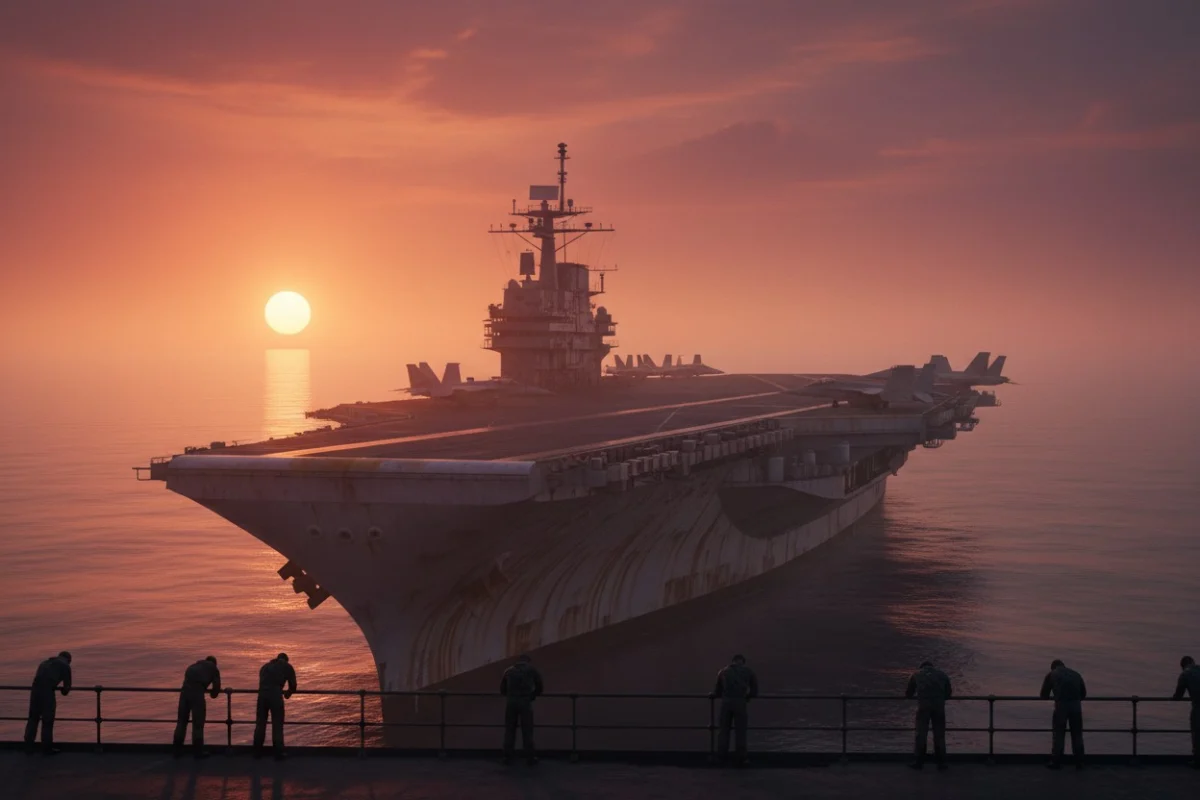
The USS Abraham Lincoln (CVN-72) is finally steaming toward home, drawing the curtain on a deployment that has shattered modern U.S. Navy records for consecutive days at sea. While the vessel’s return marks the end of an arduous 260-plus day operational cycle, the journey has become a focal point of intense political debate, sparking concerns regarding crew welfare, the sustainment of the carrier strike group, and the operational limits of the U.S. naval force.
With over 5,000 sailors and Marines aboard, the Lincoln served as the tip of the spear in the Middle East, primarily tasked with supporting U.S.-Israeli military operations against Iran. However, behind the strategic objectives lay a grueling reality of systemic supply failures, crumbling infrastructure, and a palpable decline in morale that has sent shockwaves through the Pentagon and onto the floor of the U.S. Senate.
A Chronology of Extended Service
The Lincoln’s journey began in November 2025 with a scheduled return date in May 2026. That timeline, however, was rendered obsolete as the geopolitical climate in the Middle East deteriorated. Following a February 2026 ultimatum issued by President Donald Trump regarding Iran’s nuclear ambitions and regional security, the carrier was locked into a cycle of sustained combat and blockade operations.
Repeated extensions kept the crew at sea, effectively cutting them off from port calls for over eight months. The strain of the mission was compounded by the tactical necessity of maintaining a constant presence in the region. It was not until late August 2026—long after the original deployment window had closed—that the USS George Washington arrived in the Central Command area of responsibility to facilitate the Lincoln’s relief.
This delay highlights the thinning margins of the U.S. Navy’s carrier strike force. To move the George Washington into the Middle East, the Pentagon was forced to pull the carrier from the Asia-Pacific theater, leaving a critical strategic void in the region and raising questions about the sustainability of the "Global Response" doctrine.
The Human Cost: Life Aboard the "Troubled" Carrier
While the strategic mission was clear, the internal experience of the crew became increasingly desperate as the months dragged on. Accounts from sailors and their families paint a harrowing picture of life on board. Beyond the expected rigors of military service, the crew faced a cascade of logistical failures that compromised basic living standards.
Reports corroborated by family members have detailed severe shortages of fresh food, a lack of consistent potable water, and failing plumbing systems that left thousands without reliable access to hot water or functioning showers. These conditions were not isolated; similar infrastructure failures were documented aboard the USS Benfold, which reportedly spent four days adrift without power in the South China Sea in July 2026. The loss of air conditioning, sanitation, and fresh water in a high-stress, high-temperature environment exacerbated the psychological toll on the crew.
The cumulative effect of these stressors—extended isolation, substandard living conditions, and relentless operational tempo—has manifested in a mental health crisis. Families have raised alarms regarding burnout, depression, and severe psychological distress. Most chilling are the reports, cited by multiple news organizations, of several crew members attempting to jump overboard, a grim indicator of the breaking point reached by some personnel.
Official Responses: A Clash of Narratives
The response from the top echelons of the U.S. government has been characterized by a sharp divide between those acknowledging the crisis and those dismissing the gravity of the reports.
Acting Navy Secretary Hung Cao recently attempted to temper the public outcry, acknowledging a "small number of mental health cases" on board. Cao asserted that these cases were "treated with no loss of life," suggesting that the medical infrastructure on the ship had successfully managed the surge in distress.

However, U.S. Secretary of War Pete Hegseth took a more combative stance, dismissing the media reports as "completely misrepresented." While Hegseth stopped short of issuing a flat denial of the specific infrastructure failures, he characterized the narrative as an unfair attack on the mission’s success.
The discourse reached the White House, where President Trump offered a blunt assessment, telling reporters that the deployment was "not nearly long enough" and openly rejecting the validity of the concerns raised by the sailors’ families.
Conversely, the political opposition has moved to hold the administration accountable. Senate Minority Leader Chuck Schumer (D-NY) has leveled heavy criticism at Secretary Hegseth, calling for his resignation and labeling him "completely incompetent." Amidst the political sparring, Admiral Brad Cooper, head of U.S. Central Command, conducted a visit to the ship. In his subsequent public comments, Adm. Cooper insisted that mental health was a "priority" and claimed the ship maintained "among the lowest number of cases related to mental health" in the fleet, a statement that has since been scrutinized by watchdog groups and the families of the crew.
Operational Implications and the Future of the Force
The Lincoln deployment serves as a case study in the risks of "over-extending" the Navy. The fact that the ship’s relief required the redeployment of another carrier underscores a precarious lack of depth in the U.S. fleet. The decision to leave the Asia-Pacific region devoid of a carrier presence to bolster the Iranian theater reflects a prioritization of immediate, high-stakes crises at the expense of long-term strategic posture.
Furthermore, the logistical failures—plumbing, food supply, and basic maintenance—suggest that the Navy’s support infrastructure is struggling to keep pace with the demands placed upon it. The "record-breaking" duration of the deployment, while an achievement in terms of raw endurance, has become a liability. It has exposed that when ships are kept at sea beyond their designed maintenance and resupply cycles, the efficiency of the crew and the functionality of the vessel degrade in tandem.
As the Abraham Lincoln finally reaches port, the sailors and Marines on board face a long process of reintegration. For many, the physical and psychological toll of the last 260 days will require significant recovery time. For the Navy, however, the challenge is only beginning. The incident has forced a high-level re-evaluation of the Navy’s deployment protocols.
There is mounting pressure on Congress to investigate the systemic causes of the supply shortages and the command culture that allowed conditions to deteriorate to such a degree. Whether this will lead to a change in the frequency of long-duration deployments or a surge in funding for maintenance and crew support remains to be seen.
Ultimately, the Lincoln’s return marks the conclusion of a historic chapter, but it leaves behind a legacy of unresolved questions. As the Pentagon prepares to draft its lessons-learned report, the disparity between the administration’s narrative and the lived reality of the sailors will likely remain a flashpoint in the national debate over the cost of projecting power in an increasingly volatile global environment.
Summary of Key Data Points
- Deployment Duration: 260+ days, marking a record for modern U.S. naval deployments.
- Primary Mission: Support for U.S.-Israeli military operations and blockade efforts against Iran.
- Crew Size: Approximately 5,000 personnel.
- Reported Infrastructure Failures: Inconsistent water supply, sewage/plumbing issues, food shortages, and limited hot water.
- Mental Health Context: Reports of suicide attempts; disputed internal data regarding the frequency of psychological crises.
- Strategic Shift: Relocation of the USS George Washington from the Asia-Pacific to the Middle East, resulting in a temporary gap in carrier coverage in the Pacific.
As the Lincoln docks, the focus will undoubtedly shift from the mission’s strategic goals to the well-being of the personnel who made it possible. The record set by the Abraham Lincoln may be a milestone in nautical history, but for the crew and their families, it is a testament to an operational tempo that may prove unsustainable in the years to come.