











Reviewed by Brian St. Pierre, MS, RD
When GLP-1 receptor agonists like semaglutide (Ozempic) first gained mass-market traction around 2017, a palpable anxiety rippled through the health and fitness industry. Coaches, personal trainers, and nutritionists faced an existential question: "Is this drug going to steal my job?"
For several years, this threat remained largely theoretical. Prescription rates were modest, and the medication was an abstract concept to many. By 2026, however, the landscape has shifted dramatically. With over 1 in 10 U.S. adults now utilizing GLP-1 medications, the conversation has moved from existential dread to practical integration. Most professionals now view these drugs not as replacements, but as powerful tools that, when paired with professional coaching, can redefine client health outcomes.
The Evolution of a Paradigm: From Threat to Support
The initial hostility toward GLP-1s has largely softened, replaced by a more nuanced understanding of their role in weight management. Coaches are beginning to realize that the existence of a medical intervention does not negate the need for behavioral change.
Kate Solovieva, Super Coach and Director of Community at Precision Nutrition (PN), offers a critical framing for this new era: "As a coach, you’re not in the GLP-1 world; you’re in the GLP-1 support world."
This distinction is vital. It acknowledges that the market is not simply "people on GLP-1s," but rather "people on GLP-1s who want support." Coaches cannot—and should not—attempt to serve everyone. The goal is to identify the subset of users who are ready, willing, and able to engage in the behavioral work required to optimize their medication journey.
A Chronology of the GLP-1 Integration
- 2017–2019: The Theoretical Phase. GLP-1s enter the market. Fitness professionals view them with skepticism, fearing they undermine the "hard work" of diet and exercise.
- 2020–2023: The Awareness Phase. Usage begins to climb. Coaches report an increasing number of clients using medication but note a lack of guidance regarding nutrition and muscle preservation.
- 2024–2025: The Evidence Phase. Data emerges showing significant lean mass loss among patients who use medication without resistance training or adequate protein intake. The fitness industry pivots toward "muscle-centric" coaching.
- 2026: The Support Phase. Coaching frameworks emerge that treat GLP-1 usage as a variable in a larger health equation, focusing on long-term sustainability, habit formation, and post-medication transitions.
Supporting Data: Why Coaching Matters
The clinical reality is that while GLP-1s are highly effective at suppressing appetite, they are not a comprehensive solution for metabolic health. Studies suggest that without intervention, up to 40 percent of weight lost via GLP-1s can be attributed to lean mass reduction, primarily muscle.
Furthermore, data indicates that approximately 50 percent of users discontinue the medication within the first year, often due to cost, side effects, or personal choice. For these individuals, the "rebound effect"—a rapid regain of weight—is a significant concern. However, evidence shows that individuals who integrate structured nutrition and exercise habits while on the medication are four times more likely to maintain a 10 percent or higher weight loss after stopping treatment.
Categorizing the GLP-1 Client
Understanding the mindset of a client is the first step in effective coaching. Readiness is not a static trait; it is dynamic. A client who is resistant today may become highly motivated tomorrow.
1. The Honeymooner (Low Readiness)
These clients are seeing rapid results on the scale without changing their behavior. They are satisfied and generally unreceptive to "corrective" coaching.
- Strategy: Avoid the "righting reflex." Celebrate their success and position yourself as a resource for when they eventually reach a plateau or decide they want to focus on body composition rather than just weight.
2. The Ambivalent Candidate (Low-to-Moderate Readiness)
These individuals are on the fence about starting medication. They often struggle with feelings of "weakness" or moral judgment regarding medical intervention for obesity.

- Strategy: Use tools like the "4 Crazy Questions" to help them explore their fears. Frame the decision as a medical choice to be made with a physician, while clarifying that foundational habits (nutrition/movement) remain the same regardless of the path chosen.
3. The Ready-to-Quitter (Moderate Readiness)
Overwhelmed by side effects like nausea and exhaustion, these clients are ready to stop.
- Strategy: Normalize their experience. Educate them on the prevalence of side effects and encourage them to consult their doctor about potential dosage adjustments. Suggest small, frequent meals to manage symptoms.
4. The Muscle-Loss Risk (Moderate Readiness)
The scale is dropping, but the client is sedentary and under-eating protein.
- Strategy: Use objective data like a DEXA scan or simple functional tests (e.g., sit-to-stand speed) to show them what is happening beneath the skin. Prioritize high-protein intake (25–40g per meal) and scaled resistance training.
5. The Under-Fueler (Moderate-to-High Readiness)
Medication has effectively "turned off" their appetite, leading to dangerous caloric deficits and nutrient deficiencies.
- Strategy: If an eating disorder is suspected, refer to a specialist immediately. If not, implement an "eating schedule" to ensure nutrient intake even in the absence of hunger cues.
6. The Graduate (High Readiness)
The client is planning to wean off the medication.
- Strategy: Focus on "ruts in the trail." Help them establish behavioral habits that can persist after the medication’s appetite-suppression effect fades. Temper expectations regarding the scale.
7. The Priced-Out (High Readiness)
Forced to stop due to insurance or financial constraints, these clients are often angry and frustrated.
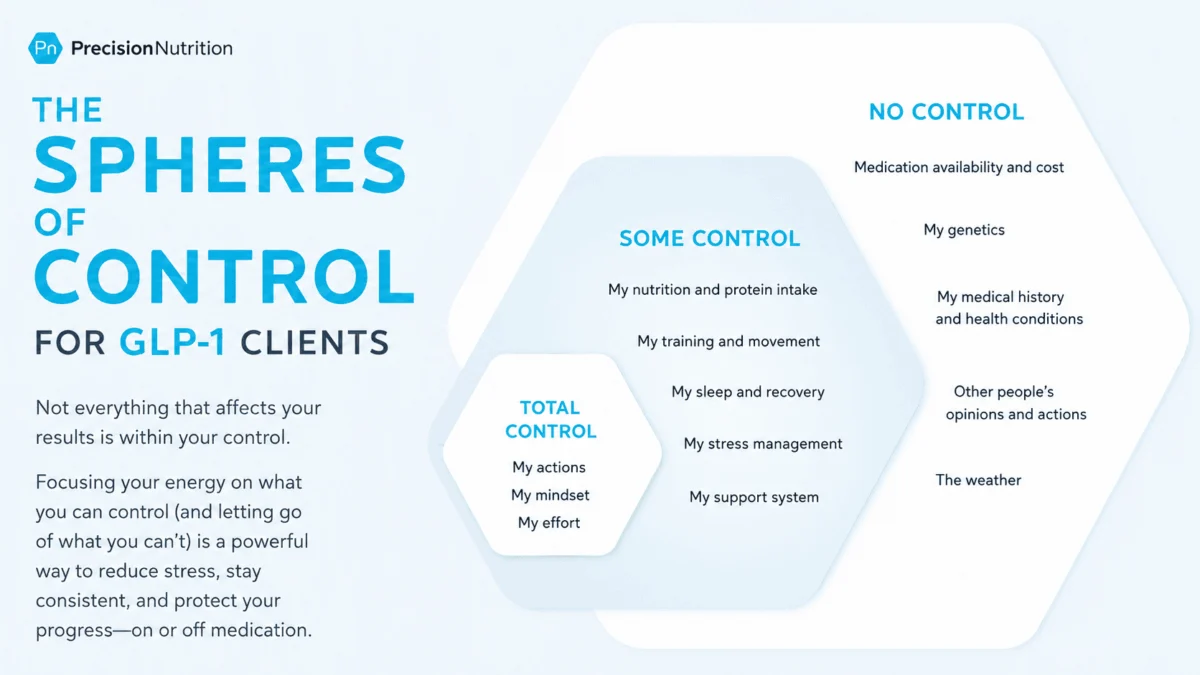
- Strategy: Acknowledge the systemic failure. Use the "Spheres of Control" exercise to move the client from a place of helplessness to a focus on what they can control (e.g., sleep, training, protein intake).
Official Responses and Ethical Boundaries
A recurring theme in the expert guidance from organizations like Precision Nutrition is the importance of "staying in your lane." Coaches must never adjust medication dosages, prescribe medical treatments, or make definitive medical promises.
Instead, the ethical coaching move is to act as an objective partner who gathers data—through food logs, performance metrics, and honest dialogue—to help the client communicate more effectively with their medical team. When symptoms exceed standard discomfort, coaches should be prepared with a referral network of registered dietitians and medical doctors.
Implications for the Future of Coaching
The long-term implication for the fitness industry is clear: the role of the coach is evolving from "taskmaster" to "behavioral architect." In the age of medical weight management, the ability to build, reinforce, and maintain lifestyle habits is more valuable than ever.
As Coach Toni Bauer, Director of Coaching and Education Operations at PN, notes, the ultimate goal is helping the client transition into a new identity. "I am the person who eats protein at every meal. I am the person who does resistance training because it builds the tissue I need to age well."
The "promise" for a coach is no longer a specific weight-loss guarantee. Instead, it is the creation of a structural foundation. By "cutting ruts deep enough" through consistent behavioral reinforcement while the medication is active, coaches provide their clients with a map for success that will remain long after the medication is gone.
For those ready to embrace this shift, the opportunity is significant. As the medical community increasingly treats obesity as a chronic condition requiring long-term care, the fitness professional becomes a crucial pillar in the patient’s support network, ensuring that the journey is not just about losing weight, but about reclaiming health.