











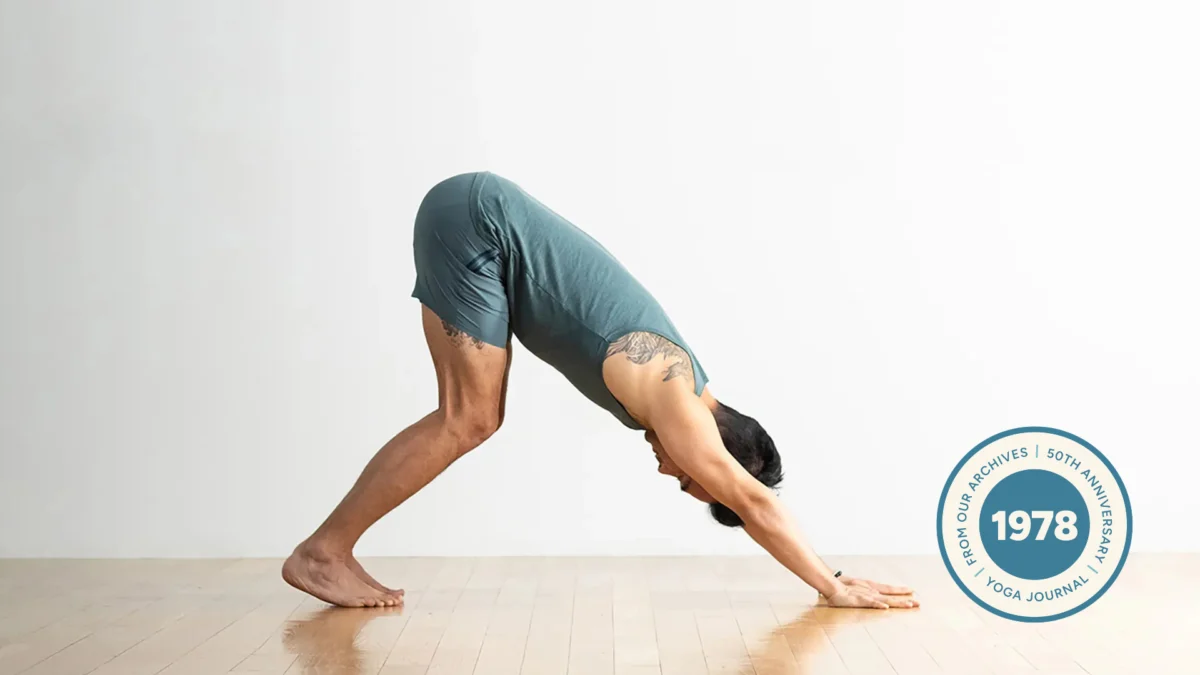
Published originally in the July-August 1978 issue of Yoga Journal, this archival feature remains a cornerstone text for understanding the structural and energetic nuances of Downward-Facing Dog. As part of our ongoing Archives series, we revisit this foundational practice to explore why the pose remains as vital for the modern athlete as it was nearly five decades ago.
Main Facts: The Anatomy of a Fundamental Pose
Adho Mukha Svanasana, or Downward-Facing Dog, is arguably the most recognizable posture in the modern yoga lexicon. More than a simple stretch, it is a complex, weight-bearing inversion that serves as a bridge between active exertion and restorative repose.
At its core, the pose is designed to lengthen the spinal column, decompress the vertebrae, and awaken the posterior chain. By placing the hands on the floor and lifting the hips toward the ceiling, practitioners create an inverted "V" shape that challenges the stability of the shoulders while simultaneously demanding flexibility from the hamstrings and calves.
The brilliance of the pose lies in its dual nature: it is simultaneously an energizing, full-body activation and a calming inversion. The downward slant of the torso encourages blood flow toward the head and heart, offering many of the physiological benefits of more advanced inversions—such as headstands—without requiring the same level of balance or risk for the beginner.
A Chronological Perspective: From Ancient Roots to 1978
The history of Adho Mukha Svanasana is woven into the broader tapestry of Hatha Yoga. While its origins trace back to ancient Indian traditions, the mid-20th century saw a resurgence of interest, largely driven by the methodical, alignment-focused approach of B.K.S. Iyengar.
In the late 1970s, as yoga began to transition from a niche philosophical pursuit into a mainstream health practice in the West, the pedagogical focus shifted toward "subjective intelligence." Practitioners began to realize that the body was not a monolith, but a collection of distinct physical experiences. Teachers began to categorize muscles not just by their anatomical function, but by their "personalities"—some muscles were seen as resilient and intelligent, while others were notoriously stubborn.
This archival look back at 1978 highlights the period when yoga instruction began to marry traditional wisdom with the burgeoning field of sports science. It was an era where the yoga mat became a laboratory for self-discovery, emphasizing that the "completed" pose was not a static destination, but a fleeting moment of integration that had to be re-attained with every breath.
Supporting Data: The "Ornery" Nature of the Hamstrings
For the athlete, particularly the runner, the hamstring muscle group often acts as the primary antagonist to progress. The anatomy of the hamstrings provides a compelling explanation for why this area of the body resists change so stubbornly.
Unlike muscles composed primarily of soft, elastic fiber, the hamstrings are rich in tendinous material. Tendons, which connect muscle to bone, are notoriously low in blood supply and possess limited elasticity. When a runner exerts themselves, the constant, repetitive contraction of these muscles can lead to a state of chronic shortening.
The Tendon-Stretch Dilemma:
- The Muscle Fiber: Highly vascular, sliding filaments allow for significant range of motion.
- The Tendon: Low vascularity, rigid structure. Stretching a tendon is akin to pulling a rubber band; once tension is released, it snaps back to its original length.
- The Consequence: When hamstrings tighten, they limit pelvic rotation. This creates a "domino effect," inhibiting forward bending and forcing the lower back to compensate, often leading to discomfort or injury.
For those who treat their bodies as machines, this realization is critical. Simply "forcing" a stretch does not yield long-term mobility. Instead, patience and the application of subtle, consistent pressure—the kind practiced in a mindful Downward-Facing Dog—are required to educate the nervous system to allow the muscle to release.
Pedagogical Adaptations: Making the Pose Accessible
One of the most profound realizations in the practice of Adho Mukha Svanasana is that the floor is not a requirement for progress. Beginners often struggle with the pose because they mistake the "floor" for the "goal."
Modifying for Success
For the student experiencing trembling knees or acute hamstring pain, the use of props is not a concession; it is a strategic necessity. Placing the hands on a stable chair or bench against a wall shifts the focus from reaching the floor to lengthening the spine. This modification allows the lower back to release without the distraction of hamstring panic, fostering a healthier foundation for future progress.
The Iyengar Rope Method
For those seeking to understand the mechanics of pelvic rotation, B.K.S. Iyengar’s use of ropes—or, in modern settings, a simple yoga strap—offers a breakthrough. By looping a strap around the crease of the hips and anchoring it to a secure structure, the practitioner can experience an artificial "tug" that encourages the pelvis to tilt correctly. This sensation of pelvic rotation is the key to unlocking the posterior chain, turning a generic stretch into a profound anatomical inquiry.
Implications: The Mind-Body Dichotomy
As we delve deeper into the practice, the implications of Adho Mukha Svanasana extend far beyond physical flexibility. The pose presents a unique dichotomy: while the external body is engaged in a rigorous, weight-bearing struggle, the internal mind is invited to a place of stillness.
The "Court of Inquiry"
When we notice tightness, we must act as observers rather than oppressors. If the back of the knees feels dead or "asleep," it is because our mental focus has failed to reach those fibers. By raising the heels and coming onto the toes, we free the hips to rotate. As we slowly lower the heels while maintaining that rotation, we re-establish a connection between the mind and the skin. This is the moment the hamstrings stop being "ornery" and start responding to conscious intent.
The Restorative Pyramid
Ultimately, the pose acts as a "pyramid of energy." The structure is strong, vital, and grounded, yet within that structure, there is a "secret place"—a point of repose. For the athlete, this is the most valuable takeaway: the ability to find rest within exertion.
Whether you are a marathon runner fighting the tightness of miles or a sedentary professional looking to reverse the effects of a desk-bound day, Adho Mukha Svanasana remains the primary tool for integration. It is a practice of constant re-awakening, where the perfection of the pose is not found in the final, fixed shape, but in the intelligent, breath-centered journey toward it.
Conclusion: The Constant Practice
Integration is not a permanent state; it is a fleeting arrival. By returning to the basics—the press of the thumb and forefinger, the quietening of the breath, and the patient rotation of the pelvis—we transform a physical stretch into a ritual of presence. As the 1978 archives remind us, the pose is a framework. We are the architects, and the blueprints must be redrawn with every single inhalation.