










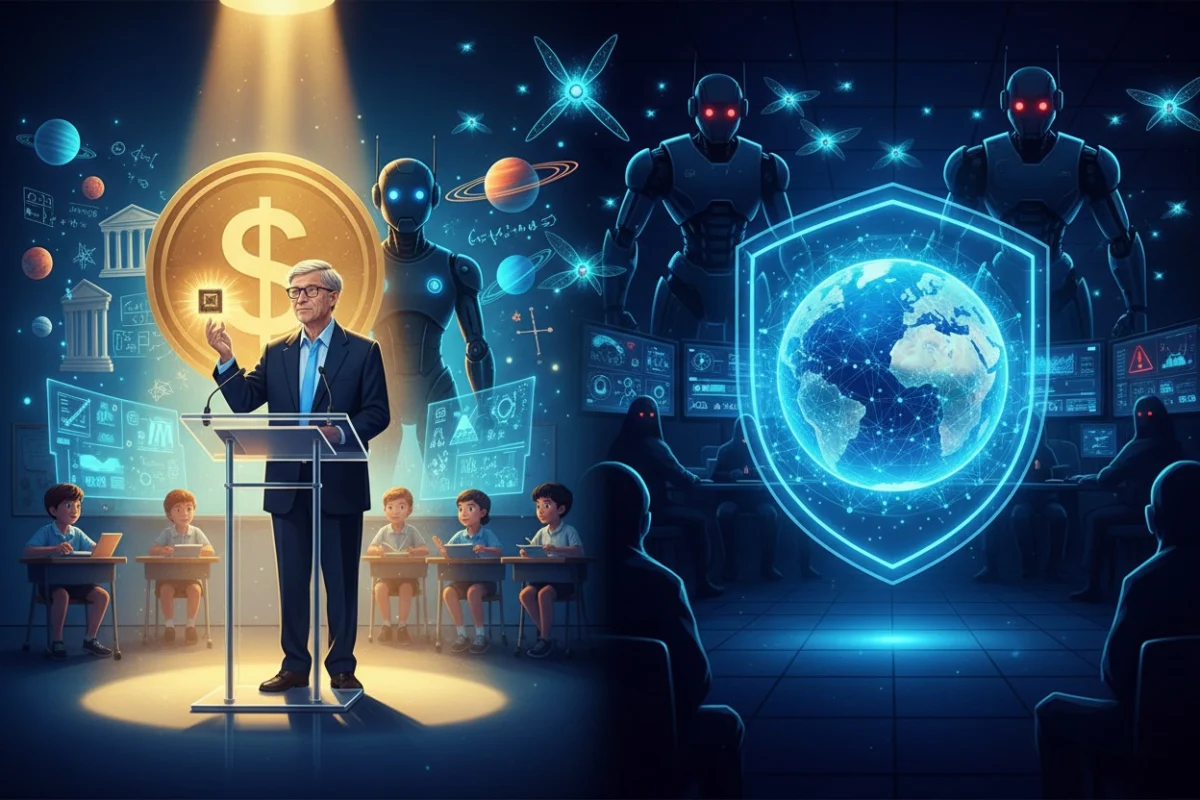
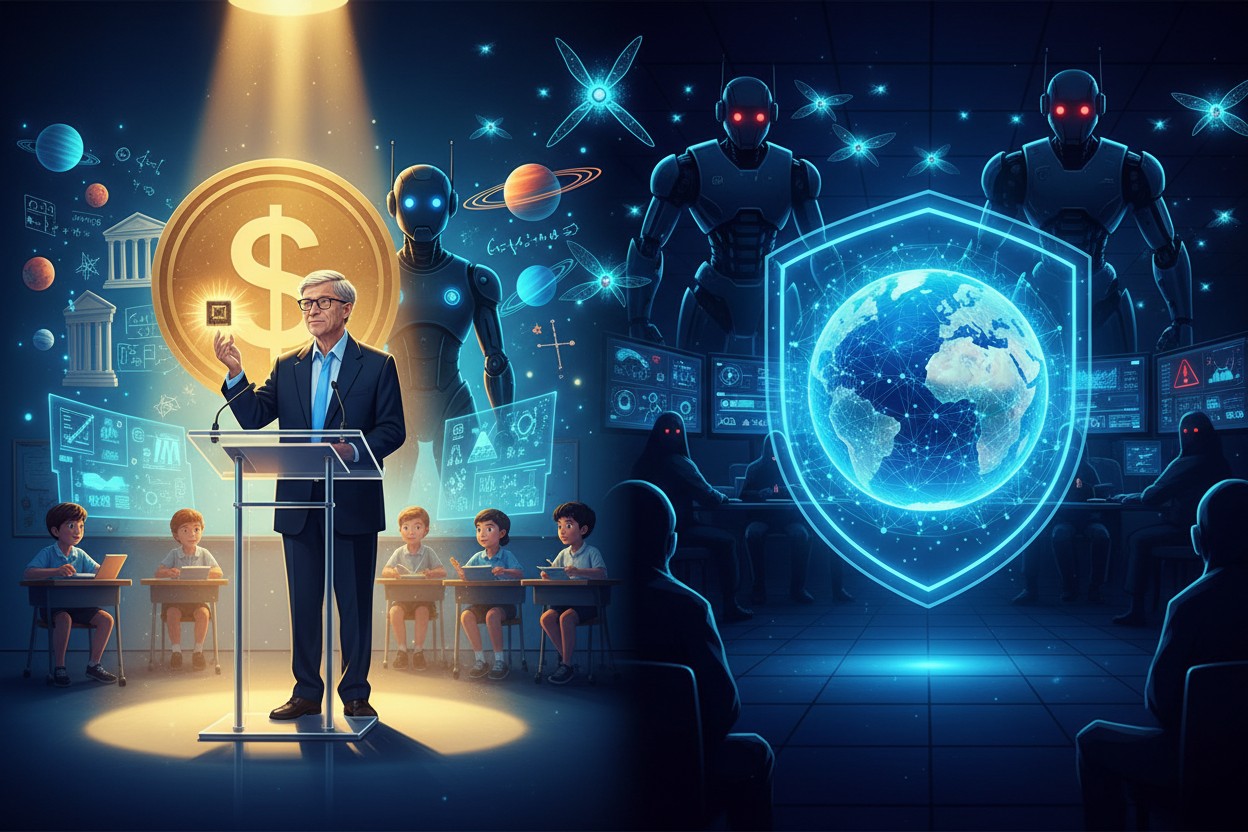
As artificial intelligence (AI) accelerates from a specialized research pursuit to a fundamental pillar of the global economy, a profound ideological divide has emerged regarding its management. Leading the conversation is Microsoft co-founder Bill Gates, who has issued a stark warning: the world is currently woefully unprepared for the arrival of what he describes as an “alien intelligence.”
In recent interviews, including a high-profile exchange with Reuters, Gates argued that no national government currently possesses the technical depth or the regulatory framework necessary to contain the risks associated with rapidly evolving AI systems. His proposed solution—a permanent, cross-border watchdog modeled after nuclear non-proliferation treaties and aviation safety authorities—has ignited a fierce debate in Washington, Beijing, and Silicon Valley.
Main Facts: The Call for a Global Watchdog
Bill Gates’ recent advocacy centers on the premise that AI is not merely another software upgrade, but a civilizational inflection point. In a wide-ranging, 6,000-word manifesto published in late August, Gates characterized the coming transition as “one of the most turbulent times in human history.”
The core of his proposal is the creation of an international regulatory body tasked with monitoring the development of frontier models. Drawing parallels to the International Atomic Energy Agency (IAEA) or the Montreal Protocol on ozone-depleting substances, Gates contends that self-regulation by industry giants is fundamentally insufficient.
“It’s not the role of the industry to self-regulate or understand the whole-of-society impact that comes out of AI,” Gates stated during an interview on "The Times Tech Pod." He maintains that the depth of understanding required to govern these systems is currently missing in every government entity, creating a perilous “governance gap” that could lead to catastrophic social or economic disruption.
Chronology: A Rapidly Escalating Discourse
The timeline of the current AI regulatory frenzy reveals how quickly the narrative has shifted from excitement to existential anxiety:
- August 26, 2026: Bill Gates publishes a 6,000-word manifesto acknowledging his own financial ties to the tech sector while outlining a roadmap for global AI oversight.
- Early September 2026: Anthropic publishes a threat report detailing the use of its Claude model by state-linked actors for weapon development and intelligence operations.
- September 15, 2026: Gates sits for an interview with Reuters, formally calling for an international oversight body to act as a permanent, cross-border watchdog.
- Mid-September 2026: The Gates Foundation pledges $1 billion over two years to integrate AI into health, education, and agriculture, prompting immediate backlash from critics citing a contradiction between his warnings and his investments.
- Late September 2026: Global leaders, including former President Barack Obama and Senator Bernie Sanders, weigh in on the necessity of a "governing project" for AI, as tensions escalate between the U.S. and China over control of the technology.
Supporting Data: The Gates Foundation’s $1 Billion Commitment
The Gates Foundation’s commitment of $1 billion toward AI initiatives serves as both a tool for development and a lightning rod for criticism. The allocation is structured as follows:
- 40% for Education: Focused on tutoring systems and classroom tools designed to personalize learning.
- 40% for Health: Targeted at diagnostics and drug discovery.
- 20% for Agriculture & Infrastructure: Dedicated to farming advice and the development of language-agnostic data layers that enable AI to function outside of English-speaking contexts.
Critics, such as David Sirota of The Lever, argue that this expenditure represents a clear conflict of interest. By pouring resources into the expansion of the very technology he simultaneously labels an existential threat, Gates has faced accusations of “regulatory capture”—the idea that he is attempting to establish a framework that protects his own interests while creating barriers to entry for smaller, competing labs.
Official Responses: A Divided Political Landscape
The political reaction to Gates’ proposals reflects a deep lack of consensus on the nature of the “AI threat.”
The American Perspective
President Donald Trump has taken a hawkish, competitive stance, explicitly rejecting the idea of a pause in development. "Whoever wins AI, wins," Trump stated recently, dismissing the notion of existential risk and emphasizing that the United States must maintain its technological lead over China at all costs.
Conversely, former President Barack Obama has signaled a more cautious, systemic approach. During a Manhattan fundraiser, he urged Democrats to treat AI as a central governing project, noting that because the technology is currently moving through private, unchecked hands, it represents a significant danger to the democratic process. Senator Bernie Sanders has taken this further, calling for a formal “pause-and-ban” treaty, framing the unchecked expansion of AI as a universal human problem rather than a national security contest.
The Chinese Stance
Beijing’s response has been marked by a focus on ideological and political control. Chen Yixin, China’s top spy chief, stated in the state-run China Cyberspace magazine that AI poses a direct threat to the Chinese Communist Party’s control over political and ideological narratives. China has called for even more stringent, state-centric controls, distancing itself from the Western model of "safety" and prioritizing the maintenance of domestic order.
International Skepticism
The push for global oversight has not been universally welcomed. Australian Labor Minister Tim Ayres explicitly rejected Gates’ suggestion of a tax on AI tokens, warning against a “loser narrative” that he claims is being pushed by Big Tech companies to entrench their market dominance. Many international observers fear that an international body could simply become a vehicle for Western, or specifically American, influence.
Implications: Safety vs. Monopoly
The debate has moved beyond theoretical concerns to the practical implications of regulation. The emergence of a new documentary, "The AI Doc: Or How I Became an Apocaloptimist," highlights how industry leaders like Sam Altman (OpenAI) and Dario Amodei (Anthropic) are simultaneously lobbying for regulation while continuing to release increasingly powerful models.
The "Regulatory Blackmail" Argument
Skeptics such as David Sacks argue that the current push for regulation is a calculated effort to create an "oligopoly." By demanding antitrust waivers and complex regulatory architectures, large companies are effectively pulling up the ladder behind them, ensuring that no startup can emerge to challenge their dominance. Critics argue this process resembles “blackmail of the public,” using the specter of an “alien intelligence” to justify state-sanctioned protectionism.
The Security Dilemma
Anthropic’s recent threat report—which accused China-linked actors of using its software for weapons development—highlights the fundamental dilemma. If companies disclose every security vulnerability, they provide a map for bad actors; if they keep them quiet, they risk a catastrophe. The Chinese Ministry of Foreign Affairs has dismissed these claims as a “smear,” further complicating the prospect of international cooperation.
The Future of Labor
Beyond security, Gates’ call for taxes on AI and robotics to protect human jobs signals a long-term shift in economic policy. As the technology continues to displace labor, governments may eventually have to confront the reality that the traditional social contract—which relies on employment as the primary vehicle for wealth distribution—is becoming obsolete.
Conclusion
The discourse surrounding Bill Gates’ warnings reflects a global society struggling to reconcile the immense potential of AI with the existential dread of losing control over its creation. Whether the solution lies in an IAEA-style international oversight body or a competitive race for technological supremacy remains the defining question of the decade.
As the lines between private industry, state security, and human well-being continue to blur, one thing remains clear: the era of "move fast and break things" is drawing to a close. In its place, we are entering a period of high-stakes, geopolitically charged governance where the definition of "safety" may well determine the future of human agency itself. Whether that oversight provides a shield for humanity or a sword for incumbent corporations is a question that will be decided in the legislative chambers and boardrooms of the world over the next several years.