











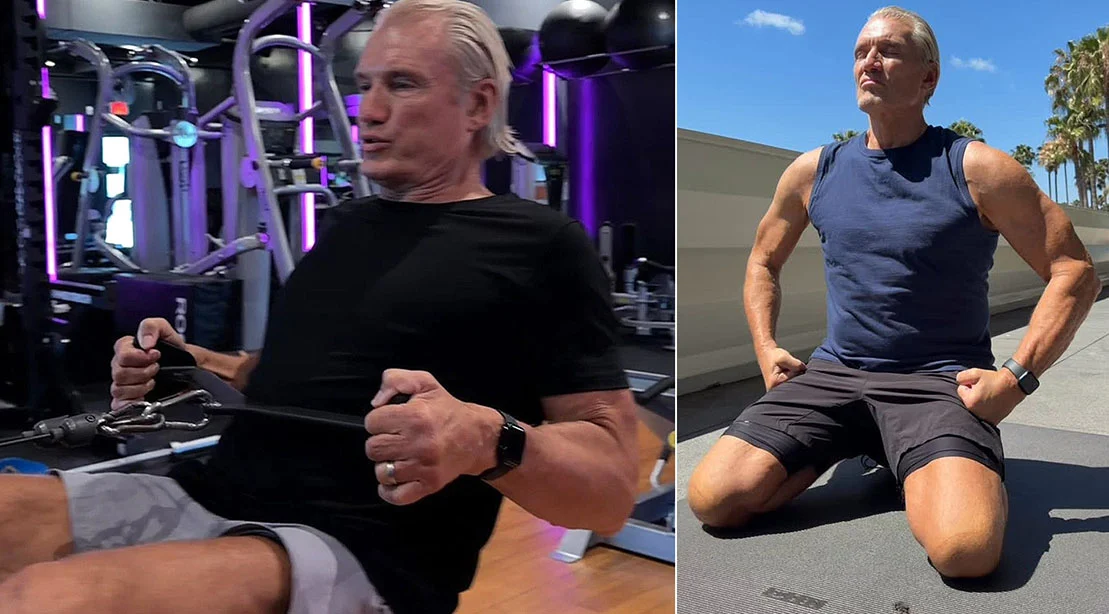
For generations of cinema fans, Dolph Lundgren has been the physical embodiment of invincibility. From his chilling, granite-hewn performance as Ivan Drago in 1985’s Rocky IV to his roles in The Punisher, Universal Soldier, and The Expendables, the 68-year-old star has spent four decades projecting a level of peak physical condition that most athletes only dream of maintaining.
However, behind the celluloid myth of the indestructible action hero lies a man who has faced the most daunting challenge of his life: a ten-year, clandestine battle with cancer. Today, Lundgren stands not only as a survivor but as a living blueprint for healthy aging. By combining disciplined resistance training, a scientific approach to recovery, and an unyielding mental fortitude, the Swedish icon is proving that age is truly just a variable in the equation of human potential.
The Chronology of a Fighter: From Karate Mats to Oncology Wards
Dolph Lundgren’s journey to his current state of fitness began long before Hollywood came calling. As a two-time European Karate champion, Lundgren possessed a deep understanding of biomechanics and cardiovascular endurance that served as the bedrock for his transition into action stardom.
However, the past decade brought a silent adversary. Following a private diagnosis, Lundgren navigated the complexities of cancer treatment with the same stoicism he applied to his film roles. The turning point in his recovery came when he refused to accept a single medical opinion. By seeking a second perspective—a move he credits with discovering a breakthrough in his treatment—Lundgren effectively recalibrated his prognosis.
His struggle is documented in his memoir, Fights Worth Fighting: Finding Strength in Struggle, and serves as the primary narrative arc for the upcoming documentary Dolph: Unbreakable, set to stream on October 6, 2026. These projects provide an intimate look at a man who, despite facing the frailty of the human condition, chose to double down on his commitment to physical vitality.
The Science of Longevity: Why Muscle Mass Matters
Lundgren’s philosophy on aging is rooted in the necessity of maintaining metabolic and hormonal health. In recent discussions with Muscle & Fitness, the star emphasized that as the body advances in age, the preservation of muscle mass is not merely an aesthetic choice—it is a medical imperative.
The Hormone Connection
"It’s very important, I think, as you get older, to keep your muscle mass and keep your testosterone levels up," Lundgren explains. Science supports this assertion: resistance training is one of the most effective ways to mitigate age-related muscle atrophy (sarcopenia) and support endocrine function. By maintaining a rigorous training schedule, Lundgren is essentially "future-proofing" his body against the typical decline in mobility and bone density that often accompanies the seventh decade of life.
The Three-Day Split
Lundgren utilizes a structured, sustainable approach to lifting. His routine is a three-day split:
- Chest and Back
- Arms and Shoulders
- Legs
This rotation allows for adequate recovery, which is essential for an athlete of his experience. Before he touches a weight, however, he returns to his roots, incorporating karate-based cardio to prime his nervous system and maintain the flexibility that made him a martial arts champion in the 1970s.
Detailed Breakdown: The "Unbreakable" Chest and Back Session
Lundgren’s approach to training is characterized by a "quality over quantity" mindset. Rather than ego-lifting, he emphasizes time under tension and slow, controlled movements. This methodical pace ensures maximal muscle fiber recruitment while significantly lowering the risk of joint injury.
1. Seated Cable Rows (Wide Grip)
Lundgren initiates his workout with the wide-grip seated row. By widening his grip, he shifts the focus toward the posterior deltoids, the trapezius, and the latissimus dorsi. This move is foundational for posture, counteracting the "slouch" that often develops with age.
2. Cable Seated Wide-Grip Pulldowns
Transitioning directly to the pulldown station, he works the back in the vertical plane. This exercise is vital for developing the "V-taper" look and strengthening the mid-back, which provides the stability needed for his other heavy movements.
3. Incline Bench Dumbbell Rows
To isolate the upper and mid-back, Lundgren uses an incline bench for support. This removes the momentum from the lower back and requires the biceps to act as secondary movers, ensuring a deep stretch at the bottom of the movement and a powerful contraction at the top.
4. Smith Machine Incline Bench Press
Lundgren opts for the Smith machine for his chest pressing, a strategic choice for seasoned lifters. By stabilizing the bar path, the machine allows him to focus entirely on the anterior deltoids and upper pectorals without the compensatory energy required to balance free weights, thus protecting his shoulders from potential impingement.
5. Machine Pec Fly
The session concludes with the pec fly, designed to hit the outer and inner pecs, as well as the serratus anterior—the "boxer’s muscle" located beneath the armpits. This final "pump" ensures complete fatigue of the chest complex.
Official Insights: The Psychology of the 30-Minute Workout
Perhaps the most significant takeaway from Lundgren’s current training philosophy is his adaptation to the time constraints of a busy life. "I realized, as you get older, it’s so much better if you know you’re only in it for 30 minutes," he shares. "It’s so much easier."
This "30-minute rule" is a masterclass in behavioral psychology. By setting a hard time limit, Lundgren avoids the paralysis of procrastination. It transforms the workout from an intimidating, two-hour marathon into a manageable, high-intensity sprint. For his 4 million Instagram followers, this serves as a powerful reminder: consistency trumps intensity every time. If an international film star fighting cancer can carve out 30 minutes, the average individual has few excuses.
Implications: A New Era of Action Heroism
The implications of Dolph Lundgren’s current chapter are profound. He is shifting the cultural narrative surrounding cancer survivors from one of "recovery" to one of "reclamation." By choosing to step back into the gym, he is not just fighting to return to his former self; he is evolving into a more refined, more disciplined version of his archetype.
The Legacy of the "Fighter"
Lundgren’s life serves as a living metaphor for his most iconic lines. When he says, "Keep fighting and believe in yourself as much as you can," it carries the weight of a man who has looked at his own mortality and decided that the fight is far from over.
His upcoming documentary, Dolph: Unbreakable, is expected to shed more light on the intersection of his medical journey and his physical discipline. It promises to be a seminal piece of media for anyone interested in the intersection of health, aging, and the indomitable human spirit.
Moving Forward
For those looking to adopt his routine, the advice is simple:
- Prioritize recovery: Understand that as we age, the body takes longer to repair.
- Prioritize form: Slow, controlled reps are the secret to longevity.
- Seek second opinions: In both medicine and fitness, don’t be afraid to challenge the status quo.
As Dolph Lundgren continues to train, write, and film, he remains a beacon for his generation. He has successfully transitioned from the fearsome antagonist of Rocky IV to the wise, resilient mentor of his own life story. Whether he is on the set of a blockbuster or in the quiet isolation of his home gym, the message remains clear: the fight is worth it, the struggle is necessary, and the work is never truly finished.
To join him on his journey, fans can follow his training updates on his official Instagram, keep an eye out for his book, and prepare for the release of his documentary in late 2026. As for the rest of us, it is time to take a page from the Drago playbook—not to be a villain, but to cultivate the strength of a hero.