










Published: September 24, 2026 | Series: Yoga Journal Archives
As the calendar turns toward the final months of the year, a subtle shift occurs in the natural world. In the Northern Hemisphere, the Earth enters a period of dormancy, a quiet preparation for the cycle of rebirth that spring promises. This transition often mirrors our internal state; the bustle of the holiday season frequently clashes with a human desire for reflection. We find ourselves asking the perennial questions: What have I accomplished? Where is my path leading? What remains unfinished?
In the tradition of yoga, this capacity for introspection is formally known as svadhyaya. Derived from the Sanskrit sva (self) and adhyaya (study), it is one of the eight limbs of Patanjali’s ashtanga yoga. While often associated with the study of sacred texts, svadhyaya is equally a practice of heightened self-observation. It is the art of watching the body-mind complex in real-time, moving toward the ultimate unification of consciousness.
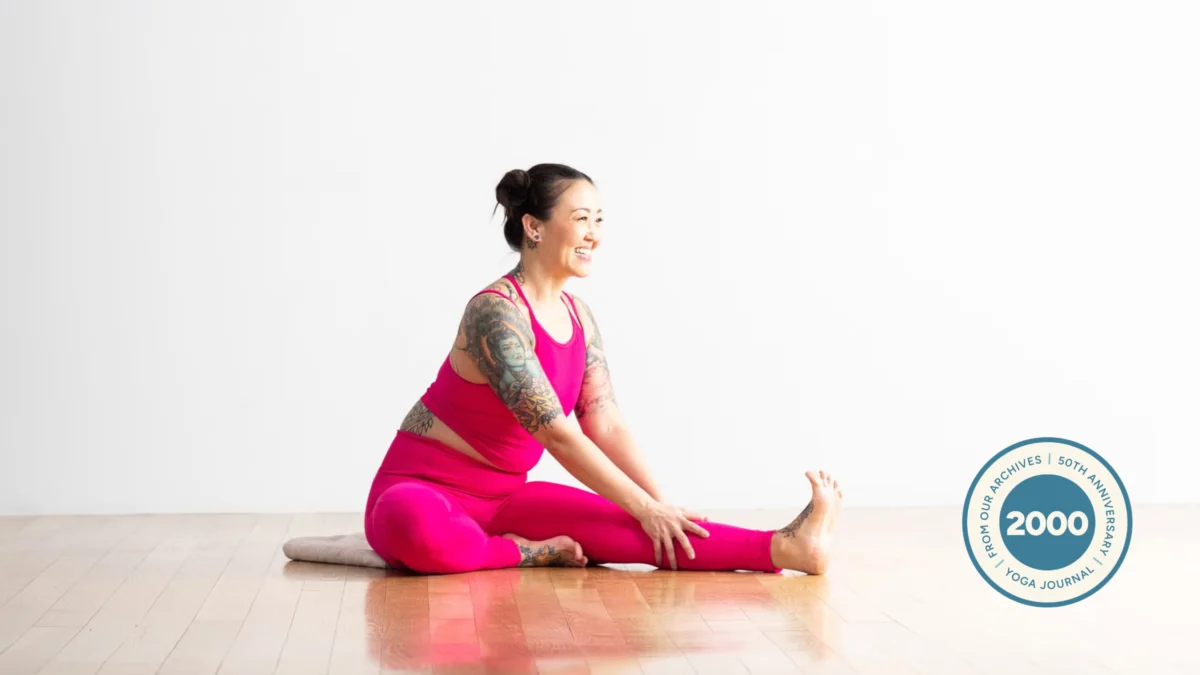
To help practitioners navigate this transition, we revisit a classic exploration of Janu Sirsasana (Head-to-Knee Forward Bend), first published in the November-December 2000 issue of Yoga Journal. By integrating svadhyaya into this asymmetrical posture, we can cultivate the balance and deep, grounded presence required for the season of introspection.
The Philosophy of the Self: Integrating Svadhyaya
Svadhyaya is not merely an intellectual exercise; it is a somatic practice. When we bring our awareness to the yoga mat, we are not simply performing a physical routine. We are conducting an ongoing inquiry into our current state of being.
In our daily lives, our minds are constantly pulled toward external stimuli—deadlines, social commitments, and digital distractions. Svadhyaya asks us to pivot that focus inward. When performing Janu Sirsasana, the posture itself becomes a mirror. By observing how the mind reacts to physical resistance, discomfort, or the simple stillness of a hold, we gain insight into our mental patterns. As we approach the new year, this practice serves as a vital tool for emotional regulation and clarity.
Preparing the Foundation: Asymmetry and Props
While many modern yoga lineages, such as the Ashtanga-vinyasa system, emphasize minimal equipment, there is profound value in the Iyengar approach, which treats props as precision instruments. For those looking to master the integrity of Janu Sirsasana, a yoga blanket and a strap are not crutches—they are essential tools for alignment.
Setting the Stage
- Elevate the Pelvis: Sit on a folded yoga blanket or a firm cushion. This lift allows the pelvis to tilt forward, preventing the common tendency to round the lower back.
- The Right Anchor: Bend your right knee and use your right hand to gently draw the knee back, fostering an opening in the hip. Position the right heel against the inner left thigh.
- The Left Activation: Extend your left leg straight. Flex the foot, pushing through the ball of the foot as if stepping on a gas pedal, while keeping the toes spread. This activation creates a kinetic chain that stabilizes the entire leg, rooting the left sitting bone into the earth.
Navigating the Twist: The Mechanics of Janu Sirsasana
Janu Sirsasana is inherently asymmetrical. Unlike a symmetrical forward bend, it requires the body to manage a twist while folding. This structural challenge is the perfect environment for svadhyaya.
Step-by-Step Alignment
- The Initial Twist: With your hands placed on either side of the left leg, inhale to lengthen the spine. As you exhale, engage the core, drawing the navel toward the spine, and begin a gentle rotation of the torso to align with the extended left leg.
- The Role of the Strap: To avoid the common mistake of hunching, loop a strap around the ball of your left foot. Hold the ends of the strap with enough tension to keep the arms extended. This provides a lever, allowing the chest to remain open and the spine to lengthen evenly.
- Shoulder Engagement: Consciously slide your shoulder blades down your back and toward your heart. This movement prevents the chest from collapsing and promotes a lifted sternum, even as you fold forward.
The Gradual Descent
Fold forward slowly, prioritizing the length of the spine over the depth of the stretch. If you reach a point where your back begins to round, stop. That is your "edge"—the precise boundary where you can stretch the hamstrings without sacrificing spinal integrity. Stay there, breathing deeply.
Supporting Data: Why Introspection Matters
Scientific research into the physiological benefits of yoga continues to validate what ancient practitioners understood intuitively. A study published in the International Journal of Yoga suggests that regular, mindful forward folding and twisting sequences can stimulate the parasympathetic nervous system, effectively lowering cortisol levels.
When we hold Janu Sirsasana for five minutes or longer, we are not just stretching muscle fibers; we are signaling to the vagus nerve that it is safe to shift from "fight-or-flight" mode to "rest-and-digest." This is particularly effective during the winter months, when the body naturally craves restorative practices.
Official Perspective: The Wisdom of the Sages
The practice of svadhyaya in Janu Sirsasana is supported by the legacy of masters like Ramana Maharshi. His core teaching—the persistent meditation on the question, "Who am I?"—is the ultimate expression of self-study.
In the context of the pose, we apply this by asking:
- What is the emotional tone of this sensation?
- Is my breath smooth, or is it jagged with mental tension?
- Can I be with this discomfort without needing to escape it?
By observing the body, we begin to observe the mind, and eventually, we touch upon the truth of our own existence. We learn that we are not the tension in the hamstring, nor the impatience of the mind; we are the silent witness observing both.
Implications for Modern Life
As we look toward the horizon of a new year, the implications of this practice extend far beyond the yoga mat. The ability to "embrace the asymmetry"—to handle life’s imbalances with grace and deliberate observation—is a skill that translates into our professional and personal lives.
Key Takeaways for the Practitioner
- Maintain Grounding: Even when folding deep into a pose, keep your pelvis connected to the earth. If the right sitting bone lifts, you have lost your center.
- Even Breathing: Direct your breath into the back of your body. Feel the ribcage expand into the back, the sides, and the front.
- Softened Gaze: Allow the face to soften. Tension in the jaw or forehead often mirrors tension in the hips. By relaxing the face, you signal the nervous system to deepen the release.
The transition of the seasons serves as a natural reminder that we are part of a larger, rhythmic whole. By dedicating time to Janu Sirsasana, we honor our need for both activity and stillness. We learn that the most profound forward progress often comes from the moments when we stop, turn inward, and listen to the truth that resides within.
Whether you are a seasoned yogi or a curious beginner, remember that the goal is not to "perfect" the pose. The goal is to use the pose as a lens through which you can study yourself. In the quiet of your own practice, in the space between breaths, you may find the clarity required to step into the new year with a renewed sense of purpose and a grounded, tranquil spirit.