











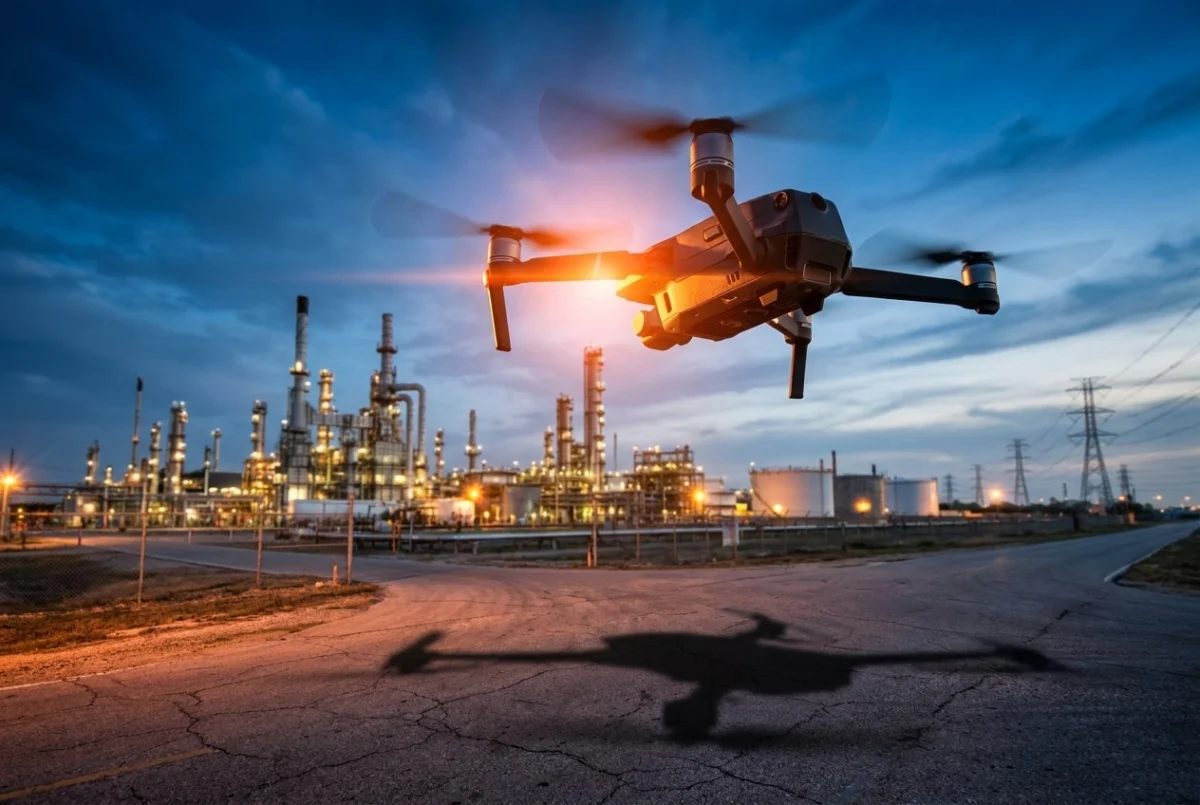
The era of American invulnerability is over. For decades, the United States relied on its geographic isolation and the sheer scale of its conventional military might to guarantee domestic security. However, the rapid proliferation of low-cost, high-precision drone technology has quietly dismantled that assumption, leaving the nation’s critical infrastructure—the refineries, power grids, and data centers that sustain modern life—dangerously exposed. We have entered the age of distributed drone warfare, a paradigm where the barrier to entry for strategic destruction has been lowered from millions of dollars to the price of a consumer-grade hobbyist kit.
Main Facts: The Democratization of Destruction
The core of the crisis lies in the "democratization of destruction." For centuries, the ability to project power at a distance was the exclusive domain of nation-states. Today, that monopoly has been shattered. The technology required to conduct precision strikes—guidance systems, autonomous navigation, and modular explosive payloads—is available to anyone with a credit card, an internet connection, and malicious intent.
This is not merely a theoretical danger. The precision-strike capability that crippled Saudi Arabian pipelines and targeted Qatari energy infrastructure is being replicated globally. Unlike traditional warfare, which requires massive logistical footprints and observable troop movements, drone strikes can be carried out by lone actors or small, decentralized cells. These assets are "point-of-failure" targets: a single successful strike on a critical refinery or an electrical substation can trigger cascading failures, resulting in widespread economic instability, supply chain paralysis, and public panic.
Chronology: The Escalation of Drone Warfare
The evolution of this threat has been rapid, moving from surveillance toys to lethal autonomous weapons systems.
- 2010–2018 (The Surveillance Era): Drones were largely viewed as intelligence-gathering tools for hobbyists and state military reconnaissance.
- 2019 (The Wake-Up Call): The attack on Saudi Aramco’s Abqaiq-Khurais oil facilities demonstrated that inexpensive drones could effectively neutralize massive, billion-dollar energy infrastructure.
- 2022–2024 (The Ukraine Accelerant): The conflict in Ukraine transformed the drone from a niche asset into the primary instrument of modern attrition. Both sides deployed swarms, AI-enabled targeting systems, and "kamikaze" (loitering munition) drones on an unprecedented scale.
- 2024–Present (The Domestic Breach): Recent reports of mysterious drone swarms over sensitive U.S. military installations—including Barksdale Air Force Base—and the disruption of European transit hubs like Brussels and Liege, indicate that the threat has arrived on Western soil.
Supporting Data: The Economic Asymmetry of Defense
The most profound challenge presented by this new reality is the economic asymmetry of the battlefield. The cost-to-kill ratio heavily favors the attacker, creating an unsustainable defensive environment.
Consider the math: An assailant can manufacture or purchase a lethal, AI-guided drone for less than $30,000. To defend against such a platform, modern military air defense systems may require an interceptor missile costing upwards of $4 million. Even when the defender successfully intercepts the threat, they lose the economic exchange by a factor of over 100-to-1.
Furthermore, the scale of the threat is expanding. During the height of the recent regional conflicts, Gulf states were forced to intercept more than 1,500 Iranian-launched missiles and drones in a single defensive operation. When a nation is forced to defend against hundreds of incoming vectors simultaneously, even the most sophisticated systems become overwhelmed by the sheer volume of "cheap" targets. This is the new "swarm" reality: creating mass effects without the need for a mass army.
Official Responses and Strategic Misalignment
While the FBI and other intelligence agencies have publicly acknowledged that commercial drones pose a "significant threat" to U.S. national security, the policy response has been largely reactive rather than preventative.
Contrast this with the actions taken by Russia, which, despite geopolitical tensions, has moved to institutionalize domestic drone defense. The Russian government has authorized its central bank to arm personnel and integrate anti-drone systems into its financial infrastructure, effectively treating the protection of the economy as a front-line military operation. Furthermore, the Kremlin has granted the state the power to seize commercial infrastructure that fails to meet minimum security standards for drone protection.
In the United States, however, the strategy remains tethered to outdated concepts of perimeter security. We still rely on barbed wire, human guards, and centralized oversight to protect thousands of miles of pipeline and grid infrastructure. These measures are entirely inadequate against an aerial threat that can bypass physical barriers in seconds. The refusal to confront the reality that our infrastructure sits in a "glass house"—mapped by public satellite imagery and vulnerable to even amateur sabotage—suggests a dangerous bureaucratic inertia.
Implications for National Security and Civil Resilience
The implications of this shift are existential. If a single individual can launch a drone from a residential rooftop to incapacitate a regional power substation, the traditional model of a centralized government providing total security becomes untenable.
The Shift to Autonomous Systems
We are moving beyond remote-controlled drones toward fully autonomous "machine cognition." Once a system can identify, track, and engage a target without a human pilot in the loop, traditional electronic warfare tactics like jamming become significantly less effective. The "decision loop"—the time from target acquisition to strike—shrinks from seconds to milliseconds.
The Necessity of Decentralized Resilience
Given the scale of the vulnerability, the traditional "cavalry" approach to national security—waiting for the government to provide a blanket solution—is unlikely to succeed. The threat is too broad, and the points of failure are too numerous.
The path forward requires a radical rethink of civil resilience:
- Systemic Redundancy: Critical industries must move away from "single-point-of-failure" models. Decentralized, off-grid power generation and distributed data storage are no longer just environmental or technical preferences; they are national security imperatives.
- Community-Level Response: Citizens must prepare for the possibility of prolonged infrastructure outages. This includes individual stockpiling of essential supplies, water purification, and local communications networks that do not rely on centralized infrastructure.
- Education and Awareness: A population that understands the technology and the mechanics of these threats is inherently more resilient. Recognizing that an "outage" may not be an accident, but a calculated strike, allows for faster adaptation during a crisis.
Conclusion: The Closing Window
The window for preparation is closing. We are living in a world where the monopoly on destruction has been effectively dissolved. The democratization of technology means that the tools of war are now in the hands of the many, not the few.
To ignore the drone threat is to invite catastrophe. Whether it is an attack on a local refinery, an assault on a regional data center, or a coordinated swarm attack on the power grid, the reality is that the threat is not "if," but "when." True security in the 21st century will not come from a single, centralized agency, but from a resilient, informed, and prepared public that understands the precarious nature of the systems upon which we all depend. We must stop assuming that our infrastructure is safe simply because it has been safe in the past; the drone revolution has changed the rules of the game forever. The time to build our own resilience—before the next major disruption—is now.