





Reviewed by Brian St. Pierre, MS, RD
In the mid-2010s, the fitness industry was defined by a singular, rigid philosophy: caloric deficit achieved exclusively through willpower, dietary restriction, and exercise. When GLP-1 receptor agonists (such as semaglutide) began to permeate the mainstream market, a wave of existential dread swept through the coaching community. "Is this drug going to steal my job?" became the pervasive, unspoken anxiety of personal trainers and nutrition coaches alike.
That was 2017. Nearly a decade later, the landscape of health has shifted irrevocably. By 2026, the data is clear: over 1 in 10 US adults are currently utilizing GLP-1 medications to manage weight and metabolic health. The medication is no longer a theoretical threat; it is a permanent fixture of the modern wellness ecosystem. For coaches, the initial defensive posturing has evolved into a more nuanced, pragmatic realization: GLP-1s are not a replacement for coaching—they are an additive complement.
The Evolution of the Coaching Role
The most successful coaches in 2026 have abandoned the binary "drug vs. natural" debate. Instead, they have embraced a new professional identity. As Kate Solovieva, Director of Community at Precision Nutrition, succinctly puts it: "As a coach, you’re not in the GLP-1 world; you’re in the GLP-1 support world."
The realization is that the target market is not "everyone on a GLP-1." Rather, it is "people on GLP-1s who want support." By narrowing this focus, coaches can bypass the wasted energy of trying to "fix" those who are not ready for behavioral change, and instead provide high-impact, evidence-based guidance to those who are ready to build a foundation for long-term health.
Understanding the Seven Archetypes of the GLP-1 Client
Change is not a linear process, and client readiness is fluid. A client who enters the gym with a "I don’t need help, the drug does it all" attitude may, within months, find themselves struggling with muscle loss or the psychological burden of a stalled regimen. To serve these clients effectively, coaches must categorize their needs dynamically.
1. The Honeymooner (Readiness: Very Low)
These clients are in the "golden phase." They have lost weight with minimal effort and view the medication as a silver bullet.
- Coaching Move: Avoid the "righting reflex." Attempting to lecture them on muscle atrophy or nutritional deficiencies often makes a coach appear as an antagonist. Instead, validate their success and plant a seed: "It’s wonderful to see these results. If you ever feel you want to optimize your body composition or energy, I am here."
2. The Ambivalent Candidate (Readiness: Low-to-Moderate)
These individuals are on the fence, paralyzed by the fear of being "weak" or "giving up" by using medication.
- Coaching Move: Acknowledge that the decision is medical, not professional. Use tools like the "4 Crazy Questions" to explore both the risks of taking the medication and the risks of staying the course without it. Help them move past the societal stigma of "taking the easy way out."
3. The Ready-to-Quitter (Readiness: Moderate)
These clients are seeing results but are suffering from significant side effects—nausea, fatigue, and systemic exhaustion.
- Coaching Move: Depersonalize the experience. Explain that roughly 50% of users experience nausea. Encourage them to consult their doctor regarding dosage adjustments. Suggest small, nutrient-dense, frequent meals rather than large, infrequent ones.
4. The Muscle-Loss Risk (Readiness: Moderate)
Weight loss is visible, but body composition is suffering. These clients are often sedentary and protein-deficient.
- Coaching Move: Shift the focus from the scale to the DEXA scan. Providing objective data regarding lean mass loss is a powerful motivator. Prioritize a high-protein intake (25–40g per meal) and scalable resistance training.
5. The Under-Fueler (Readiness: Moderate-to-High)
The medication has suppressed their appetite so effectively that they are consuming insufficient calories for basic biological function.

- Coaching Move: This is a red flag for potential disordered eating. If the client resists tracking, use a "show me" approach. If calories are dangerously low, implement an "eating schedule"—treating food as a requirement for biological maintenance rather than a response to hunger.
6. The Graduate (Readiness: High)
These individuals are choosing to taper off the medication and are terrified of weight regain.
- Coaching Move: Temper expectations. The "finish line" of medication is actually the starting line of a new, manual endurance challenge. Focus on solidifying habits so that they are deeply ingrained before the chemical appetite suppression wanes.
7. The Priced-Out (Readiness: High)
These clients lose access to the medication due to insurance changes or economic hardship.
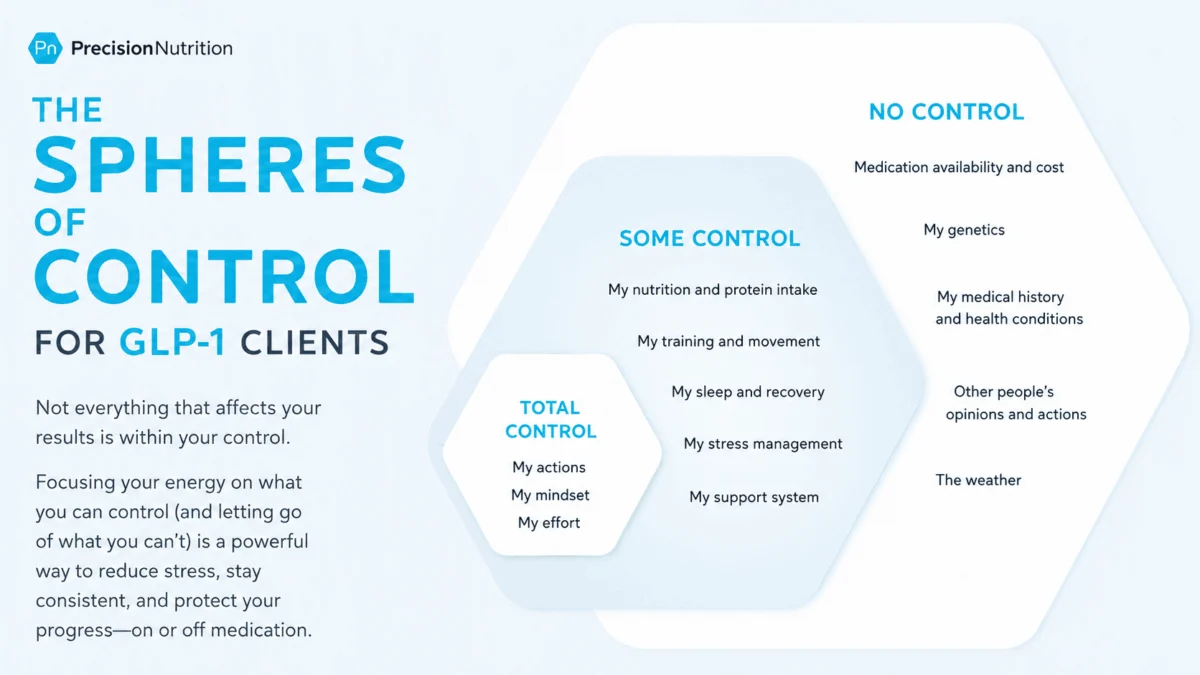
- Coaching Move: Validate their frustration—this is a systemic failure, not a personal one. Utilize the "Spheres of Control" exercise to help them reclaim agency over nutrition, sleep, and movement, despite the loss of their pharmacological support.
Supporting Data and Medical Implications
The medical reality of GLP-1s is that they are powerful tools, but they are not autonomous. Clinical data indicates that up to 40% of weight lost on GLP-1s can be lean muscle mass if not paired with resistance training and adequate protein. This "skinny fat" outcome creates a secondary metabolic crisis: a lower basal metabolic rate, which makes weight regain almost inevitable once the medication is stopped.
Furthermore, studies show that those who integrate and sustain healthy lifestyle behaviors while on the medication are four times more likely to maintain their weight loss after discontinuing the drug. This is the "ruts in the trail" philosophy—the medication provides the path, but the habits carve the ruts that allow the client to continue traveling forward once the "wheels" of medication are removed.
Official Stance: The Professional Boundary
It is vital to recognize the scope of practice. Coaches are not prescribers. They are not medical doctors. The most dangerous mistake a coach can make is attempting to adjust a client’s medication dosage or ignoring signs of severe adverse reactions.
Red flags that necessitate an immediate medical referral include:
- Severe or persistent vomiting.
- Signs of gallstones or gallbladder pain.
- Symptoms of pancreatitis (severe abdominal pain radiating to the back).
- Signs of severe depression or suicidal ideation.
A coach’s role is to ensure the client shows up to their medical appointments prepared with detailed notes, symptoms, and data, allowing the physician to make informed adjustments.
Implications for the Future of the Industry
The "GLP-1 era" is not the end of personal training; it is the professionalization of it. The market is shifting away from generic "weight loss" coaching toward specialized "metabolic health" coaching. Clients who are on these medications need someone who understands the biology of muscle retention, the psychology of food-dread, and the reality of life after the injection.
The coaches who will thrive in this environment are those who view themselves as facilitators of human behavior. By helping clients build identities around movement and nutrition, they are providing a service that no drug can replicate: the internal architecture for a healthy, sustainable life.
As Coach Toni Bauer, Director of Coaching and Education Operations at Precision Nutrition, notes: "Ideally, your client will have embraced the identity of a new person. I am the person who does resistance training because it builds the tissue I need to age well. That’s the client who maintains."
The medication may change the body, but the coach changes the person. In a world of fast-acting pharmaceuticals, that remains the most valuable service one can provide.